

An under-sink reverse osmosis installation should include the specified equipment, a drinking-water faucet, supply and drain connections, secure mounting, startup flushing, leak checks, and operating instructions. Your written quote should also identify any countertop work, electrical work, alkaline stage, and future filter replacements that sit outside the installation scope.
- Compare reverse osmosis system installation cost by equipment, plumbing work, startup checks, and exclusions—not the total alone.
- PSL Water Guy serves homeowners seeking city-water treatment selected for their home’s water and needs.
- Under-sink reverse osmosis treats drinking water at its connected outlet, not every tap in your home.
- An alkaline reverse osmosis installation should name the added stage and its replacement requirements.
What should an under-sink reverse osmosis installation include?
A complete installation quote should describe a working drinking-water system, not just a box of equipment. For your 2026 project, use the checklist below to separate included work from items you still need to arrange.
If you live in Port St. Lucie or Tradition, PSL Water Guy offers residential water treatment, including reverse osmosis drinking-water installations. Request a personalized quote based on your city-water supply, cabinet layout, and intended drinking-water connections.
| Installation item | What a clear quote specifies | What needs clarification |
|---|---|---|
| Equipment | System identification, included filters, membrane, and tank if used | Equipment described only as an RO system |
| Drinking-water faucet | Faucet supply, finish selection, and installation location | Whether the faucet and mounting work are included |
| Water supply | Connection point, shutoff arrangement, and included fittings | Who repairs an unsuitable existing valve |
| Drain connection | Connection method suited to the equipment and applicable requirements | Drain work left outside the written scope |
| Cabinet installation | Mounting location, tubing routing, and service access | Whether equipment blocks storage or maintenance |
| Startup | Manufacturer-required flushing, operation checks, and leak checks | Installation ending immediately after connections |
| Handover | Maintenance instructions and identification of replacement components | No explanation of ongoing care |
Why this matters
An under-sink system depends on the plumbing and space around it. A quote that leaves out the faucet opening, drain connection, or startup work leaves you without a clear definition of completion.
The same equipment can require different work in different homes. Compare the finished installation scope before comparing quote totals. That approach keeps your 2026 decision tied to what you will receive rather than how briefly an estimate is written.
What equipment belongs in the installation scope?
Ask the installer to identify the proposed system and its included components in writing. The description should distinguish the membrane, prefilters, any finishing filter, and any alkaline stage instead of treating them as interchangeable parts.
A reverse osmosis membrane separates part of the incoming water into a drinking-water stream and a reject-water stream. Supporting filters have their own roles, and their arrangement depends on the equipment. Ask for the manufacturer's component list rather than assuming every system has the same layout.
Your quote should also identify the faucet and whether the design uses a storage tank. Tubing, connectors, mounting hardware, and other installation materials belong in the scope discussion, even when they are grouped under installation labor.
Stored-water systems: best for households choosing tank storage
A stored-water design holds treated water in a tank for dispensing. Its practical advantage is stored drinking water; its limitation is the cabinet space occupied by the tank and the need to maintain access around it.
Ask where the tank will sit and how the installer will reach its connections. Do not approve a layout that requires dismantling unrelated cabinet contents whenever the system needs service.
Tankless systems: best for households avoiding a storage tank
A tankless design produces treated water without a separate drinking-water storage tank. It removes that particular storage component, but the treatment unit still needs space, accessible filters, and connections.
Confirm the exact model's electrical requirements before approving the installation. Tankless does not mean connection-free or maintenance-free.
| Configuration | Best for | Practical advantage | Limitation to check |
|---|---|---|---|
| Stored-water reverse osmosis | Households choosing tank storage | Holds treated water for dispensing | Tank footprint and service access |
| Tankless reverse osmosis | Households avoiding a storage tank | Does not require a separate storage tank | Unit dimensions and model-specific power needs |
| Reverse osmosis with an alkaline stage | Households specifically requesting alkaline drinking water | Adds a separate finishing stage | Additional component and replacement requirements |
Alkaline reverse osmosis: best for a specific drinking-water preference
An alkaline stage is an addition to the specified reverse osmosis system, not a substitute for the membrane. Ask what the proposed stage does, where it sits in the treatment sequence, and which replacement component it requires.
Do not treat the word alkaline as proof of a health benefit. For your 2026 installation quote, the useful details are the actual component, its stated function, and its maintenance instructions.
What plumbing and cabinet work should be included?
The installer should assess the cold-water connection, drain arrangement, faucet location, and available cabinet space before settling the work scope. Existing plumbing determines which connections are suitable; a generic equipment description does not answer those questions.
Ask whether the installation includes a dedicated system shutoff and how you will isolate the equipment for service. If an existing valve needs repair or replacement, get that work identified separately rather than assuming it is included.
The faucet location also needs agreement before work starts. An existing opening still needs to suit the proposed faucet; a new opening requires permission and a method appropriate for the sink or countertop material.
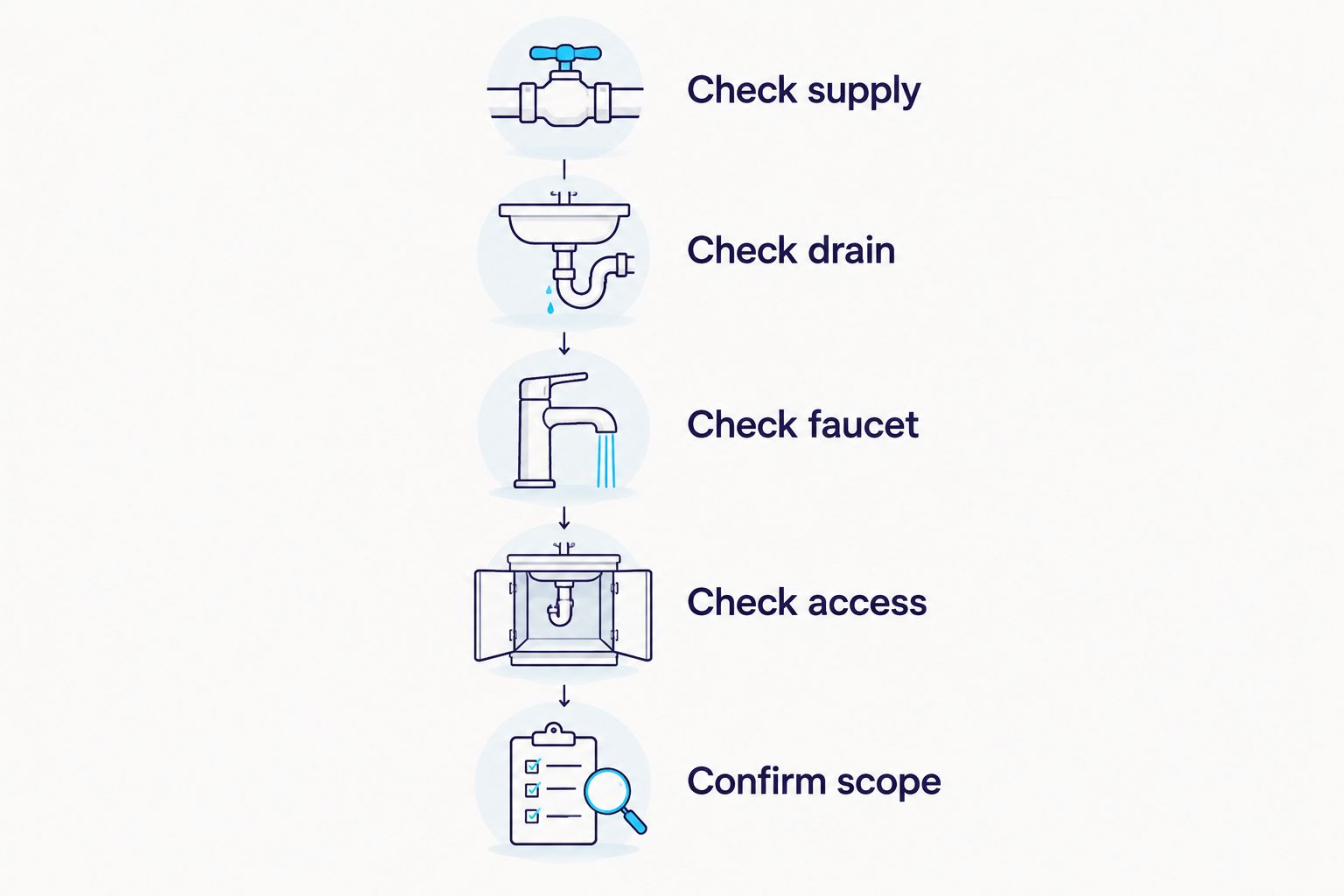
Use this site-review sequence with the installer:
- Check supply: Identify the cold-water connection and accessible shutoff.
- Check drain: Confirm the proposed drain connection follows the equipment instructions and applicable requirements.
- Check faucet: Agree on the mounting location and responsibility for any opening.
- Check access: Confirm room for the equipment, tubing, and filter changes.
- Confirm scope: Record additional work and exclusions before approval.
Cabinet access deserves attention even when everything physically fits. Filters need removal clearance, tubing needs protection from stored items, and shutoffs need to remain reachable.
Why reverse osmosis system installation cost varies
Reverse osmosis system installation cost depends on the selected equipment and the work needed to connect it correctly. Request a personalized quote rather than applying another home's total to your own installation.
For a 2026 comparison, ask each installer to address the same factors:
- Equipment configuration: Stored-water, tankless, and alkaline-stage arrangements have different component requirements.
- Existing plumbing: Supply valves, drain layout, and connection access determine the installation work.
- Faucet opening: Using a suitable existing opening differs from arranging a new one.
- Cabinet conditions: Mounting space and filter-change clearance affect the proposed layout.
- Electrical requirements: A model requiring power needs a suitable electrical connection and a clear division of responsibility.
- Additional outlets: A requested refrigerator connection adds routing and compatibility questions beyond the drinking-water faucet.
These factors explain scope differences; they do not establish a price for your home. Ask the installer to separate the base installation from optional connections and work assigned to another trade.
PSL Water Guy is a local family-owned option for Port St. Lucie and Tradition homeowners seeking city-water treatment selected for their home's water and needs. Request an under-sink quote that addresses your drinking-water setup rather than assuming a whole-house system is necessary.
Request your installation quote
Ask PSL Water Guy to specify equipment, connections, startup work, and exclusions for your city-water home.
What should happen before the installer leaves?
The system should be started according to its manufacturer's instructions. That includes the prescribed flushing or sanitizing procedure where required, along with checks that the faucet, supply connection, and drain connection operate as intended.
Ask the installer to inspect the connections for leaks during operation. For equipment with a tank, the startup process should also address the tank according to the manufacturer's directions.
The handover should leave you able to operate the equipment without guessing. Ask the installer to show you:
- The system shutoff and normal operating position.
- The filter and membrane locations.
- The component names needed for replacements.
- The maintenance instructions and any required reset procedure.
- What to do if you find a leak or notice a change in operation.
A brief faucet demonstration does not replace maintenance instructions. Keep the equipment information and written installation scope together so future service starts with the correct system details.
Does under-sink reverse osmosis replace whole-house treatment?
Under-sink reverse osmosis treats water at its connected drinking-water outlet; whole-house treatment serves a different scope. Installing an under-sink system does not soften the water supplied to every shower, appliance, and bathroom tap.
If your concern is drinking and cooking water, start by discussing the under-sink installation. If your concern includes hardness throughout the home, discuss water softening separately. Whole-house filtration is another distinct treatment decision.
Keep these requests separate in your 2026 quote comparison. Bundling them into an unexplained package makes it harder to see which equipment addresses each concern and which installation tasks belong to each system.
Can the installer connect reverse osmosis to my refrigerator?
A refrigerator connection should be an explicit addition to the installation scope, not an assumed inclusion. Ask the installer to check the refrigerator manufacturer's requirements and the proposed reverse osmosis system's suitability before agreeing to the connection.
The route matters too. Identify where the tubing will run, how it will be protected, and whether access or cabinet work falls outside the quoted installation.
What ongoing maintenance should the quote explain?
The quote should identify the replacement components and distinguish initial installation from future service. Filter changes, membrane replacement, and alkaline-stage replacement are maintenance tasks, not evidence that the installation was incomplete.
Ask for the manufacturer's maintenance guidance for the proposed equipment. Do not substitute a generic replacement schedule for the instructions that apply to your system and operating conditions.
For PSL Water Guy reverse osmosis installation discussions, request a clear explanation of what you will maintain yourself and what you would arrange as a separate service. That keeps the installation decision practical without assuming any service plan is included.
FAQ
What should I ask about reverse osmosis system installation cost?
Ask which equipment, faucet, plumbing connections, startup work, and exclusions the reverse osmosis system installation cost covers. Request a personalized quote for your cabinet and city-water connection rather than comparing totals with different scopes.
Does an under-sink reverse osmosis installation include the faucet?
The written quote should state whether the drinking-water faucet and its installation are included. It should also identify who handles a new sink or countertop opening if one is needed.
Is a tankless reverse osmosis system better for a small cabinet?
A tankless system avoids a separate storage tank, but you still need to check the treatment unit’s dimensions and service clearance. Confirm any electrical requirements before choosing the layout.
Does alkaline reverse osmosis mean I do not need replacement filters?
Alkaline reverse osmosis still requires maintenance of the specified filters, membrane, and added alkaline stage. Ask for component names and the manufacturer’s maintenance instructions.
Will under-sink reverse osmosis soften all the water in my house?
Under-sink reverse osmosis does not soften the water throughout your house. Discuss a separate whole-house water softener if hardness at other fixtures is your concern.
Can I keep cleaning supplies beside an under-sink reverse osmosis system?
Keep stored items from pressing against tubing, blocking shutoffs, or preventing filter access. Ask the installer to show you the clearance the equipment needs before reorganizing the cabinet.
What should I request from a Port St. Lucie reverse osmosis installer?
Request a written scope covering the selected equipment, cabinet layout, supply and drain connections, faucet work, startup, and maintenance handover. Homeowners in Port St. Lucie and Tradition should specify that the quote is for their city-water home.
One last thing
Ask the installer to show how a filter will come out before approving the cabinet layout. Equipment that fits inside a cabinet is not automatically easy to service there.
Make that access check part of your 2026 installation discussion. It is a concrete way to assess the proposed layout before mounting holes and tubing routes are fixed.


