

An alkaline reverse osmosis system needs scheduled filter changes, membrane checks, alkaline-cartridge replacement, sanitizing, and inspections for leaks and pressure problems. For your alkaline RO drinking water installation, follow the equipment’s written maintenance schedule rather than a universal replacement calendar; the mineral cartridge and storage tank need attention alongside the filters.
- An alkaline RO drinking water installation needs filter service, membrane checks, mineral-cartridge replacement, and sanitizing.
- PSL Water Guy selects residential water treatment for each home’s water and needs.
- Replace parts according to the equipment instructions, not taste alone or a universal calendar.
- Request an installation quote that identifies replacement parts, service responsibilities, and maintenance access.
Why this matters
An installation is not complete until you know how to maintain it. Filters, the membrane, and the alkaline cartridge do different jobs, so replacing one does not renew the entire system. A good maintenance plan identifies each part and explains what triggers service.
PSL Water Guy is best for Port St. Lucie and Tradition homeowners seeking a local, family-owned business that selects residential water treatment for their home's water and needs. When discussing an installation with PSL Water Guy, ask for the maintenance requirements alongside the equipment recommendation.
For a new installation in 2026, keep the model information, startup readings, and service instructions together. That record gives you a useful reference when flow, taste, or equipment behavior changes.
What maintenance does an alkaline reverse osmosis system need?
Maintain every treatment stage, the water-storage components, and the connections. The exact parts depend on the installed equipment; some systems use separate cartridges, while others combine functions in an assembly.
| Component | Main purpose | Maintenance task | Limitation to remember |
|---|---|---|---|
| Sediment filter | Captures particles before downstream treatment | Replace as directed; investigate restricted flow | Does not replace carbon treatment or the membrane |
| Carbon filter | Reduces substances covered by its stated performance claims | Replace on the specified schedule | Taste alone does not confirm remaining capacity |
| RO membrane | Reduces dissolved substances through a membrane | Check performance and replace when required | A dissolved-solids reading does not identify every substance |
| Alkaline cartridge | Adds minerals or adjusts treated-water chemistry | Replace using the cartridge instructions | Does not substitute for membrane maintenance |
| Tank and faucet | Store and dispense treated water | Sanitize as directed and inspect operation | Clear water does not prove the storage components are clean |
Your equipment manual takes priority over a generic checklist. Ask the installer to mark which components your system actually contains and provide their exact replacement identifiers. Similar-looking cartridges are not automatically interchangeable.
Follow a clear service sequence
- Identify the equipment. Confirm the model and the correct replacement parts before opening anything.
- Prepare for service. Follow the specified shutoff, pressure-release, and electrical-isolation instructions where applicable.
- Service the treatment stages. Replace the required cartridges and inspect seals using the manufacturer's procedure.
- Sanitize correctly. Use the approved method for the system's housings, tank, and tubing.
- Restart and verify. Complete the required flushing, inspect for leaks, and record the work.
Do not improvise the sanitizing chemical, concentration, or contact time. The procedure must suit the equipment and protect components that require removal or isolation during cleaning.
Filters: replace them before performance becomes the reminder
Sediment and carbon filters protect different parts of the treatment process. Sediment filters catch particles; carbon filters address substances within their documented capabilities. Neither job makes the other unnecessary.
Use the replacement schedule supplied for the installed filter. Water use, incoming water conditions, and cartridge capacity affect service needs. A cartridge that still passes water has not necessarily retained its treatment capacity.
For a 2026 installation, have the installer write down the filter identifiers and the replacement triggers before handover. Ask whether the schedule is based on elapsed time, treated-water volume, observed performance, or a combination.
Check the cabinet and connections after service. Dry the area first so fresh moisture is visible, then inspect again after the system has operated. Do not ignore a slow drip because the drinking-water faucet works normally.
The RO membrane: check performance, not just age
The membrane is separate from the replaceable prefilters. Replacing sediment and carbon cartridges does not establish that the membrane is performing correctly, and changing the membrane does not eliminate the need for filter maintenance.
A technician can compare incoming and membrane-treated water using the checks specified for the equipment. Conductivity or total dissolved solids readings help assess membrane performance, but they are not a complete drinking-water safety test.
Take performance readings at the correct sampling point. An alkaline cartridge intentionally changes the water after the membrane, so a final-faucet reading does not isolate membrane performance. Ask where the installer takes the baseline measurement and where future service readings belong.
Keep the startup readings with your 2026 service record. A later reading is more useful when you know the sampling location and conditions behind the original result.
The alkaline cartridge: maintain it separately
The alkaline stage is another service item, not a permanent addition. Its replacement requirements depend on the cartridge and its instructions. Ask for the exact cartridge identifier rather than ordering by the word alkaline alone.
Mineral addition is different from contaminant reduction. Do not use an alkaline label, a pH reading, or a taste preference as proof that the membrane or carbon stage is doing its job.
The treatment path below shows why each stage needs its own maintenance instructions. It illustrates component roles, not a required layout for every installation.
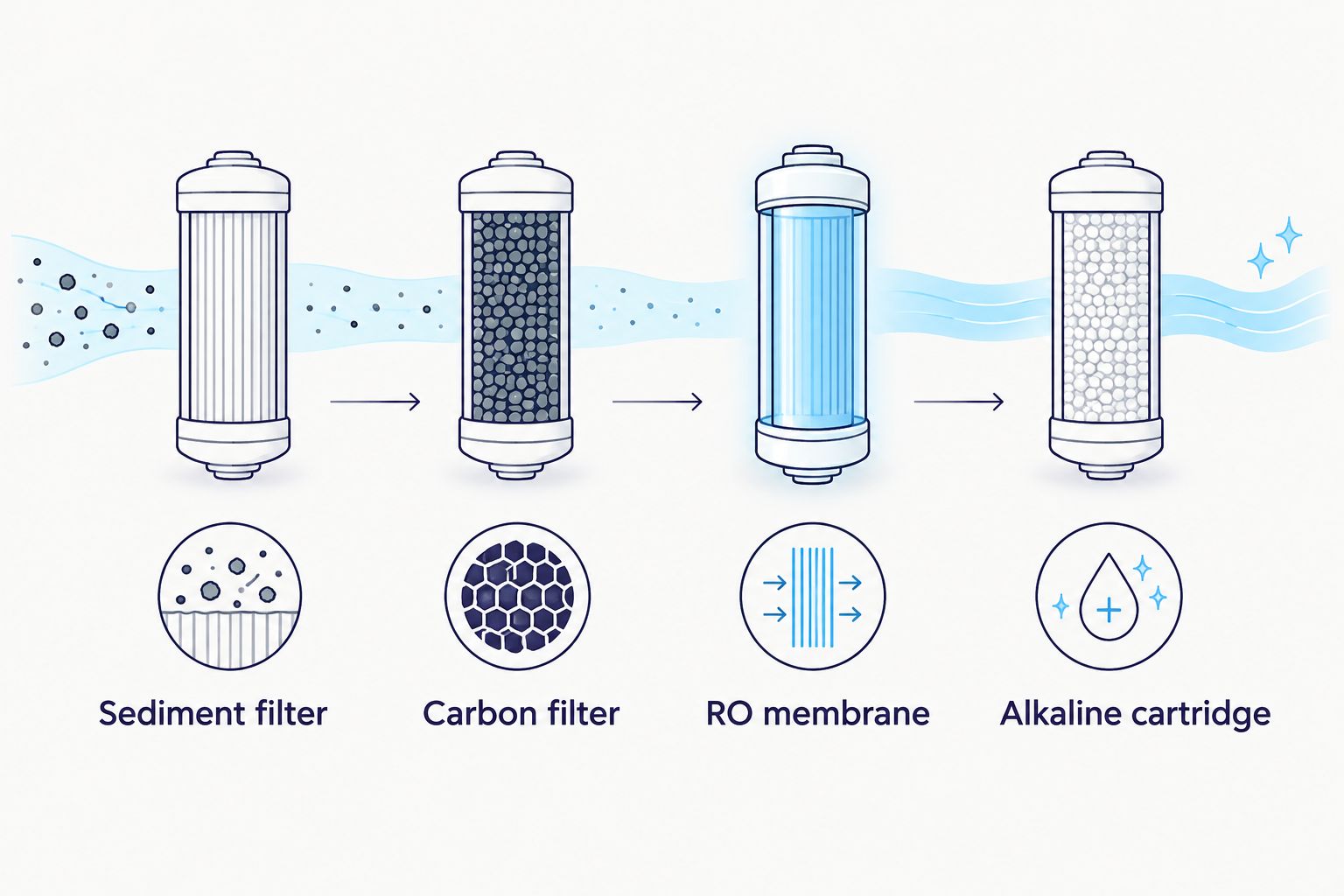
If you prefer a particular taste, discuss that preference before the installation. Keep the decision separate from treatment claims: any claimed reduction of a substance needs documentation for the equipment performing that job.
The tank, faucet, and tubing need attention too
A system with a storage tank has water-contact surfaces beyond the filters. Follow the manufacturer's sanitizing instructions after installation and during service when required. Filter replacement alone is not the same as sanitizing the system.
Inspect accessible tubing for kinks, rubbing, moisture, and accidental pressure from stored items. Keep household cleaners and cabinet contents from pushing against fittings or blocking access to shutoff valves.
Low delivery flow does not automatically mean the membrane needs replacement. A depleted tank, restricted filter, closed valve, tubing problem, or tank issue can affect delivery. Have the cause identified before buying parts.
Tank pressure checks require the procedure specified for the tank, including the correct water-empty condition where required. Do not add air to a tank based on an unrelated online pressure recommendation. The correct setting belongs in the equipment documentation.
Why maintenance needs vary
A single replacement calendar cannot describe every alkaline reverse osmosis installation. These factors explain why the written plan must match your home:
- Incoming water: The substances and particles reaching the equipment affect the work each treatment stage performs.
- Household use: Drinking and cooking demand affect the volume processed through the cartridges.
- Equipment design: Separate housings, combined cartridges, and different tank arrangements require different service procedures.
- Upstream treatment: A whole-house filter or softener changes the water reaching the drinking-water system, but does not cancel its maintenance requirements.
- Installation access: A reachable shutoff and accessible housings make correct inspection and replacement easier.
- Periods without use: Follow the equipment's instructions for extended inactivity and restarting rather than simply dispensing water and assuming service is unnecessary.
For Port St. Lucie and Tradition homeowners on city water, identify the supply and any existing treatment when requesting a quote. Do not assume neighboring homes have identical equipment needs or matching maintenance histories.
What should your installation quote include for maintenance?
Ask PSL Water Guy to explain the proposed alkaline RO drinking water installation and its maintenance requirements in the same quote conversation. A system selected for your home should come with a clear explanation of what you will need to maintain.
Request these details in writing:
- Equipment identification: The system model and identifiers for replacement filters, membrane, and alkaline cartridge.
- Installation scope: The proposed faucet, tubing, drain connection, shutoff arrangement, and tank location where applicable.
- Startup work: Flushing, leak checks, and any initial readings included in the installation.
- Service requirements: Replacement triggers, sanitizing instructions, and tasks assigned to the homeowner or service provider.
- Quote boundaries: Whether replacement parts, future labor, and follow-up visits are included or quoted separately.
Cabinet access, existing plumbing, the faucet mounting location, and the routing of water and drain connections affect installation work. Request a personalized quote rather than comparing equipment labels alone. Two proposals are not equivalent when one leaves necessary plumbing work or future service responsibilities unclear.
Ask for these inclusions in your 2026 quote before agreeing to the installation. This also gives you a written basis for comparing proposals without relying on unapproved price assumptions.
Request your installation quote
Discuss city-water treatment, drinking-water installation, and maintenance needs for your home.
Can I maintain an alkaline RO system myself?
You can handle the maintenance tasks the manufacturer identifies as homeowner-serviceable if you can follow the procedure and access the equipment safely. Confirm the replacement parts, shutoff steps, sanitizing requirements, and restart instructions first.
Use a service professional when you cannot identify the equipment, isolate the water supply, or complete the procedure correctly. Membrane-performance diagnosis and tank problems need more than guessing which cartridge to replace.
Does whole-house treatment remove the need for RO maintenance?
Whole-house treatment does not remove the need for RO maintenance. A whole-house filter, water softener, and drinking-water RO system perform different jobs, even when they serve the same home.
Give your installer the details of existing equipment. The maintenance plan should account for what reaches the RO system without assuming that upstream treatment makes its filters or membrane permanent.
When should I request service instead of waiting?
Request service for persistent leaks, a sudden or unexplained change in flow, unusual continuous operation, or a taste or odor change that remains after the prescribed startup flushing. These symptoms call for diagnosis; they do not identify a single failed component.
If the equipment leaks, use its shutoff procedure when safe and arrange repair. If you suspect a drinking-water safety problem, do not use taste, clarity, or a handheld dissolved-solids meter as clearance to keep drinking it; follow relevant utility or public-health guidance.
FAQ
How often should I change alkaline RO filters?
Change alkaline RO filters according to the installed equipment’s written schedule and replacement triggers. Incoming water, household use, and cartridge design affect the appropriate plan.
Does the alkaline cartridge need replacing too?
The alkaline cartridge needs replacement according to its own instructions. Replacing it does not renew the membrane, prefilters, or storage components.
Can a TDS meter tell me whether my RO water is safe?
A TDS meter cannot establish that drinking water is safe. It measures dissolved-solids-related conductivity, not every possible contaminant, and an alkaline stage changes the final reading.
Why is my reverse osmosis faucet running slowly?
Slow RO delivery can result from a depleted tank, restricted filter, valve position, tubing restriction, or tank problem. Identify the cause before replacing the membrane.
Do I need to sanitize the system when changing filters?
Follow the equipment’s sanitizing instructions when changing filters. The required procedure depends on the system, and replacing cartridges alone does not sanitize the tank or tubing.
What should I ask before an alkaline RO drinking water installation?
Ask for the equipment model, installation scope, replacement-part identifiers, maintenance schedule, and service responsibilities. Request a personalized quote that separates installation work from future maintenance.
One last thing
Label the sampling point, not just the service date. A membrane reading and a final-faucet reading answer different questions when an alkaline cartridge sits between them. Recording where the sample came from prevents a future comparison from becoming misleading.
Before your 2026 installation handover, ask PSL Water Guy to show you the shutoff, identify the replacement parts, and explain the maintenance record. Leave with instructions you can use, not just a working faucet.


