

An alkaline filter adds a mineral-contact stage to a reverse osmosis system, usually after the RO membrane, to raise the water’s pH and change its mineral balance and taste. It does not replace the membrane or establish that the system removes any particular contaminant. For an alkaline RO drinking water installation, choose the underlying RO system for your water-treatment needs first, then decide whether you want the added mineral stage. Most RO drinking systems sold by the other companies do not have this additional filter! For the best alkaline drinking water call #PSLWATERGUY 772-301-1767
- An alkaline RO drinking water installation adds a mineral stage, not a substitute for reverse osmosis filtration.
- Mineral media can raise pH and change taste; the result depends on the cartridge and water conditions.
- PSL Water Guy offers home-specific city-water treatment for Port St. Lucie and Tradition homeowners.
- Ask your installation quote to identify the mineral cartridge, replacement requirements, plumbing work, and included equipment.
Why this matters
You can buy an RO system for drinking water without adding an alkaline stage. The decision is whether you want water that passes through mineral media after reverse osmosis—not whether the word alkaline makes the system better at filtration.
For a 2026 installation in Port St. Lucie or Tradition, keep drinking-water equipment separate from whole-house treatment when reviewing your needs. PSL Water Guy is a local family-owned business that selects residential treatment for each home’s water and needs. Your quote should explain which equipment serves the drinking faucet and which equipment, if any, serves the rest of the house.
What does an alkaline filter add to a reverse osmosis system?
An alkaline filter adds contact with mineral media. Depending on the cartridge, that media can dissolve into the treated water, increase its mineral content, and raise its pH. The exact change depends on the media, the incoming water, and how water moves through the cartridge.
The distinction is simple: the RO membrane performs the reverse osmosis treatment; the alkaline cartridge changes the water afterward. Do not count the mineral stage as proof of additional contaminant reduction unless documentation for that exact system supports the claim.
| What you are comparing | RO without an alkaline stage | RO with an alkaline stage |
|---|---|---|
| Best for | Homeowners who want RO drinking water without added mineral media | Homeowners who want RO drinking water followed by mineral contact |
| Main treatment | Reverse osmosis membrane with the system’s specified supporting filters | Reverse osmosis membrane with supporting filters and an added mineral stage |
| Effect on minerals | RO reduces dissolved minerals | Mineral media adds some minerals back after RO treatment |
| Taste | Does not include a deliberate remineralization stage | Mineral contact can change taste, but preference is personal |
| Main advantage | One less cartridge to identify and maintain | Lets you choose a mineral finish for drinking water |
| Main limitation | Does not provide the added mineral finish | Adds a replacement item and does not guarantee a fixed pH |
Neither option wins for every household. Choose based on the treatment you need, the taste you prefer, and the maintenance you are willing to handle.
What happens between the membrane and your drinking faucet?
In a typical arrangement, water passes through the RO membrane before reaching a mineral cartridge. The cartridge contacts the treated water before dispensing. Storage tanks, finishing filters, and the order of other components vary by system, so the installer should explain the actual layout rather than rely on a generic diagram.
The basic relationship is RO membrane, then mineral cartridge, then drinking faucet. That sequence explains the purpose of the alkaline stage; it is not a complete plumbing plan.
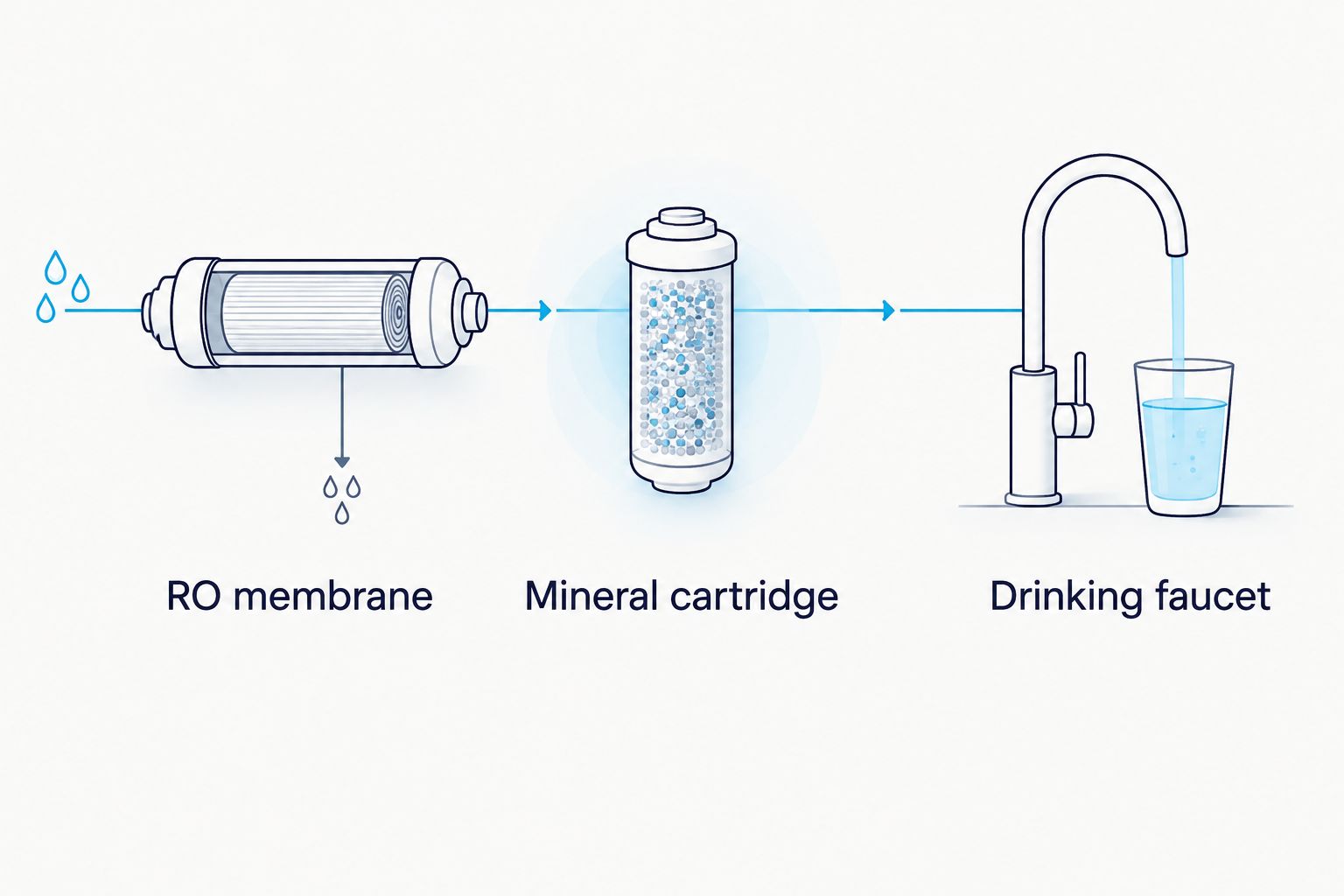
Ask where the mineral cartridge sits in the proposed installation and how you will reach it for replacement. A cartridge hidden behind other equipment creates a different maintenance task from one mounted where you can access its connections.
What does the mineral cartridge actually add?
Mineral cartridges use materials intended to dissolve into the water as it passes through. Calcite, a form of calcium carbonate, is a common example. Some cartridges use other mineral blends, so ask for the proposed cartridge’s identity rather than assuming every alkaline filter contains the same material.
The cartridge does not restore an exact copy of the minerals present before treatment. Its output depends on its own media and operating conditions. Remineralized water is not a return to the original tap-water composition.
For your 2026 equipment selection, request the cartridge documentation and replacement instructions. Those details are more useful than a broad promise of alkaline water because they identify what you will own and maintain.
Why the alkaline effect varies
A cartridge label does not establish the pH at your faucet. These factors explain why results differ:
- Mineral media: Different materials and blends dissolve differently and produce different changes in the water.
- Water chemistry: The water entering the mineral stage affects how it interacts with the media.
- Contact time: The time water spends in contact with the media influences mineral dissolution.
- Flow rate: How quickly water moves through the cartridge affects that contact.
- Cartridge condition: Media is consumed during use, so a cartridge’s condition matters when assessing its performance.
If a specific pH matters to your decision, ask how the installer will check the water at the drinking faucet. A reading describes the sampled water under those conditions; it is not a permanent promise for every glass.
Does a higher pH mean better drinking water?
A higher pH does not, by itself, demonstrate better contaminant removal or a health benefit. pH describes acidity or alkalinity, not the complete quality of drinking water. Keep those questions separate.
Taste is a valid reason to consider the mineral stage, but it remains a preference. Some homeowners prefer the taste after mineral contact; others do not need the extra stage. If a tasting opportunity is available, compare the water before deciding rather than buying from the label alone.
An alkaline cartridge is also not a substitute for a balanced diet or medical care. Evaluate it as a drinking-water equipment choice, with a defined purpose and a maintenance requirement.
How does alkaline RO fit with whole-house city-water treatment?
A drinking-water RO system treats water at its designated outlet. It does not soften the water throughout your house or treat every shower and laundry connection. Whole-house equipment serves a different part of the plumbing.
A water softener addresses hardness minerals. A whole-house filter addresses the substances its particular media is designed to reduce. Neither description automatically establishes that the equipment performs the other job, and adding an alkaline cartridge to an RO system does not change that distinction.
For a Port St. Lucie or Tradition home on city water, describe your concerns separately: drinking-water taste, hardness-related buildup, or another identified treatment need. That gives the installer a clearer basis for selecting equipment without treating every concern as a reason to add another cartridge.
What should your installation quote include?
Your 2026 installation quote should identify the equipment and the work, not just describe the package as alkaline RO. Ask for enough detail to understand what happens under the sink and what you will need to maintain afterward.
Use this checklist when requesting a personalized quote:
- System identity: Request the proposed RO system and mineral cartridge names, with documentation for the exact equipment.
- Included components: Confirm the faucet, mounting hardware, tubing, connections, and any storage tank included in the design.
- Plumbing work: Ask how the system will connect to the cold-water supply and drain, and whether existing connections need changes.
- Faucet work: Confirm whether an existing opening can be used or whether the installation requires another opening.
- Usable space: Have the installer account for cabinet contents, existing plumbing, access, and cartridge replacement clearance.
- Startup and hand-off: Ask who handles the manufacturer’s flushing procedure and explains normal operation.
- Ongoing service: Identify every replacement item, the instructions governing replacement, and any service work excluded from installation.
A useful quote separates the alkaline add-on from the rest of the RO installation. That lets you decide whether the mineral stage earns its place without confusing its purpose with the membrane’s treatment role.
PSL Water Guy is best for Port St. Lucie homeowners seeking a home-specific city-water installation quote. Explain whether you want drinking-water treatment alone or an installation coordinated with whole-house filtration or water softening.
Request your installation quote
Ask for a home-specific RO proposal with the mineral stage, plumbing work, and maintenance clearly identified.
What affects the installation quote?
The alkaline cartridge is only part of the scope. Cabinet access, the faucet arrangement, supply and drain connections, and the proposed system layout all affect the work required. A quote based only on the phrase alkaline RO leaves those decisions unresolved.
Existing equipment matters too. Tell the installer whether you already have a softener, whole-house filter, or older drinking-water system, and whether that equipment will remain. Do not assume an existing faucet or tank can be reused; have compatibility confirmed for the proposed installation.
Request a personalized quote rather than applying another household’s total to your home. Ask which items are included, which require separate approval, and what happens if the installer finds a connection that needs correction.
What should you check before accepting the installation?
For a 2026 installation, make the hand-off practical. You should know where the shutoff is, how to recognize a leak, which cartridges belong in the system, and how to obtain the correct replacements.
Ask the installer to show you the equipment after startup and explain the manufacturer’s operating instructions. If the proposal included an output check, confirm what was measured and what the result means. Do not treat a pH reading as verification of every treatment claim.
Keep the equipment information with your home records. A clear cartridge identity is more useful at replacement time than a handwritten note that only says alkaline filter.
Can I add an alkaline filter to an existing RO system?
You can add a mineral stage to an existing RO system when the system design and proposed cartridge are compatible. Have the installer check the connections, operating requirements, mounting space, and intended flow path before adding it.
The add-on does not repair a worn membrane or overdue supporting filters. Assess the existing RO system first, then decide whether a mineral stage is a useful addition.
Is an alkaline cartridge the same as a water softener?
An alkaline cartridge is not a water softener. A softener reduces hardness minerals in the water it treats, while an alkaline cartridge introduces mineral contact to drinking water after RO treatment.
Those roles can coexist in one home. The correct arrangement depends on the home’s water and the equipment selected, not on a claim that one stage replaces the other.
Do I need an alkaline stage if I only want RO drinking water?
You do not need an alkaline stage simply to have RO drinking water. Choose it when you specifically want the mineral finish and accept the additional maintenance item.
Skip the add-on if its purpose is unclear. The proposal should explain what the cartridge adds without relying on health claims or implying that higher pH proves cleaner water.
FAQ
What does an alkaline filter add to reverse osmosis water?
An alkaline filter adds contact with mineral media after reverse osmosis treatment. That contact can raise pH and change mineral content and taste, depending on the cartridge and water conditions.
Is alkaline RO better than regular RO for my home?
Alkaline RO is better suited to homeowners who specifically want a mineral finish after reverse osmosis. Regular RO avoids the extra mineral cartridge, so the choice depends on taste preference and maintenance rather than an automatic improvement in filtration.
Will an alkaline filter make my drinking water healthier?
A higher pH alone does not establish a health benefit. Select the RO system for its documented treatment capabilities and consider the mineral stage separately.
Does an alkaline RO system treat every faucet in the house?
A drinking-water RO system treats its designated outlet, not every faucet in the house. Whole-house filtration and water softening serve separate treatment purposes.
How often should I replace an alkaline cartridge?
Replace an alkaline cartridge according to the instructions for that exact cartridge and its operating conditions. Ask the installer to identify the replacement item and explain the applicable schedule.
What should I ask about an alkaline RO drinking water installation in 2026?
Ask for the exact RO system, mineral cartridge, included faucet, plumbing scope, startup procedure, and replacement requirements. Request a personalized installation quote that makes the mineral add-on clear.
Who can help me choose city-water treatment in Port St. Lucie or Tradition?
PSL Water Guy offers residential city-water treatment selected for each home’s water and needs. Request an installation quote that separates drinking-water RO, the alkaline stage, and any proposed whole-house equipment.
One last thing
Ask for the mineral cartridge’s replacement identity before approving the installation. It is a small detail that makes the ownership decision clearer: you know what the add-on does, what you will maintain, and which part you will need later.


Hydronix’s ALK filter makes our RO drinking water delicious!