

Replacing an existing whole-house water filter changes the equipment, but it does not automatically eliminate plumbing work: the installer must check whether the connections, shutoffs, bypass, and available space suit the replacement. Your whole house water filter installation cost depends on what can stay, what needs rebuilding, and whether you are replacing filtration alone or adding water softening or separate drinking-water treatment.
- Whole house water filter installation cost depends on reusable plumbing, replacement equipment, and changes to the treatment layout.
- A cartridge change is maintenance; replacing the complete whole-house filter requires a separate installation scope.
- PSL Water Guy is best for Port St. Lucie homeowners seeking city-water treatment selected for their home’s needs.
- Request an itemized replacement quote that identifies removal, connections, startup, and ongoing maintenance.
What changes when replacing an existing whole-house water filter?
The biggest change is the installation scope, not simply the age of the filter. An existing treatment location gives the installer something to assess, but it does not prove that a different system will fit or connect without alterations. The replacement needs to match both your water-treatment goals and the home's plumbing.
For a 2026 replacement in Port St. Lucie or Tradition, separate routine filter maintenance from complete equipment replacement before requesting a quote. These jobs involve different work.
| Replacement approach | Best for | What changes | Main advantage | Main limitation |
|---|---|---|---|---|
| Cartridge change | Maintaining a compatible, serviceable housing | The replaceable filter element | Keeps the existing housing and plumbing | Does not resolve damaged housings or unsuitable treatment |
| Like-for-like equipment replacement | Keeping the same treatment purpose | The complete unit and its connections | Preserves the existing layout when compatible | Existing valves and connections still need inspection |
| Treatment redesign | Addressing a different water concern or installation problem | Equipment selection and potentially the plumbing layout | Matches the replacement to current needs | Requires a broader installation scope |
These are planning categories, not interchangeable services. A cartridge change cannot correct every equipment problem, and a complete replacement does not necessarily require rebuilding every connection.
Why this matters
For homeowners on city water, the replacement decision starts with the problem you want to solve. Taste and odor, mineral buildup, and drinking-water preferences call for different treatment functions. Buying another unit without identifying that function risks repeating the same mismatch.
PSL Water Guy is a local family-owned business that selects residential water-treatment systems for each home's water and needs. For a replacement, ask for an installation quote tied to the existing setup rather than a generic equipment recommendation.
Keep useful infrastructure only when it is compatible and serviceable. Reusing a connection is not the same as confirming that the connection belongs in the finished installation.
Cartridge replacement: maintenance within the existing housing
A cartridge replacement leaves the filter housing in place and changes its replaceable element. This applies to systems designed for cartridge servicing; not every whole-house treatment system uses the same maintenance arrangement.
Before treating the job as routine maintenance, identify the housing and the cartridge it accepts. Compatibility includes more than appearance: the replacement element must fit the housing and serve the intended treatment purpose.
Ask the installer to distinguish a used-up cartridge from a problem with the housing, seals, or connections. Replacing the element does not repair a leaking housing or change where the equipment sits in the plumbing.
Best for: keeping an otherwise suitable cartridge system in service. The advantage is retaining the installed equipment; the limitation is that its treatment function and physical condition remain unchanged.
Complete filter replacement: equipment and connection work
A complete replacement removes the existing treatment unit and installs another. Even when the purpose stays the same, the new equipment can have different connection locations, dimensions, or service requirements.
The installer should assess the pipework entering and leaving the unit, the condition of the shutoffs, and how water will bypass the system during servicing. Any reused parts need to suit the new equipment rather than merely being present.
Ask whether removal and disposal of the old unit belong in the quote. Also ask whether the replacement stays in the same location and what work is required to reconnect it.
Best for: replacing equipment while keeping the same treatment goal. The advantage is continuity; the limitation is that a familiar location does not guarantee a straightforward connection.
Treatment redesign: changing what the system does
A redesign changes the treatment plan rather than simply exchanging equipment. For example, a homeowner seeking relief from mineral buildup needs to distinguish water softening from filtration aimed at taste or odor.
A conventional water softener reduces hardness minerals through ion exchange. A whole-house filter's function depends on its media and design. Neither description alone establishes that a particular system addresses every water concern.
An alkaline reverse osmosis drinking-water installation serves a separate purpose at the drinking-water outlet. It is not a substitute for treating water throughout the home, and adding it creates a separate installation scope.
Best for: homeowners whose current equipment does not match their present needs. A redesign allows treatment selection by function, but it also requires the quote to explain additional equipment, connections, and maintenance clearly.
Why replacement installation scope varies
Whole house water filter installation cost follows the work required at your home. For a 2026 quote, ask the installer to explain these factors rather than describing the job only as a replacement:
- Equipment compatibility: Different inlet and outlet positions can require changes to the existing connections.
- Plumbing condition: Damaged, leaking, or unsuitable components need attention before they become part of the replacement installation.
- Access and clearance: The installer needs room to connect the equipment and leave it accessible for servicing.
- Treatment function: Replacing filtration alone differs from adding a softener or separate reverse osmosis drinking-water equipment.
- Service connections: Drain or electrical requirements depend on the selected equipment; existing connections need a compatibility check.
- Removal and startup: Disconnecting the old unit, handling it, and commissioning the replacement are distinct parts of the job.
Ask which factors apply to your installation. A useful quote connects each proposed change to a specific requirement rather than leaving you to infer why it is included.
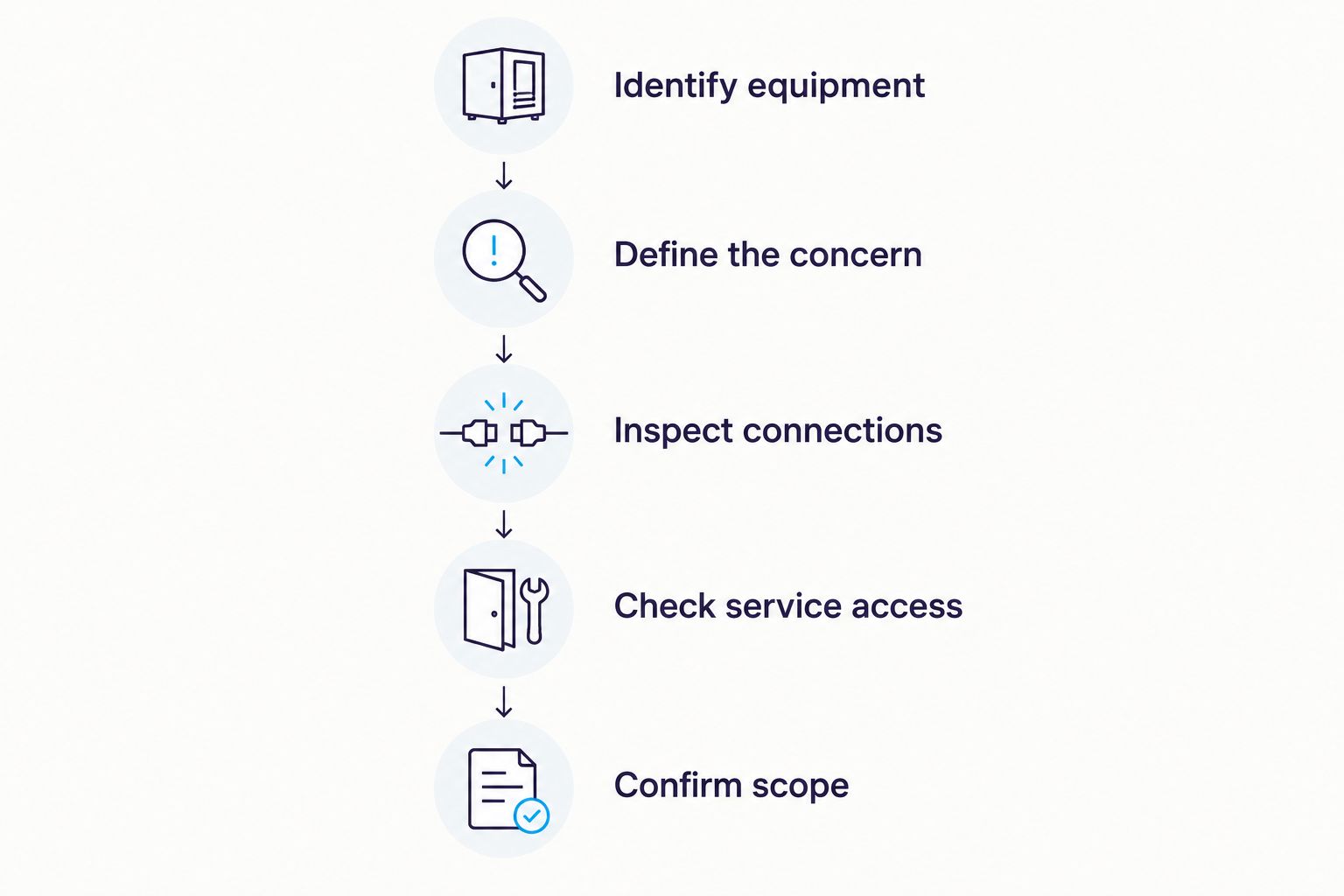
How should the existing installation be assessed?
Start with the equipment that is already there. Clear identification helps the installer separate components that can remain from components that need replacement.
- Identify equipment. Photograph the existing unit, its label, and any separate filter housings. Record the maintenance information you already have.
- Define the concern. Explain whether you want to address taste, odor, mineral buildup, an equipment fault, or a change in household needs.
- Inspect connections. Have the installer assess the visible plumbing, shutoffs, bypass arrangement, and any equipment-specific service connections.
- Check service access. Confirm that the proposed location leaves room for future filter changes, valve operation, and other required maintenance.
- Confirm scope. Ask for a written explanation of what stays, what is removed, and what will be installed.
These steps turn an equipment swap into a defined installation. You should be able to understand the proposed layout without needing to know plumbing terminology.
Which existing parts can stay?
Existing parts can stay only when they suit the replacement and remain serviceable. That applies to connections, valves, mounting arrangements, and any drain or electrical provision the selected equipment requires.
Ask the installer to identify retained components explicitly. A quote that says only that existing plumbing will be used leaves unanswered questions about the bypass, shutoffs, and connection changes.
Avoid making reuse the primary goal. The purpose is a suitable finished installation, not preserving every old part. Conversely, replacing the entire unit does not justify removing sound, compatible plumbing without an explanation.
For your 2026 project, request a distinction between required alterations and optional layout improvements. That makes it easier to compare installation proposals on the same basis.
What should a replacement installation quote include?
A replacement quote should describe the finished installation and the work needed to reach it. Use this checklist when reviewing the proposal:
- Treatment purpose: The water concern each proposed component is intended to address.
- Equipment identification: The actual equipment included, not just a broad label such as whole-house system.
- Removal: Which existing components will be disconnected and how removal or disposal is handled.
- Retained plumbing: Which connections, valves, or other components remain in use.
- New plumbing: The connection changes, bypass arrangement, and equipment-specific service connections included.
- Startup: The flushing, setup, and leak checks required by the equipment instructions.
- Handover: Instructions for operating the bypass and carrying out routine maintenance.
- Exclusions: Work or components that are not included in the proposal.
For city-water treatment in Port St. Lucie and Tradition, PSL Water Guy offers whole-house treatment, water softening, and alkaline reverse osmosis drinking-water installations. Ask for a personalized replacement quote that separates the whole-house work from any additional drinking-water installation.
Compare scope before comparing quote totals. Proposals are not equivalent when one includes removal, connection changes, and startup while another leaves those items undefined.
Request your replacement installation quote
Discuss your existing city-water setup, treatment goals, and the work your replacement needs.
Should you keep the same type of water treatment?
Keep the same treatment function when it still matches the problem you want to address. Change the plan when the current equipment serves a different purpose or does not suit your household's needs.
Do not treat filtration, softening, and drinking-water treatment as different names for the same service. A filter's capabilities depend on its design; a softener addresses hardness; reverse osmosis treats water supplied to its drinking-water outlet.
Ask the installer to explain the role of each proposed component in plain language. Every component should have a stated job. Adding equipment without explaining that job makes the replacement harder to evaluate and maintain.
What happens during the replacement?
The installer isolates the relevant water supply, disconnects the old equipment, completes the agreed connection work, and starts up the replacement according to its instructions. The exact sequence depends on the equipment and existing layout.
Ask how the work affects household water use and when the system will be ready to use. Do not assume that an existing bypass keeps every fixture supplied during all parts of the installation.
Before the job is complete, request an explanation of normal valve positions and bypass operation. Confirm which maintenance tasks belong to you and which require service.
What should you check after installation?
Review the finished work against the written scope. Confirm that the equipment is accessible, retained and new components match the proposal, and the installer has completed the specified startup checks.
Keep the equipment information and maintenance instructions together. Different treatment components have different servicing needs, so ask for instructions for the actual equipment installed rather than a generic replacement schedule.
For a 2026 installation, keep a record of the equipment fitted and the date of completion. That gives the next service visit a clear starting point without relying on memory.
FAQ
Does replacing an existing whole-house filter reduce installation work?
Replacing an existing whole-house filter reduces work only where the current layout and components suit the replacement. Connections, valves, access, and equipment-specific requirements still need assessment.
What affects whole house water filter installation cost when replacing a system?
Whole house water filter installation cost depends on the replacement equipment, reusable plumbing, connection changes, removal, and startup work. Request a personalized quote that identifies each included task.
Can I replace only the cartridge instead of the whole system?
You can replace only the cartridge when the system uses a replaceable element and the housing remains suitable and serviceable. A cartridge change does not repair a damaged housing or change the system’s treatment function.
Can the installer reuse my existing bypass and shutoff valves?
The installer can reuse existing bypass and shutoff valves when they are compatible and serviceable. Ask the quote to identify which valves stay and which need replacement.
Do I need a water softener as well as a whole-house filter?
A water softener and a whole-house filter serve different treatment functions. Ask whether hardness is a concern and what the proposed filter actually treats before deciding on both.
Does alkaline reverse osmosis replace whole-house filtration?
Alkaline reverse osmosis drinking-water treatment does not replace treatment throughout the home. Its installation serves the drinking-water outlet and should be identified separately in the replacement scope.
What should I send when requesting a replacement quote?
Send photographs of the existing equipment, its label, and visible connections, along with your treatment concerns. Ask what further inspection is needed to define the installation scope.
One last thing
Photograph the valve positions before the old equipment is removed. Those photos provide a useful record of the previous layout, but they are not instructions for operating the replacement. Ask the installer to show you the new system's normal and bypass settings before handover.
For your 2026 replacement, the most useful decision is not whether to buy the closest-looking unit. It is whether the proposed installation solves the right problem and leaves you with clear operating and maintenance instructions.


