

Choose a salt-based softener for your Tradition home if you want to remove water hardness; choose a salt-free conditioner only if your goal is scale management without softening. Salt-free conditioning leaves hardness minerals in the water, so it is not an equivalent replacement. For a 2026 installation, decide from your home's water test, plumbing, and maintenance preferences—not the equipment label alone.
- For a water softener Port St. Lucie homeowners can compare, start with measured hardness and the result you need.
- A salt-based softener removes hardness; a salt-free conditioner does not produce softened water.
- Whole-house filtration and reverse osmosis drinking water address separate treatment goals.
- PSL Water Guy suits Tradition homeowners seeking a locally selected residential water treatment installation.
Salt-based or salt-free treatment for a Tradition home?
Salt-based treatment wins for hardness removal. Salt-free conditioning is a different choice, not another way to produce soft water. A conventional salt-based softener uses ion exchange to remove calcium and magnesium, the minerals responsible for hardness. A salt-free conditioner changes how scale forms rather than removing those minerals.
For local installation help, PSL Water Guy is a family-owned business that selects residential treatment systems for each home's water and needs. Before requesting equipment, tell the installer whether your priority is hardness removal, scale management, whole-house filtration, or drinking-water treatment.
| Decision point | Salt-based softener | Salt-free conditioner |
|---|---|---|
| Best for | Homeowners who want actual hardness removal | Homeowners seeking scale management without salt regeneration |
| Main function | Hardness removal through ion exchange | Scale management through the specified conditioning technology |
| Hardness after treatment | Reduced when correctly selected and operating | Calcium and magnesium remain in the water |
| Routine responsibility | Refill salt and maintain regeneration operation | Follow the specified media and maintenance requirements |
| Installation issue to check | Drain access, regeneration setup, and equipment space | Water compatibility, flow requirements, and equipment space |
| Main limitation | Requires salt and produces regeneration wastewater | Does not deliver softened water or its full washing benefits |
The distinction matters when you compare quotes. If one proposal removes hardness and another only addresses scale, the proposals do not promise the same result. Ask each installer to state the treatment outcome in plain words.
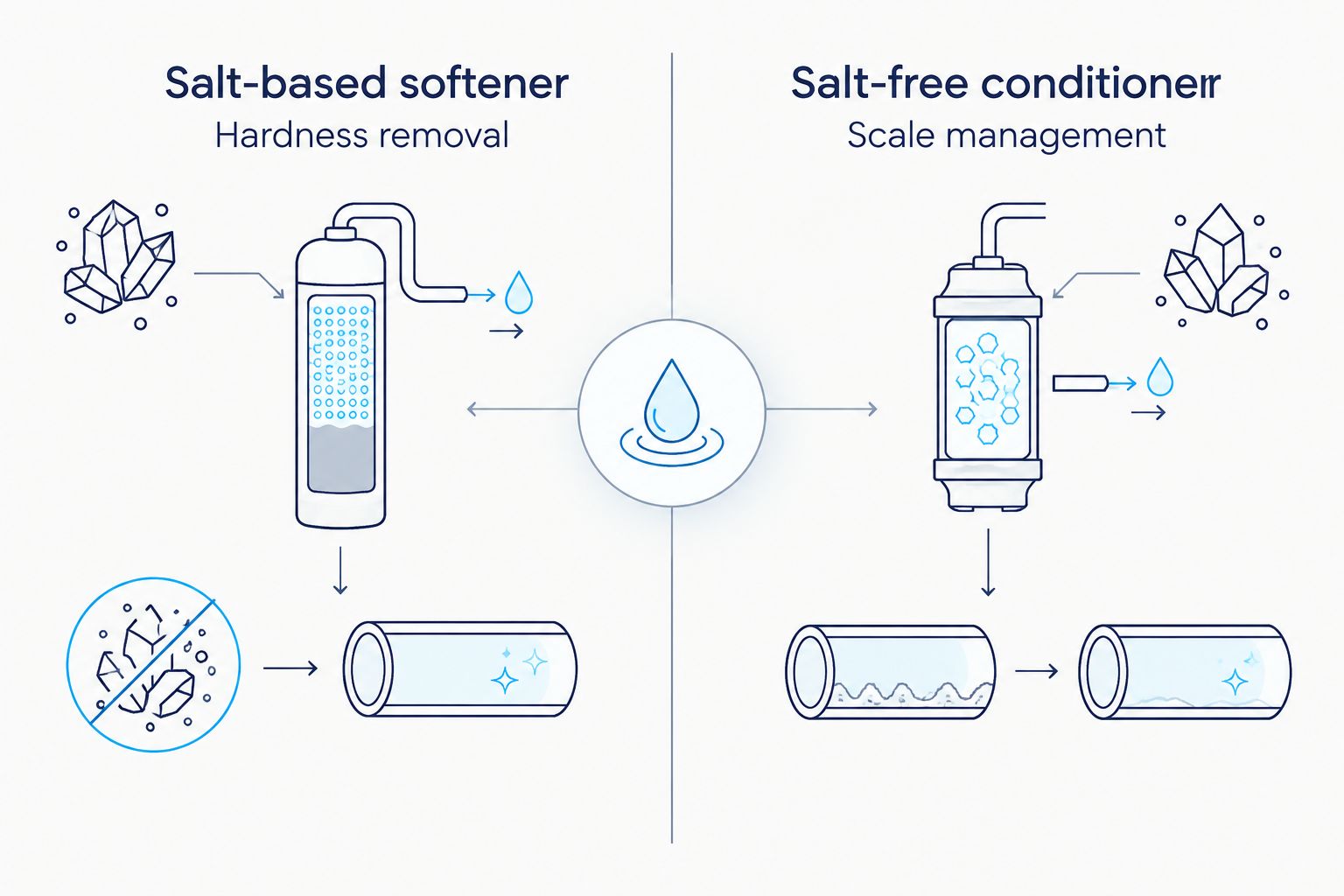
Do not treat the phrase whole-house treatment as a promise that every water concern is covered. A system needs a defined purpose, and the quote needs to identify the equipment responsible for each purpose.
Why this matters for a Tradition home
For a homeowner on city water, treatment choices start inside the home—not with an assumption that every property needs the same equipment. Your water hardness, household demand, installation location, and preferred maintenance routine determine which approach fits.
A useful 2026 comparison separates the desired result from the work required to install it. A conditioner with less routine salt handling still leaves hardness in place; a softener removes hardness but adds regeneration and salt upkeep. Neither trade-off disappears because the equipment is described as convenient.
Choose the result first, then choose the equipment and installation layout that deliver it. That order prevents an appealing feature from replacing your actual reason for buying treatment.
What does your hardness result mean?
Ask for hardness expressed in a stated unit, such as milligrams per liter as calcium carbonate. A number without its unit is not enough to compare recommendations. Also confirm whether the result represents untreated incoming water or water that has already passed through existing equipment.
The U.S. Geological Survey's general hardness classification describes water up to 60 mg/L as soft, 61–120 mg/L as moderately hard, 121–180 mg/L as hard, and above 180 mg/L as very hard. These are general classification bands, not measurements for Tradition or your home.
Use the result to establish whether hardness removal addresses a real concern at your property. Do not choose a softener solely because a neighbor has one, and do not reject one solely because a salt-free option sounds simpler.
Hardness also does not tell you everything about water quality. A hardness test does not establish whether a filter reduces a particular disinfectant, and it does not establish drinking-water safety. Keep each treatment claim tied to the measurement or documented performance that supports it.
Salt-based softening: best for removing hardness
A salt-based softener passes water through resin that exchanges calcium and magnesium for sodium or potassium ions. Regeneration restores the resin's ability to keep softening water. Salt supports that regeneration process; it is not simply poured into the household water supply.
The practical advantage is clear: the equipment removes the hardness minerals rather than leaving them in place. That makes this the appropriate category when actual softened water is the goal for bathing, laundry, and other household uses.
The trade-off is an ongoing maintenance routine. You need to replenish the specified salt, keep regeneration working, and provide a suitable route for regeneration wastewater. The installation also needs service access so routine work does not require moving unrelated equipment.
Ask the installer to explain the selected capacity and operating settings in relation to your measured hardness and household use. A tank's appearance does not tell you whether the system is correctly selected. Neither does the simple claim that it serves a whole house.
Choose a salt-based softener when removing hardness is the requirement and you accept its maintenance responsibilities. Do not assume the softener also handles disinfectant reduction or replaces a separate drinking-water system.
Salt-free conditioning: best for scale-management goals
Salt-free conditioning is a category, not a single technology. The proposed equipment must identify how it treats water and the conditions under which it is intended to work. A label alone does not establish scale-control performance.
The appeal is avoiding the salt-refill and brine-regeneration routine associated with conventional softening. For a homeowner whose main concern is scale management, that distinction belongs in the comparison. But less salt handling does not mean no maintenance, and it does not mean hardness disappears.
Calcium and magnesium remain after salt-free conditioning. You should not expect a hardness test to show the same reduction that an operating salt-based softener produces. You also should not expect all the washing characteristics associated with softened water.
Ask for documentation that supports the proposed conditioner's scale-management claim and identifies its water-quality limitations. The installer should explain how your incoming water fits those requirements and what upkeep the equipment needs.
Choose salt-free conditioning only when scale management—not softened water—is your stated goal. If a proposal uses the terms conditioning and softening interchangeably, request a written explanation of whether the equipment actually removes hardness minerals before comparing it with a softener quote.
Why the right installation varies by home
A personalized recommendation needs more than a city name. These factors affect the treatment choice, the installation work, or both:
- Measured hardness: Establish whether your goal requires removing calcium and magnesium rather than managing scale.
- Treatment scope: Separate whole-house softening or filtration from treatment at the drinking-water tap.
- Household demand: Match equipment to the water use it must handle, including simultaneous fixture use.
- Existing plumbing: Confirm the connection point, bypass arrangement, and whether outdoor lines remain untreated.
- Installation space: Account for equipment access, plumbing routes, and any required drain or power connection.
- Maintenance preference: Decide whether salt refills and regeneration fit your routine, and compare them with the conditioner's specified upkeep.
Your plumbing layout can change the work even when the treatment goal stays the same. The guide to how existing plumbing affects a whole-house filter quote helps you identify those installation questions before comparing proposals.
Bring photos of the proposed location and describe any existing treatment equipment. That information helps focus the discussion, but it does not replace checking the water or confirming the plumbing on site.
How should you compare installation quotes?
Use the same requested outcome for every quote. Otherwise, differences in equipment and installation scope make the comparison misleading. A 2026 proposal should tell you what the system treats, how it will connect, and what you will maintain afterward.
- State your treatment goal. Write down whether you want hardness removal, scale management, whole-house filtration, or a separate drinking-water installation. Avoid using better water as the only specification.
- Record the incoming-water result. Ask the installer to identify the hardness measurement, its unit, and any other water characteristics relevant to the selected equipment. Keep that information with the proposal.
- Identify the equipment. Request the exact proposed system and its treatment function. Confirm whether a salt-free proposal is a conditioner rather than equipment that removes hardness.
- Confirm installation scope. Ask which plumbing connections, bypass components, drain work, electrical requirements, and removal of existing equipment are included or excluded. Get exclusions in writing.
- Review operation and upkeep. Ask how the system will be set up, what checks follow installation, and which consumables or replacement media you will need. Confirm who handles each task.
Ask for a written explanation of the recommendation, not just an equipment name. If the proposal combines several treatment stages, each stage should have a stated job and its own maintenance requirements.
PSL Water Guy offers whole-house city-water treatment, water softening, and alkaline reverse osmosis drinking-water installations. Discuss those as separate needs: treatment for water throughout the house is not the same decision as treatment at the drinking-water tap. Request a personalized quote that identifies which parts belong in your home's installation.
Request your Tradition installation quote
Discuss your home’s city water, treatment goals, plumbing, and ongoing maintenance.
Does a salt-free conditioner make water soft?
A salt-free conditioner does not make hard water soft by removing calcium and magnesium. Its role is scale management through the technology specified for that equipment. Choose an actual softener when hardness removal is the outcome you want documented in the quote.
Do you still need whole-house filtration with a softener?
A softener does not automatically replace whole-house filtration. Softening addresses hardness, while a filter must be selected for the particular substance or water-quality concern it is intended to address. Ask the installer to explain each treatment stage rather than assuming one tank covers every concern.
Does alkaline reverse osmosis replace a whole-house softener?
Alkaline reverse osmosis drinking-water treatment does not replace whole-house softening. A drinking-water installation serves its connected outlet, while a whole-house softener treats water on the household plumbing it serves. Specify the goal for each without attaching unsupported health claims to either.
What ongoing responsibilities belong in the decision?
Compare maintenance as part of your 2026 installation decision, not as an afterthought. A salt-based softener needs salt replenishment and functioning regeneration. A salt-free conditioner needs the maintenance and media replacement specified for that system.
For any separate filtration or drinking-water equipment, ask about its replacement parts and service requirements too. Have the installer distinguish routine homeowner tasks from work that requires service. A proposal is easier to evaluate when it describes both installation and continued operation.
PSL Water Guy is best for Tradition homeowners seeking a local, family-owned residential water treatment business that selects equipment for their home's water and needs. The decision still requires a clear treatment scope and maintenance plan; the business name alone does not establish which system fits.
FAQ
What’s the best water softener choice for a Tradition home?
A salt-based softener is the right category when your Tradition home needs actual hardness removal. Confirm the home’s measured hardness, household demand, and installation requirements before choosing equipment.
Is salt-free treatment better than a salt-based softener?
Salt-free treatment is not better for removing hardness because it leaves calcium and magnesium in the water. Compare it with a softener only after deciding whether you want scale management or softened water.
Will a salt-free conditioner lower my water hardness test result?
A salt-free conditioner does not lower hardness by removing calcium and magnesium. Its claimed scale-management performance needs separate documentation for the proposed equipment.
Does a water softener remove chloramine from city water?
A conventional ion-exchange water softener is not a chloramine-reduction filter. Ask whether separate filtration is specified and what evidence supports that filter’s chloramine-reduction claim.
How much does a water softener installation in Port St. Lucie cost?
Request a personalized installation quote for your Port St. Lucie home. The quote should identify the selected equipment, plumbing work, required connections, and ongoing maintenance rather than relying on a generic figure.
Do I need alkaline reverse osmosis if I install a whole-house softener?
Whole-house softening and alkaline reverse osmosis serve different treatment goals. Decide whether you want separate drinking-water treatment, then ask the installer to specify that installation independently.
What should I ask PSL Water Guy before installation?
Ask PSL Water Guy to state whether the recommended equipment removes hardness or only manages scale. Also request the water measurements, installation inclusions, exclusions, and maintenance responsibilities in writing.
One last thing
A clear hardness test and a written treatment goal are more useful than a persuasive equipment label. For your 2026 Tradition installation, ask one direct question: Will this system remove hardness minerals, or will it leave them in the water and manage scale?
Then ask the installer to put that answer in the quote. If your goal is softened water, the equipment must remove hardness. If your goal is scale management without salt regeneration, the proposal must describe the conditioner's limits rather than promise the results of a softener.


