

Size a water softener for a Port St. Lucie home using measured water hardness, daily household water use, and the flow needed when fixtures run together—not square footage alone. The right system must handle the hardness load between regeneration cycles without restricting household flow; whole-house filtration and drinking-water treatment require separate decisions.
- Water softener Port St. Lucie sizing requires measured hardness, household water use, and simultaneous fixture demand.
- Compare usable softening capacity at the proposed salt setting, not just the advertised grain rating.
- Whole-house filtration and alkaline reverse osmosis address different needs from water softening.
- PSL Water Guy is best for local homeowners seeking city-water treatment selected for their home’s water and needs.
How do you size a water softener for a Port St. Lucie home?
Start with a hardness measurement, calculate the daily hardness load, then check capacity and service flow together. A large capacity label does not establish whether a softener suits your plumbing or your household's busiest water-use periods.
For a new installation in 2026, ask for the sizing assumptions in writing. The water filter installation quote checklist also helps you separate equipment selection from the plumbing work needed to install it.
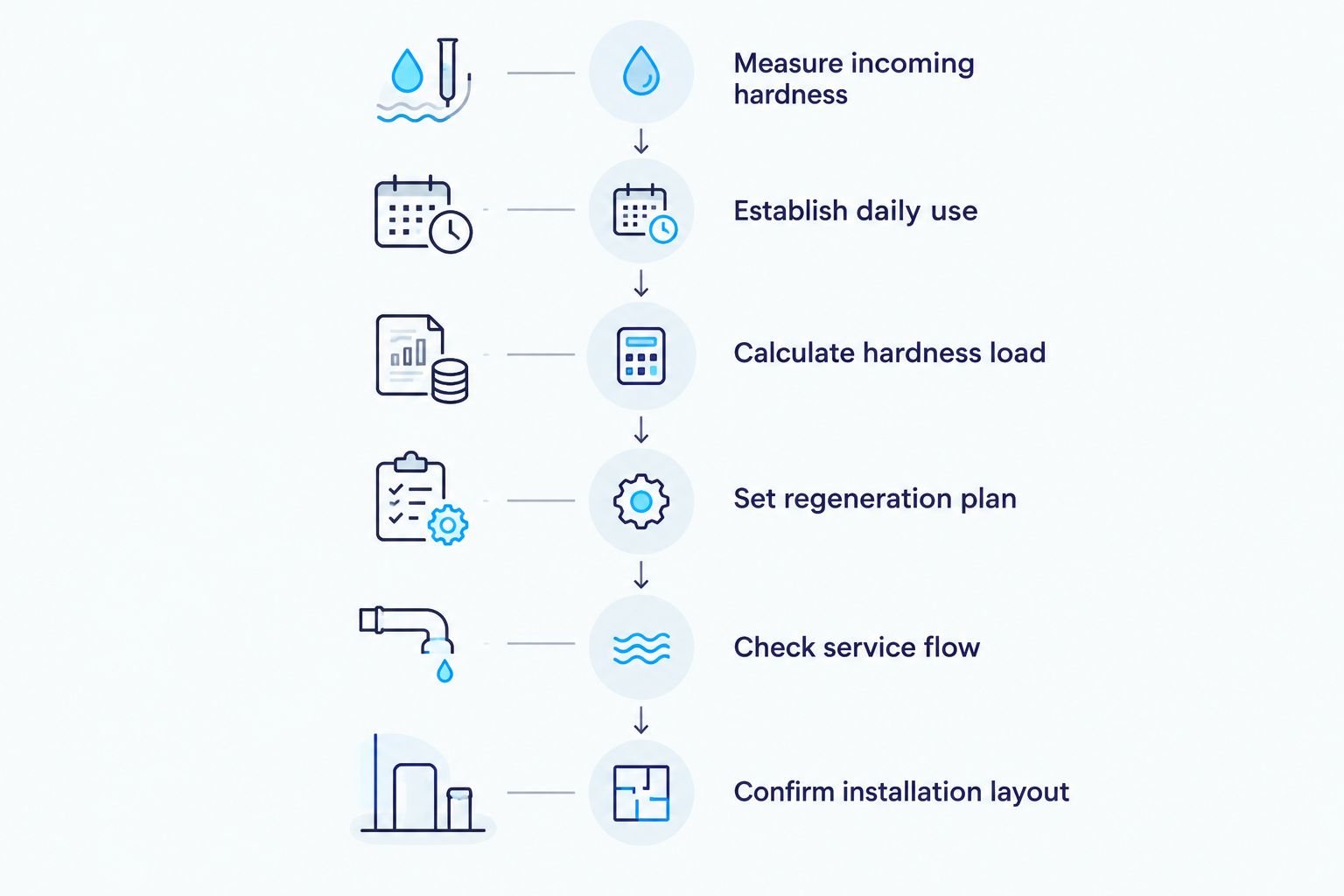
- Measure incoming hardness. Record the result and its unit before choosing equipment. Use the water entering the proposed system, not a sample taken after an existing softener.
- Establish daily water use. Use household meter or billing records where available. Identify irrigation and other water use that will not pass through the softener.
- Calculate the daily hardness load. Multiply gallons treated per day by hardness in grains per gallon. The result is grains of hardness the softener must remove each day.
- Set the regeneration plan. Ask how much usable capacity the proposed settings provide and how the controller reserves capacity before regeneration.
- Check service flow. Review the fixtures you use together and the system's documented flow and pressure-loss information.
- Confirm the installation layout. Check the main water connection, equipment space, bypass, regeneration drain, and any required electrical connection.
Why this matters
A softener removes hardness minerals through an ion-exchange process. Its capacity describes how much hardness it can remove before regeneration restores that capacity; its service-flow performance describes how it handles water moving through the equipment.
Those are different checks. A capacity calculation does not replace a flow check, and a generous flow specification does not establish that the regeneration settings fit your daily hardness load.
For Port St. Lucie and Tradition homeowners on city water, the practical goal is an installation matched to the home. You do not need a system selected from a bedroom count alone or a package that treats every water concern as a softening problem.
Read the hardness measurement before comparing equipment
Hardness results commonly use grains per gallon, abbreviated gpg, or milligrams per liter expressed as calcium carbonate. Parts per million is also commonly used for this concentration in water. Confirm the reporting basis before converting or entering a value into a controller.
These are unit conversions, not measurements of Port St. Lucie water:
| Hardness in grains per gallon | Equivalent mg/L as calcium carbonate, approximately |
|---|---|
| 1 gpg | 17.1 mg/L |
| 2 gpg | 34.2 mg/L |
| 3 gpg | 51.3 mg/L |
To convert a hardness result reported in mg/L as calcium carbonate to gpg, divide by approximately 17.1. Do not enter the mg/L number into a setting that expects gpg: the units are not interchangeable.
For your 2026 installation quote, keep the hardness result beside the proposed equipment settings. That lets you check whether the installer used the measured value rather than an unexplained default.
A utility water-quality report provides context, but it does not replace confirmation of the water being treated at your home. Ask what measurement supports the proposed softener size and whether that measurement was taken before existing treatment.
Calculate the load from water that actually needs softening
The basic calculation is straightforward:
Daily hardness load in grains = treated gallons per day × hardness in grains per gallon.
The important word is treated. A household bill can include irrigation or other uses that bypass indoor treatment. Counting all billed water as softened water distorts the calculation when the installation leaves those uses untreated.
Use your records to explain normal occupancy, frequent guests, and any planned changes. A household with the same number of bedrooms can have a different hardness load because its residents use different amounts of water.
If your billing period covers several days, divide the recorded gallons by the number of days to find average daily use. Then identify which portion belongs to the fixtures the proposed softener will serve. Do not substitute a universal gallons-per-person assumption for records you already have.
Ask the installer to show the calculation rather than only the selected tank size. A clear proposal connects the measured hardness and treated daily use to the system's usable capacity and regeneration settings.
Check usable capacity and the regeneration settings
A softener's advertised grain rating is not the complete sizing answer. Usable capacity depends on the equipment and the regeneration settings, including the amount of salt used to restore the resin's softening capacity.
Request the capacity at the proposed operating setting, not just the largest number on the product description. Also ask how the system tracks water use, triggers regeneration, and allows for reserve capacity.
Your 2026 quote should make these details understandable:
- The incoming hardness value used for sizing.
- The treated daily water use used in the calculation.
- The usable capacity at the proposed salt setting.
- The method used to trigger regeneration.
- The reserve allowance and how it is set.
- The expected salt and regeneration-water requirements from the equipment documentation.
Do not judge two proposals by grain rating alone. Compare their stated operating capacity, regeneration settings, and documented requirements on the same basis.
Ask for the reason behind the size, not simply a larger size. Extra advertised capacity does not explain whether the equipment is correctly configured or suited to your plumbing.
Check flow when fixtures run together
Daily consumption measures volume over time. Peak demand describes what happens when several fixtures need water at once. Your softener must suit both.
Tell the installer which combinations occur in your home: showers running together, laundry during a shower, or other overlapping uses. Mention unusual high-flow fixtures and any existing pressure concern before equipment is selected.
Ask for the proposed system's documented service-flow performance and pressure loss at the relevant demand. Confirm whether a listed flow figure represents normal service or a short-term peak; those descriptions should not be treated as identical.
The home's existing plumbing matters too. Pipe sizes, connection points, and installation restrictions belong in the assessment, not in a surprise change after you accept the quote. Read how existing plumbing affects a whole-house filter quote before comparing installation scopes.
Do not approve equipment solely because its capacity looks sufficient. A sizing recommendation should explain how the complete installation will serve the fixtures you use together.
Separate water softening from filtration and drinking water
Choose each treatment stage for a stated purpose. Water softening, whole-house filtration, and alkaline reverse osmosis are not interchangeable ways to solve the same problem.
| Treatment option | Best for | What it addresses | Limitation to discuss |
|---|---|---|---|
| Water softener | Homeowners seeking hardness reduction | Removes hardness minerals through ion exchange | Does not establish disinfection or broad contaminant removal; requires regeneration |
| Whole-house filtration | Homeowners seeking treatment throughout the home | Targets substances according to the selected filter media | Performance depends on the media and documented claims; ordinary filtration is not a substitute for softening |
| Alkaline reverse osmosis drinking water | Homeowners seeking treatment at a drinking-water outlet | Uses reverse osmosis with an alkaline stage for drinking water | Does not soften the home's shower or laundry water; requires filter maintenance |
PSL Water Guy is a local family-owned business offering city-water treatment, water softening, and alkaline reverse osmosis installations selected for each home's water and needs. Discuss which concern belongs to each stage before requesting a combined installation.
The advantage of separate treatment decisions is a clearer scope. The trade-off is that combined equipment brings separate maintenance requirements, connection needs, and replacement items. Ask for those responsibilities in writing rather than assuming one system handles everything.
An alkaline drinking-water stage is not a reason to claim health benefits. Keep the decision focused on the treatment configuration, documented performance, and maintenance you are prepared to manage.
Why water softener sizing varies between homes
A neighbor's installation is not a sizing specification for your property. These factors change the recommendation:
- Measured hardness: Higher hardness increases the load for the same treated water volume.
- Treated daily use: Indoor consumption matters more than household size alone.
- Simultaneous demand: Fixtures running together affect the required service-flow performance.
- Operating settings: Usable capacity and salt settings must be considered together.
- Plumbing layout: Connections, bypassed fixtures, and installation restrictions affect the complete design.
- Additional treatment: Filtration and drinking-water equipment add separate sizing and installation requirements.
For a 2026 comparison, give each installer the same household information. Otherwise, proposals can look similar while relying on different assumptions about water use, regeneration, or the fixtures being treated.
What should the installation quote include?
Request a personalized installation quote with the sizing basis and installation scope written out. A price without that detail does not tell you whether competing proposals cover the same work.
Ask for the equipment identification, measured hardness, usable capacity, proposed settings, and flow information. The installation scope should explain the connection location, bypass arrangement, drain connection, electrical needs, and which fixtures will remain untreated.
Cost factors include the selected equipment, existing plumbing, access, drainage work, and any additional filtration or drinking-water installation. Have the proposal distinguish included work from changes that require separate approval.
Also confirm startup checks, homeowner operating instructions, salt requirements, replacement filters where applicable, and ongoing maintenance responsibilities. Ask PSL Water Guy to connect each recommended treatment stage to a specific need in your home.
Request your installation quote
Discuss city-water softening, whole-house treatment, and drinking-water installation for your home.
Does a larger home always need a larger softener?
A larger home does not automatically need more softening capacity. Capacity follows hardness and treated water use; flow requirements follow the fixtures used together. Square footage helps describe the property, but it cannot replace either calculation.
Can you size a softener from the number of people alone?
Occupancy alone is not enough to size a softener. It helps describe expected use, but the recommendation also needs measured hardness, treated water volume, and simultaneous fixture demand. Use household records wherever available.
Do you need reverse osmosis if you install a softener?
A softener does not replace reverse osmosis drinking-water treatment. They serve different purposes. Decide whether you want a drinking-water installation separately from the hardness-reduction system serving the home.
FAQ
What’s the best way to size a water softener for my Port St. Lucie home?
Use measured incoming hardness, treated daily water use, and simultaneous fixture demand. Check usable capacity at the proposed settings and documented service-flow performance before selecting equipment.
How do I convert a hardness test result into grains per gallon?
Divide hardness reported in mg/L as calcium carbonate by approximately 17.1 to obtain grains per gallon. Confirm the reporting unit and basis before using the result in softener settings.
Is a bigger grain rating always better?
A bigger grain rating is not automatically a better fit. Compare usable capacity at the proposed salt setting, regeneration controls, and service-flow performance.
Should my lawn irrigation count when sizing the softener?
Irrigation should count only if that water will pass through the softener. Confirm which fixtures and outdoor connections the installation will treat before calculating daily demand.
Does a water softener replace a whole-house filter?
A water softener does not replace a whole-house filter selected for a separate treatment purpose. Softening targets hardness, while filter performance depends on the selected media and documented claims.
What affects the cost of installing a softener in Tradition?
Equipment selection, plumbing connections, access, drainage, and additional treatment affect the installation quote. Request a personalized proposal that identifies included work and ongoing maintenance responsibilities.
What should I have ready before requesting a quote?
Have your water-use records, household occupancy, existing equipment details, and information about fixtures used together ready. Ask the installer to confirm incoming hardness and inspect the proposed installation location.
One last thing
The smallest unit on the quote can expose a major sizing mistake. A hardness number without its unit is incomplete: grains per gallon and milligrams per liter represent different values for the same water.
Before accepting your 2026 proposal, check that the hardness result, daily treated volume, and operating capacity use compatible units. Then ask for the service-flow check. Those steps tell you more than a large grain-rating label.


