

Yes. Household water flow affects a chloramine water filter because faster flow gives water less contact time with the treatment media; a system must be sized for the demand created when fixtures run together. Chloramine reduction also depends on the media, incoming water conditions, and maintenance, so a filter's advertised flow rate alone does not establish its chloramine performance.
- A chloramine water filter must handle simultaneous household demand, not just average water use.
- Whole-house filtration and water softening solve different problems; a softener does not replace chloramine treatment.
- PSL Water Guy is best for local homeowners seeking a home-specific city-water installation quote.
- Ask for chloramine reduction evidence at the flow your household needs.
Does household water flow affect chloramine filter performance?
Higher flow reduces contact time in the same filter bed. Carbon treatment needs contact between water and the media. When more water passes through an unchanged amount of media, each portion of water spends less time in that bed.
That does not mean every busy household needs the largest available filter. It means the selected system needs documented chloramine performance under conditions relevant to your home. A tank dimension, pipe connection, or maximum throughput figure does not answer that question by itself.
For a new installation in 2026, start with your household's simultaneous demand:
- List active fixtures. Identify the showers, faucets, and appliances that regularly run together.
- Check peak flow. Have the installer assess the demand those combinations place on the treatment system.
- Match treatment capacity. Ask which chloramine reduction evidence supports the proposed system at that demand.
- Check installation limits. Confirm that the plumbing, pressure, and available space suit the proposed equipment.
- Define maintenance. Get the media replacement or service requirements in writing.
A personalized assessment from PSL Water Guy should connect those household needs to the proposed equipment, rather than treating every city-water home as the same installation.
Why this matters for Port St. Lucie and Tradition homeowners
A filter can appear adequate when one faucet runs, yet face a different demand when showers and appliances operate together. Your installation decision needs to account for the way you actually use water, not just the number of people living in the house.
First, confirm whether your water supplier uses chloramine. Do not assume every Port St. Lucie or Tradition address receives the same disinfectant treatment. Check the current supplier information for your service address before choosing equipment specifically for chloramine.
For your 2026 installation, separate the treatment goals: reducing a disinfectant residual, addressing hard water, and treating drinking water at the kitchen sink are different jobs. One piece of equipment does not automatically cover all of them.
Why chloramine filter performance varies
Flow matters, but it is not the only factor. These are the main points to resolve before approving a whole-house system:
- Peak flow: Running fixtures together increases the volume passing through the filter at once. Size for relevant simultaneous use, not just a quiet period in the home.
- Media selection: Carbon types differ in their chloramine treatment characteristics. Ask for evidence for the actual media and system being proposed.
- Media volume: More treatment media can provide more contact opportunity, but tank size alone does not establish the finished system's performance.
- Incoming water: Chloramine concentration, temperature, and water chemistry affect treatment. Performance evidence needs relevant test conditions, not an unexplained percentage.
- Media condition: Treatment capacity is finite. Service intervals and replacement requirements belong in the installation decision.
- System design: The tank, media bed, internal distribution, and any bypass arrangement determine how water passes through treatment.
Avoid choosing equipment from a single specification. A flow number without a treatment claim describes throughput, not necessarily the quality of the treated water.
What contact time means in plain language
Contact time is the opportunity water has to interact with the filter media. Imagine the same filter serving a kitchen faucet, then serving that faucet while showers run. The equipment has not changed, but the water passing through it has increased.
For a fixed media volume, higher flow means less nominal contact time. Actual performance also depends on how water travels through the bed and the properties of the media. That is why a simple calculation cannot replace system-specific reduction evidence.
Use this sequence when discussing a proposal: Household demand, Peak flow, Media selection, and Performance evidence. The installer should connect each step to the next. A proposed tank should be the result of that assessment, not the starting assumption.
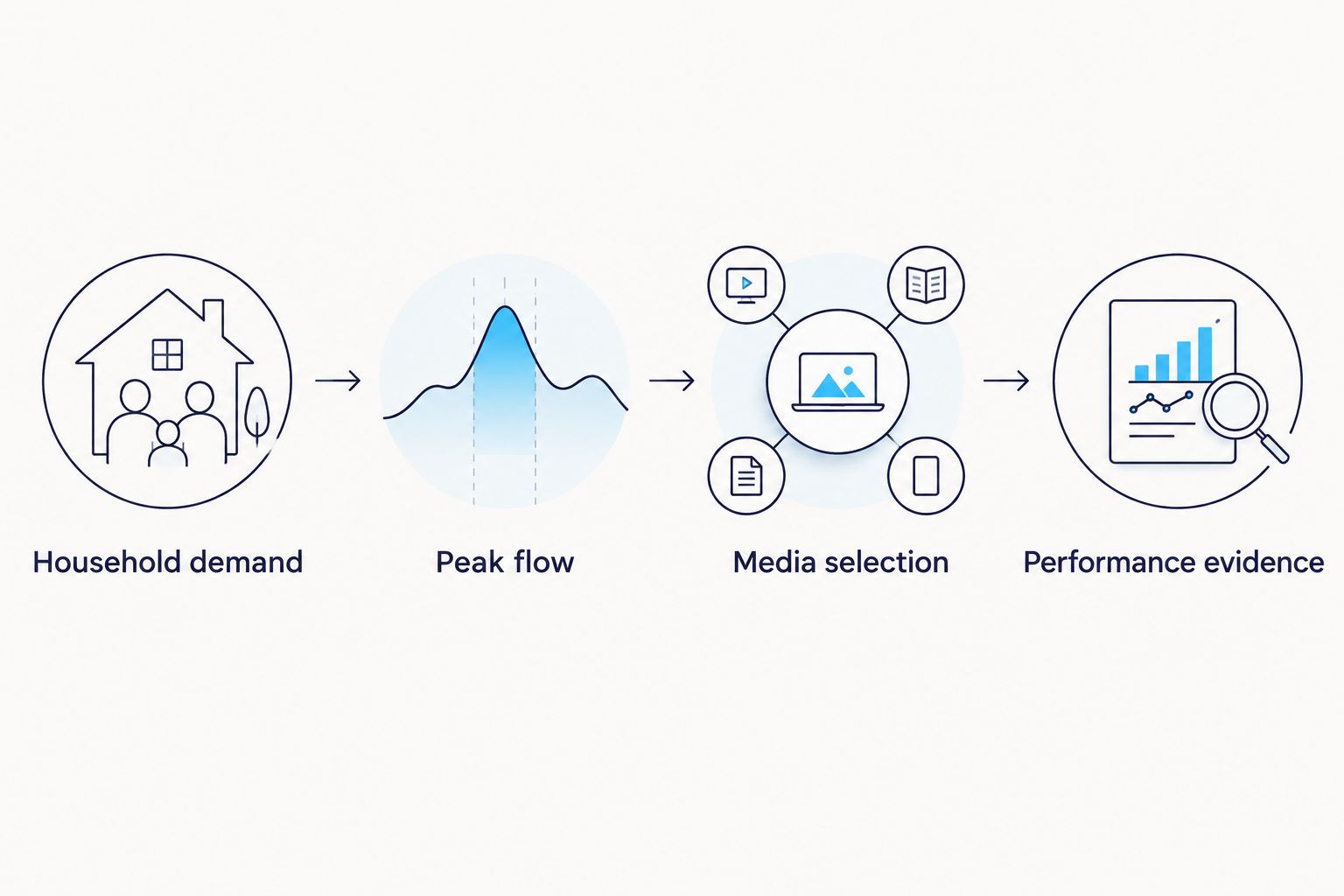
You do not need to become a filter designer. You need a clear answer to this question: What shows that this system reduces chloramine at the flow my home requires?
Rated flow is not the same as verified treatment flow
A specification can describe how much water equipment passes, how much pressure it loses, or the flow used during a reduction test. Those are related measurements, but they are not interchangeable.
When reviewing equipment in 2026, identify exactly what each listed flow figure means. A maximum flow claim does not automatically mean the filter achieves its chloramine reduction claim at that maximum.
Ask the installer to distinguish these terms:
| Specification | What it tells you | What it does not establish alone |
|---|---|---|
| Hydraulic flow | How much water can pass under stated conditions | Chloramine reduction at that flow |
| Pressure drop | The pressure difference across equipment at a stated flow | Disinfectant reduction performance |
| Tested treatment flow | The flow used for a stated reduction test | Performance outside the test conditions |
| Treatment capacity | The amount treated before a defined test endpoint | An unlimited service life |
Read the conditions attached to the performance claim. Look for the relevant contaminant, test flow, capacity endpoint, and maintenance requirements. A statement about chlorine is not a substitute for a statement about chloramine.
Which equipment addresses which household need?
Whole-house filtration, water softening, and reverse osmosis serve different purposes. Choose the treatment function first, then confirm its performance and installation requirements. Adding equipment without defining the problem makes a quote harder to evaluate.
| Equipment | Best for | Main advantage | Limitation to account for |
|---|---|---|---|
| Whole-house carbon filtration specified for chloramine | Homeowners seeking chloramine reduction across treated household fixtures | Treats water before it reaches multiple fixtures | Needs relevant flow, capacity, and maintenance evidence |
| Water softener | Homeowners addressing hard-water minerals | Reduces hardness through ion exchange | Does not replace a chloramine filter |
| Reverse osmosis drinking-water system | Homeowners seeking separate treatment at a drinking-water outlet | Focuses treatment on drinking and cooking water | Does not treat the home's showers or laundry |
| Alkaline reverse osmosis drinking-water system | Homeowners specifically requesting alkaline drinking-water treatment | Adds an alkaline treatment stage to a drinking-water system | Requires clear component specifications; no health benefit should be assumed |
For reverse osmosis, assess the complete system rather than attributing every treatment function to the membrane. Carbon pretreatment, membrane requirements, and component replacement instructions all matter.
You can need both whole-house treatment and a drinking-water system. That is a decision about where you want treatment and what you want it to address, not proof that every home needs both.
What should you tell the installer about household flow?
Describe a normal busy period in your home. Tell the installer whether showers overlap, whether laundry runs during that period, and which fixtures are used together. Those details are more useful than saying you want a system for a large house.
Include the following in your installation discussion:
- Water source: Confirm city water and identify the supplier serving your address.
- Treatment goals: Separate chloramine reduction, hardness control, and drinking-water treatment.
- Fixture combinations: Explain the uses that regularly overlap.
- Existing equipment: Identify any current filter, softener, bypass, or drinking-water system.
- Installation space: Show where the main water line enters and where equipment can be accessed for service.
- Future changes: Mention planned bathrooms or other plumbing changes that affect demand.
Home size helps describe the property, but it does not reveal peak demand by itself. Two homes with similar floor area can have different fixture use. The proposal should explain the connection between your usage and the selected system.
What should a chloramine installation quote include?
A useful 2026 installation quote identifies the treatment goal, equipment, plumbing work, and ongoing responsibilities. It should let you compare scope without relying on a sales description.
Ask for these items in writing:
- Equipment identification: The actual system and media proposed, with the relevant performance documentation.
- Sizing basis: The household demand used to select the equipment and the applicable treatment flow.
- Included plumbing: Connections, valves, bypass provisions, and any changes to existing equipment.
- Site requirements: Space, access, and any drain or electrical needs specific to the selected equipment.
- Startup work: The preparation, flushing, and operating checks included with installation.
- Service requirements: Replacement components, media servicing, and the conditions that determine maintenance.
- Scope exclusions: Work or equipment that is not included, including any separate drinking-water installation.
Installation cost depends on the selected equipment and the work required at your home. Existing plumbing, installation access, and combining treatment functions all affect the scope. Request a personalized quote rather than choosing from a general installation figure.
PSL Water Guy is a local family-owned business offering residential whole-house treatment, water softening, and alkaline reverse osmosis drinking-water installations. PSL Water Guy is best for Port St. Lucie and Tradition homeowners seeking a city-water installation selected for their home's water and needs. The proposed system still needs a clear sizing basis and relevant treatment documentation.
Request a home-specific installation quote
Discuss city-water treatment, household demand, and the equipment your home needs.
Does a larger chloramine filter always work better?
A larger chloramine filter is not automatically better. Additional media can support more contact opportunity, but the complete design and documented operating conditions determine whether it fits your home.
An oversized-looking tank with unclear performance evidence is not a stronger proposal than a properly specified system. Ask why the selected equipment fits your household demand and how its maintenance requirements apply to your installation.
Can you keep good shower pressure and reduce chloramine?
Yes, pressure and chloramine reduction are separate design requirements that should be assessed together. The installer needs to account for incoming pressure, household flow, equipment pressure loss, and treatment performance.
Good pressure at a shower does not prove chloramine reduction. Likewise, a reduction claim does not establish that the installation will deliver the flow you need through your plumbing.
Is chloramine the same as chlorine for filter selection?
No. Chloramine and free chlorine are different disinfectant forms, and a chlorine reduction claim does not establish chloramine reduction.
Choose evidence that explicitly addresses chloramine when chloramine is the treatment target. Do not treat a general taste-and-odor statement as a substitute for that evidence.
FAQ
Does running more than one shower affect a chloramine water filter?
Running showers together increases flow through a whole-house chloramine water filter and reduces contact time in an unchanged media bed. The system should be selected for the household demand it is expected to treat.
What’s the best chloramine water filter for a city-water home?
The best chloramine water filter is one with relevant chloramine reduction evidence at your home’s required flow. Match the equipment to household demand, incoming water conditions, and maintenance requirements rather than tank size alone.
Can a water softener remove chloramine?
A conventional water softener is not a substitute for chloramine treatment. Its main function is reducing hardness minerals, so chloramine reduction needs a separately supported treatment function.
Does every Port St. Lucie home need a chloramine filter?
A Port St. Lucie home should not select a chloramine filter without confirming its supplier’s disinfectant and defining the homeowner’s treatment goals. Check current information for the service address rather than assuming all local homes receive identical water.
Does alkaline reverse osmosis treat water throughout my house?
An alkaline reverse osmosis drinking-water installation treats water at its designated drinking-water outlet, not throughout the house. Whole-house treatment requires equipment installed to serve the household plumbing.
How much does a whole-house chloramine filter installation cost?
Request a personalized installation quote based on the equipment and work your home requires. The quote should identify sizing, plumbing, site requirements, startup work, maintenance, and exclusions.
Can PSL Water Guy help choose treatment for my city-water home?
PSL Water Guy offers residential whole-house treatment, water softening, and alkaline reverse osmosis drinking-water installations. Request a home-specific quote that connects your water-treatment goals and household demand to the proposed equipment.
One last thing
Do not use taste as your performance test. Water tasting different after installation does not quantify chloramine reduction, and acceptable pressure does not establish treatment performance either.
Before approving a 2026 installation, ask the installer to put the treatment target, sizing basis, relevant performance evidence, and maintenance requirements together in the proposal. Those details give you something concrete to evaluate before equipment reaches your home.


