

You need a water softener for Port St. Lucie city water when a hardness test shows calcium and magnesium that you want to reduce—not simply because your home uses city water. A softener addresses hardness; it does not replace filtration selected for disinfectant reduction or a separate drinking-water system. For a new installation in Port St. Lucie or Tradition, match the equipment to your home's water, plumbing, and household needs before requesting a quote.
- For a water softener Port St. Lucie installation, test hardness before choosing equipment.
- A water softener reduces hardness; whole-house filtration serves a different purpose.
- Reverse osmosis treats drinking water at a dedicated outlet, not every household tap.
- PSL Water Guy offers local, home-specific water treatment installation; request a personalized quote.
Why this matters
Choose equipment by the problem it solves, not by the city-water label. A drinking-water concern, mineral buildup, and a disinfectant taste are different reasons to consider treatment. Buying one system and expecting it to address all three creates the wrong expectations.
PSL Water Guy is a local family-owned business offering residential water treatment selected for each home's water and needs. For your 2026 installation decision, start with what you want changed: hardness throughout the house, filtration throughout the house, or drinking water at the kitchen sink.
That distinction also makes quotes easier to compare. A whole-house installation and an under-sink drinking-water installation do not cover the same outlets or require the same plumbing work.
Do you need a water softener for Port St. Lucie city water?
You need measured hardness and a reason to reduce it before choosing a softener. City-water service alone does not establish the hardness at your home. White residue and poor soap lather are reasons to investigate, but appearance alone does not identify what is in the water.
Use the following comparison to separate the jobs. These are treatment categories, not interchangeable versions of the same equipment.
| Treatment option | Best for | Main benefit | Limitation or upkeep |
|---|---|---|---|
| Water softener | Homeowners seeking hardness reduction throughout the house | Removes calcium and magnesium through ion exchange | Requires regeneration and routine salt replenishment; does not replace disinfectant filtration |
| Whole-house filtration | Homeowners seeking reduction of a specific substance at household taps | Treats water entering the home's connected plumbing | Performance depends on the selected media, flow, and maintenance; ordinary filtration does not soften water |
| Alkaline reverse osmosis drinking water | Homeowners seeking a dedicated drinking-water installation | Uses reverse osmosis for drinking-water treatment, with an alkaline stage | Does not treat showers or laundry; requires filter maintenance and produces reject water |
A home can have more than one treatment goal. If hardness and a separate filtration concern both need attention, ask the installer to explain the purpose of each stage. Do not accept a list of equipment without an explanation of what each component does.
Also distinguish a softener from a product described only as a water conditioner. Ask whether the proposed equipment actually removes hardness minerals or instead changes how scale forms. Those are different outcomes, and the quote should say which one you are buying.
What hardness numbers tell you
The U.S. Geological Survey's Water Science School classifies water hardness by calcium carbonate concentration. The classification describes hardness; it is not a Port St. Lucie household test result or a requirement to install treatment.
- Soft: 0–60 mg/L as calcium carbonate.
- Moderately hard: 61–120 mg/L as calcium carbonate.
- Hard: 121–180 mg/L as calcium carbonate.
- Very hard: more than 180 mg/L as calcium carbonate.
These are useful reference points for a 2026 assessment. Water at 60 mg/L falls within the soft category, while water above 180 mg/L falls within the very hard category. Neither label tells you whether a particular installation fits your plumbing or household priorities.
Ask for the hardness result, its units, and where the sample was collected. A sample taken after existing treatment describes treated water, not the untreated water entering your home. Keep that distinction clear when discussing replacement equipment.
Do not confuse hardness with total dissolved solids. A total dissolved solids reading covers dissolved substances more broadly; it does not isolate calcium and magnesium. A handheld meter reading alone is not a substitute for a hardness measurement.
If you already have treatment, ask for a comparison of untreated and treated water. That helps separate a new treatment need from an existing system that needs attention. Record the results so the installation recommendation has a clear starting point.
Water softening: for hardness throughout the house
A conventional ion-exchange softener exchanges calcium and magnesium ions for sodium or potassium ions. Its job is hardness reduction across the plumbing connected to it. That makes it the relevant category when your goal involves mineral-related buildup and cleaning throughout the home.
The trade-off is ongoing operation. A conventional softener regenerates, needs salt replenishment, and requires an appropriate drain connection. Include those requirements in the installation discussion rather than treating them as details to handle afterward.
Ask which lines will receive softened water and which will remain untreated. Outdoor irrigation and other branches deserve explicit attention. A whole-house label should come with a clear description of the plumbing it covers.
Choose this category for measured hardness—not as a general answer to every taste, odor, or drinking-water concern. A softener's hardness-removal function does not establish reduction of other substances.
Whole-house filtration: for a defined filtration goal
Whole-house filtration belongs in the discussion when you want to reduce a specific substance in water serving multiple household fixtures. The filter media must match that substance. A generic description such as carbon filter does not explain every treatment claim.
If disinfectant reduction is part of the proposal, ask which disinfectant the equipment is intended to reduce and what evidence supports that claim. Do not assume chlorine and chloramine claims mean the same thing. Have the installer explain the proposed media and its replacement requirements.
Filtration also has limits. A filter selected for taste or disinfectant reduction does not automatically remove calcium and magnesium. If you want filtration and softening, the quote should identify them as separate functions.
Ask how the proposed filter handles household flow and when its media needs attention. Your decision is not just whether the equipment fits physically; it is whether its stated treatment purpose matches your actual concern.
Alkaline reverse osmosis: for drinking water at a dedicated outlet
Reverse osmosis uses a membrane to reduce dissolved substances in drinking water. An alkaline stage changes the treated water's mineral balance. This is a separate installation decision from softening water for showers, laundry, and other household uses.
For homeowners in Tradition or Port St. Lucie who want a dedicated drinking-water setup, ask where the system will sit and which outlet it will supply. The quote should identify the membrane, filter stages, alkaline stage, faucet connection, and maintenance requirements.
The limitation is coverage: an under-sink drinking-water system does not treat the entire house. It also needs filter changes and a drain arrangement for reject water. Inspect the cabinet space and plumbing before choosing a configuration.
Do not choose an alkaline stage based on an assumed health benefit. Choose the installation for its stated treatment function and your drinking-water preferences. Keep whole-house goals separate so neither system is asked to do the other's job.
Why the right installation varies by home
Two homes on city water can need different installation plans. A 2026 quote should explain the differences rather than offer the same equipment package without a reason.
- Measured hardness: The incoming hardness result establishes whether hardness reduction addresses your concern.
- Treatment goals: Softening, whole-house filtration, and drinking-water treatment serve different purposes.
- Household demand: Simultaneous showers, laundry, and other uses affect the flow the equipment must handle.
- Existing plumbing: Pipe layout, the main shutoff, and available connection points affect installation work.
- Installation space: Equipment access, drain routing, and cabinet space affect where components belong.
- Maintenance needs: Salt handling, filter replacement, and service access affect day-to-day ownership.
These factors also affect installation cost, but a home-specific quote is the right place to address the amount. Request the proposed equipment and work scope in writing. Do not compare totals before checking that the quotes cover the same treatment functions and connections.
How to prepare for an installation quote
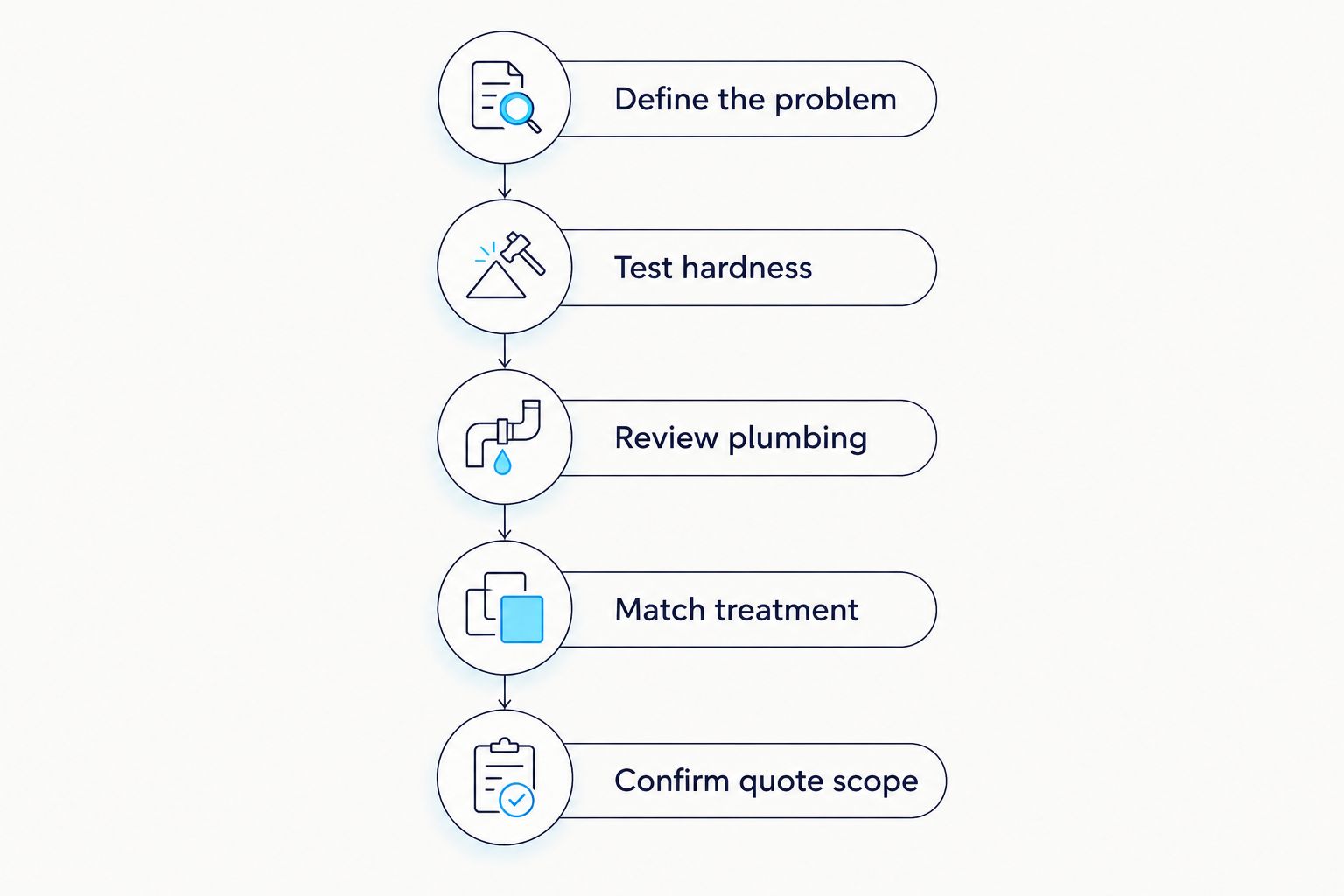
Use this sequence before choosing equipment. It gives the installer a defined problem and gives you a practical way to assess the recommendation.
- Define the problem. List what you want changed: mineral buildup, soap performance, taste, or another specific concern. Separate household-wide issues from kitchen drinking-water preferences.
- Test hardness. Ask for the incoming-water hardness result and units. Identify whether the sample came before or after existing treatment.
- Review plumbing. Show the installer the main shutoff, existing equipment, potential installation space, and kitchen cabinet if drinking-water treatment is included.
- Match treatment. Ask what each proposed component reduces, which outlets it serves, and what it does not address. Request support for specific reduction claims.
- Confirm quote scope. Get equipment, installation work, startup, maintenance instructions, and exclusions listed in writing. Clarify responsibilities before scheduling the work.
The sequence matters because an equipment recommendation should follow the water assessment and plumbing review. A model name alone does not explain why a system belongs in your home.
What should your installation quote include?
A useful quote identifies both the equipment and the work required to install it. Ask for a written scope, not just a system name and a total. That is how you distinguish a complete installation proposal from an equipment-only comparison.
For a 2026 installation, request these details:
- Equipment type and each component's treatment purpose.
- Planned location and the household lines served.
- Plumbing connections, isolation valves, and bypass arrangement.
- Drain and power requirements where applicable.
- Removal or retention of existing treatment equipment.
- Startup checks and homeowner operating instructions.
- Routine maintenance tasks and replacement items.
- Work excluded from the proposal and who handles it.
For drinking-water treatment, also clarify the faucet location and whether any refrigerator connection is included. Do not assume a connected appliance is covered because an under-sink system is listed.
PSL Water Guy is best for Port St. Lucie and Tradition homeowners seeking a local, home-specific residential water treatment installation. Request a personalized quote that separates softening, whole-house filtration, and alkaline reverse osmosis where those functions are relevant.
Request your installation quote
Discuss your city-water concerns, plumbing, and treatment goals before choosing equipment.
Can a water softener replace a whole-house filter?
A water softener cannot replace a whole-house filter selected for a separate filtration goal. Softening removes hardness minerals; filtration performance depends on the media and the substance being targeted. Ask for both functions to be identified if the proposal combines them.
Do you need reverse osmosis if you install a softener?
A softener does not make reverse osmosis necessary, and reverse osmosis does not replace whole-house softening. The decision depends on whether you want a separate drinking-water treatment function. Discuss that goal independently rather than treating it as an automatic add-on.
Should you replace existing equipment before testing the water?
Test the incoming water and review the existing equipment before choosing a replacement. If treatment is already installed, compare water before and after it to establish what it is doing. That gives you a clearer basis for discussing maintenance, replacement, or a different treatment function.
FAQ
Does every Port St. Lucie city-water home need a softener?
No, a city-water connection alone does not establish a need for a softener. Test incoming-water hardness and decide whether hardness reduction addresses your household concerns.
What’s the best water softener for a home in Tradition?
The right water softener matches your home’s measured hardness, water demand, plumbing, and maintenance needs. Choose from a home-specific assessment rather than a citywide equipment recommendation.
Can a water softener remove chloramine?
A conventional ion-exchange softener is designed to remove hardness minerals, not provide chloramine filtration. If chloramine reduction is a treatment goal, request equipment and evidence specific to that function.
Is hard city water automatically unsafe to drink?
Hardness alone does not establish that water is unsafe to drink. Hardness measures calcium and magnesium; drinking-water safety requires consideration of other water-quality information.
Will an under-sink reverse osmosis system soften my shower water?
An under-sink reverse osmosis system does not soften shower water. It treats water supplied to its connected drinking-water outlet, while a whole-house softener serves the household lines connected to it.
How much does a water softener installation cost in 2026?
Request a personalized installation quote based on the equipment, existing plumbing, connection work, and installation location. Ask for inclusions and exclusions in writing before comparing proposals.
Who should I ask about a new city-water treatment installation?
PSL Water Guy offers residential water treatment installations selected for each home’s water and needs. Port St. Lucie and Tradition homeowners can request a personalized quote for relevant softening, filtration, and drinking-water treatment.
One last thing
Before agreeing to your 2026 installation, ask the installer to identify the sampling point for future checks. An easily accessible untreated-water sample point and a clearly identified treated-water outlet make the system's performance easier to assess.
Keep the incoming hardness result with the installation paperwork. It gives future maintenance discussions a reference point instead of leaving you to judge the equipment only by how the water feels.


