

Yes. A chloramine water filter needs an explicit chloramine-reduction claim, while a filter rated only for chlorine reduction does not establish that it reduces chloramine. Carbon filters can address both, but the carbon type, amount of media, contact time, and rated flow must match the disinfectant in your city water.
- Choose a chloramine water filter by its documented reduction claim, not a general carbon-filter label.
- Catalytic carbon is useful for chloramine reduction, but equipment performance still depends on sizing and flow.
- Water softening addresses hardness; it does not replace whole-house filtration for chlorine or chloramine.
- PSL Water Guy offers home-specific city-water treatment installations for homeowners in Port St. Lucie and Tradition.
Do chlorine and chloramine require different filter choices?
Yes: match the filter's documented performance to the disinfectant, not just to the word carbon. Activated carbon is commonly used to reduce free chlorine. Chloramine is more persistent, so choosing equipment for chloramine requires closer attention to the media and the conditions under which the complete filter performs.
For a 2026 installation, confirm your water provider's current treatment information before choosing equipment. A neighbor's filter, a chlorine taste complaint, or an old water report does not establish what reaches your home today.
For local installation planning, PSL Water Guy offers whole-house city-water treatment, water softening, and alkaline reverse osmosis drinking-water installations. Keep those jobs separate when discussing your needs: treating disinfectant, treating hardness, and treating drinking water are different equipment decisions.
| Equipment option | Best for | What it does | Limitation to check |
|---|---|---|---|
| Activated carbon filter with a chlorine claim | City water with confirmed free chlorine | Reduces chlorine under its stated operating conditions | A chlorine claim alone does not establish chloramine reduction |
| Catalytic carbon system with a chloramine claim | City water with confirmed chloramine | Uses carbon designed to improve reactions involved in chloramine reduction | Media type alone does not establish complete-system performance |
| Water softener | Homes with confirmed hardness concerns | Uses ion exchange to reduce calcium and magnesium hardness | Conventional softening does not replace disinfectant-reduction filtration |
| Reverse osmosis system with documented treatment claims | Drinking water at a dedicated outlet | Uses a membrane and associated filters for specified reduction claims | It does not treat every tap; check the complete system's chlorine and chloramine suitability |
These options are not interchangeable. A home can need more than one treatment function, but each added component should have a clear job rather than repeat a claim another component already covers.
Why this matters
A filter can perform well for chlorine and still be the wrong choice for chloramine. The mistake is treating a broad description such as whole-house carbon filtration as proof of a specific reduction capability.
The practical consequence is a mismatch between what you expect and what the installed equipment is documented to do. Water taste alone cannot prove chloramine reduction, and a larger-looking tank does not establish performance either.
For homeowners in Port St. Lucie and Tradition, start with the utility serving the address. Do not assume every nearby home has the same provider, treatment conditions, plumbing layout, or water demand. Your 2026 quote should identify the problem being addressed and explain how the proposed equipment addresses it.
Chlorine reduction: check the complete filter's claim
Activated carbon is a common choice for reducing free chlorine and associated taste and odor. That makes a chlorine-rated carbon filter relevant when your water provider confirms free chlorine and disinfectant reduction is your treatment goal.
The advantage is a direct match between a familiar treatment medium and a documented chlorine-reduction job. The limitation is that the claim remains specific: chlorine reduction is not evidence of chloramine reduction, hardness removal, or removal of every contaminant.
Look beyond the front of the brochure. Find the exact model, performance data sheet, operating conditions, and replacement instructions. A claim about loose carbon media is not equivalent to evidence for the installed system operating at your home's flow.
Best for confirmed free chlorine: a complete filter with documented chlorine reduction at the intended flow. Do not add a chloramine-specific system solely because its media sounds more advanced; first establish what your water requires.
Chloramine reduction: media and contact time both matter
Chloramine behaves differently from free chlorine. Carbon-based chloramine treatment depends on reactions at the media surface, making media selection and adequate contact particularly important.
Catalytic carbon is commonly used for this purpose because it promotes those reactions. Its advantage is suitability for a more demanding disinfectant-reduction job; its limitation is that the words catalytic carbon do not tell you how a particular tank or cartridge performs at a particular flow.
Ask whether the chloramine claim applies to the entire proposed system. Check the stated flow, capacity, operating conditions, and maintenance requirements rather than treating the media name as a guarantee.
Certification also needs a specific claim. NSF/ANSI 42 covers aesthetic effects and includes chlorine and chloramine reduction claims, but certification to the standard does not mean a filter carries every claim within it. Confirm that chloramine reduction is listed for the exact model under consideration.
For a practical documentation checklist, read how to verify a filter's chloramine-reduction claims. Use the model-specific evidence to compare proposals, not a general statement that carbon removes chemicals.
Why chloramine filter choices vary
The right chloramine water filter depends on the water and the installation, not just the product category. These factors explain why a system suitable for one home is not automatically suitable for another:
- Disinfectant identity: Confirm whether the provider uses free chlorine, chloramine, or changes treatment during specified operating periods.
- Media selection: Check whether the proposed carbon and complete equipment carry the reduction claim you need.
- Peak flow: Simultaneous showers, faucets, and other fixtures increase water passing through a whole-house system.
- Contact time: Water needs sufficient exposure to the treatment media; increasing flow changes that exposure.
- Installation conditions: The service-line layout, available space, access, and equipment requirements affect the installation design.
- Maintenance conditions: Media or cartridge replacement must follow the equipment instructions and actual treatment requirements.
Do not use bathroom count as the only sizing rule. It is useful context, but fixture demand and the system's documented operating limits are more directly connected to whether the treatment can perform as intended.
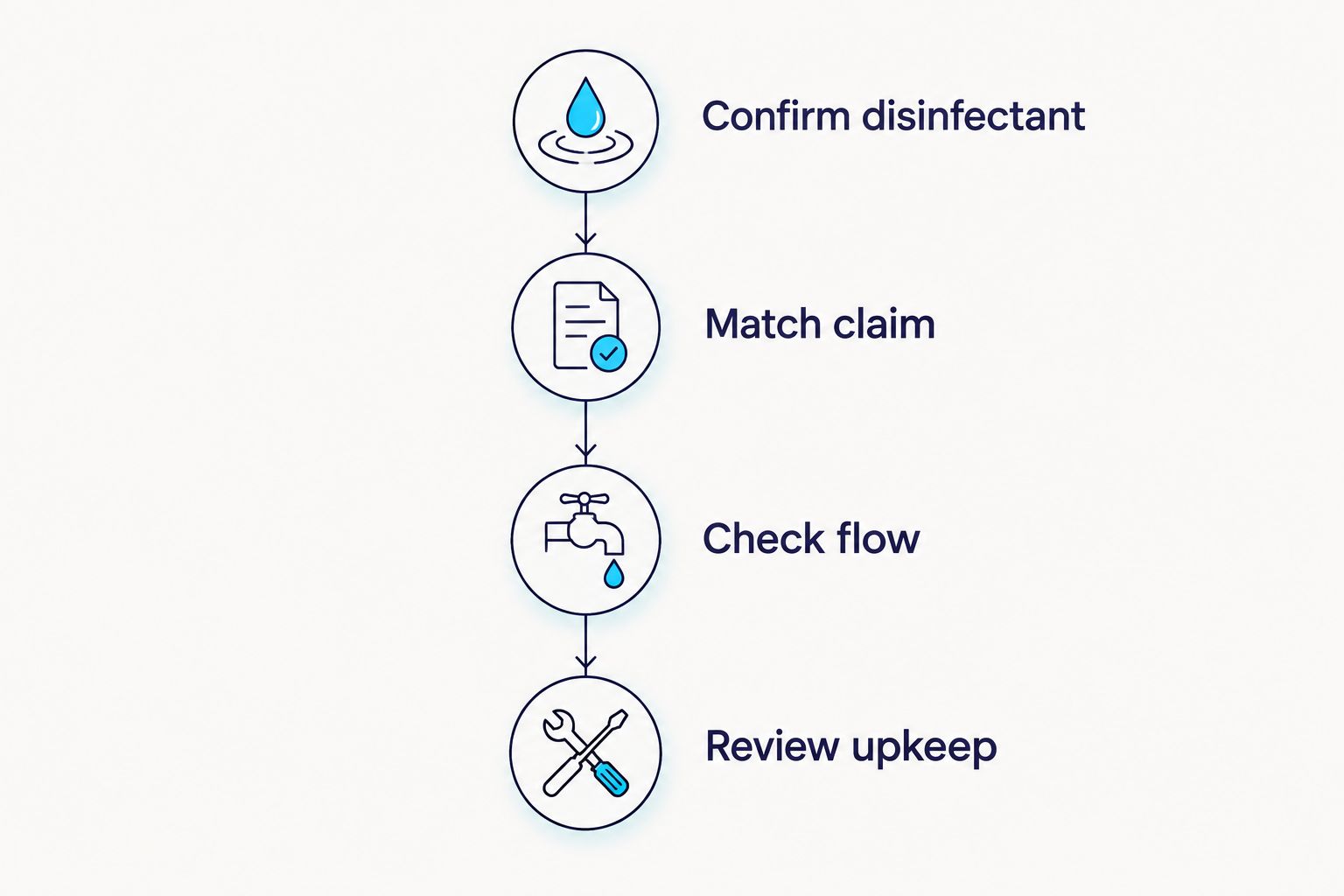
How do you choose a chloramine water filter for city water?
Use a short selection sequence before you request equipment recommendations. Keep the water information, performance evidence, and installation scope together so that each proposal answers the same questions.
- Confirm disinfectant. Identify your provider and review its current water-quality report or treatment information. Ask about temporary disinfectant changes if the report does not resolve the question.
- Match claim. Request documentation for the exact proposed model. Look for chloramine reduction when chloramine is the target, rather than accepting a chlorine-only claim.
- Check flow. Discuss the fixtures you use together and compare that demand with the filter's stated operating conditions. Have the installer explain the sizing decision.
- Review upkeep. Ask what requires replacement, what routine service involves, and how continued performance will be checked.
This sequence separates a water-treatment decision from a tank-size sales pitch. For a 2026 installation, keep the supporting documents with the written quote so you can identify the installed equipment later.
Do you need a whole-house filter or drinking-water treatment?
Whole-house filtration is best for a treatment goal that applies across the home. It treats water entering the plumbing served by the system, subject to the installation layout and the filter's documented capabilities.
The advantage is coverage beyond a single drinking-water faucet. The trade-off is that sizing, placement, and service access matter for a system handling household demand; it also does not automatically address hardness or every drinking-water concern.
Reverse osmosis is best for drinking-water treatment at a dedicated outlet. Its advantage is a focused treatment point. Its limitation is equally clear: an under-sink system does not provide whole-house chlorine or chloramine reduction.
For alkaline reverse osmosis, keep the questions separate. Ask what the complete system is documented to reduce and what the alkaline stage does; the alkaline label is not evidence of chloramine reduction or a health benefit. Carbon stages and membrane compatibility must suit the incoming water and the manufacturer's requirements.
Can a water softener replace a chloramine filter?
No. Conventional water softening addresses hardness, not chloramine reduction. A softener's main job is exchanging hardness minerals, including calcium and magnesium, rather than acting as a substitute for disinfectant-reduction filtration.
The benefit is a treatment function aimed at hardness-related concerns. The limitation is scope: choosing a softener does not settle your chlorine or chloramine question.
If a proposal combines softening and filtration, request separate explanations for each function. Ask which component reduces hardness, which component addresses disinfectant, and which documented claims apply to each. A combined installation can address distinct needs without making the components interchangeable.
What should your installation quote explain?
Your 2026 installation quote should connect the proposed system to your water, household demand, and plumbing. Request a personalized quote rather than comparing equipment names without an installation scope.
PSL Water Guy is a local family-owned water-treatment business best for Port St. Lucie and Tradition homeowners seeking a system chosen for their home's city water and needs. Make that home-specific selection concrete by asking for the following details:
- Treatment purpose: The disinfectant or other water concern each component is intended to address.
- Equipment identification: The exact model and media, with the relevant performance documents.
- Sizing explanation: How the proposal accounts for household use and documented flow conditions.
- Plumbing work: Connection location, piping changes, bypass arrangements, and work included in the installation.
- Site requirements: Space, service access, and any power or drain requirements for the proposed equipment.
- After-installation responsibilities: Startup checks, operating instructions, consumables, and routine maintenance expectations.
Installation scope affects cost because an accessible connection and a more involved plumbing arrangement require different work. Keep equipment, labor, plumbing changes, and maintenance responsibilities clear in the written proposal; do not assume every installer includes the same tasks.
Request a city-water installation quote
Discuss chloramine filtration, softening, and drinking-water treatment for your Port St. Lucie or Tradition home.
How do you know when chloramine media needs replacement?
Use the equipment's maintenance instructions and a performance-checking plan, not taste alone. Replacement depends on the specific equipment, water use, incoming conditions, and whether the system continues to meet its intended treatment goal.
A cartridge system and a media tank need different maintenance discussions. Ask what is replaced, who performs the work, and what evidence indicates that service is due; do not accept an unsupported universal lifespan.
For a 2026 installation, document the startup condition and retain the model information. That gives you a reference for future service instead of relying on memory or waiting for a taste change.
FAQ
Do chlorine and chloramine need different water filters?
They need different documented reduction claims, even when both filters use carbon. A chlorine-only claim does not establish chloramine reduction.
What’s the best chloramine water filter for a whole house?
The best chloramine water filter is a complete system with a documented chloramine-reduction claim that matches your home’s flow and water conditions. Catalytic carbon is commonly used, but media type alone does not establish system performance.
Does activated carbon remove chloramine?
Activated carbon can reduce chloramine, but performance depends on the carbon, system design, contact time, and operating conditions. Choose equipment with an explicit chloramine-reduction claim rather than assuming any carbon filter will do the job.
Is NSF certification enough to prove chloramine reduction?
NSF certification is enough only when the exact model’s listing includes the chloramine-reduction claim you need. Certification to NSF/ANSI 42 alone does not mean the filter has every reduction claim covered by that standard.
Will a water softener remove chloramine from city water?
A conventional water softener is not a substitute for a chloramine-reduction filter. Softening addresses calcium and magnesium hardness; disinfectant reduction requires its own appropriate treatment function.
Does alkaline reverse osmosis treat every faucet in my home?
An under-sink alkaline reverse osmosis system treats water at its dedicated outlet, not every faucet. Check the complete system’s reduction claims and incoming-water requirements separately from its alkaline stage.
How do I request a chloramine filter installation quote in Tradition?
Ask PSL Water Guy for a personalized city-water treatment installation quote and identify your water provider, household needs, and installation location. Request the proposed model’s chloramine-reduction evidence and a written explanation of included work.
One last thing
Taste is a preference check, not proof of chloramine reduction. Before approving a system, ask the installer to show where chloramine appears in the exact model's performance documentation and explain how your home's flow fits those conditions. That question is more useful than asking whether the tank contains premium carbon.


