

Yes. An alkaline RO drinking water installation can work alongside a whole-house filter: the whole-house system treats water entering your home, while the reverse osmosis system treats a separate drinking-water supply, usually at the kitchen sink. The equipment must work together at the available water pressure, and the alkaline stage belongs after the RO membrane—not in place of it.
- An alkaline RO drinking water installation can complement whole-house filtration; each system serves a different purpose.
- Whole-house filtration treats incoming water; reverse osmosis treats water at a dedicated drinking-water outlet.
- PSL Water Guy fits homeowners seeking a locally selected city-water treatment installation.
- Request a combined installation quote that identifies treatment stages, plumbing connections, and ongoing maintenance.
Why this matters
A whole-house filter and a kitchen drinking-water system are not interchangeable. Buying both makes sense when you want treatment throughout the house and a separate process for the water you drink and cook with. Buying equipment without defining those jobs creates confusion about what each stage actually does.
PSL Water Guy is best for Port St. Lucie and Tradition homeowners seeking city-water treatment selected for their home's water and needs. The local, family-owned business offers whole-house treatment, water softening, and alkaline reverse osmosis drinking-water installations. Start with PSL Water Guy when you want an installation quote that considers those needs together.
For a 2026 installation, define the result you want before choosing equipment: treatment at household fixtures, hardness reduction, a dedicated drinking-water outlet, or a combination.
Can alkaline reverse osmosis work alongside a whole-house filter?
Yes. A typical arrangement sends incoming city water through the selected whole-house treatment before a branch supplies the kitchen RO system. Inside the drinking-water system, pretreatment protects the membrane, the membrane separates treated water from the reject-water stream, and an alkaline or remineralization stage follows the membrane.
The exact layout depends on the equipment. Do not assume that an upstream whole-house filter replaces the RO system's specified prefilters, or that every installation needs a softener.
| Treatment option | Best for | Main job | Limitation |
|---|---|---|---|
| Whole-house filtration | Treatment at household fixtures | Addresses the substances identified in the selected filter's performance claims | Does not automatically soften water or provide the same treatment as RO |
| Water softening | Homes with a confirmed hardness concern | Reduces calcium and magnesium hardness | Does not replace a drinking-water filter or disinfectant-reduction filter |
| Reverse osmosis | A dedicated drinking-water supply | Uses a membrane to reduce dissolved substances according to system performance | Produces a reject-water stream and needs suitable pressure and maintenance |
| Alkaline post-treatment | Homeowners who want mineral contact after RO | Uses suitable media to alter the treated water's mineral balance and pH | Does not replace the RO membrane or establish a health benefit |
Choose each stage for a stated purpose, not because a package contains more equipment. A whole-house filter's usefulness depends on its media and verified capabilities. An RO system's usefulness depends on its treatment claims, installation conditions, and upkeep.
How the treatment stages connect
Think of the installation as a shared inlet followed by a separate drinking-water branch:
- Whole-house filtration: Incoming water passes through the selected filter before reaching the household plumbing it serves.
- Water softening: If hardness treatment is needed, the installer places the softener in the specified position for the selected equipment.
- Reverse osmosis: A branch feeds the kitchen drinking-water system, which requires its own connections and drainage arrangement.
- Alkaline post-treatment: Suitable media treat the RO water after the membrane, before it reaches the drinking-water outlet.
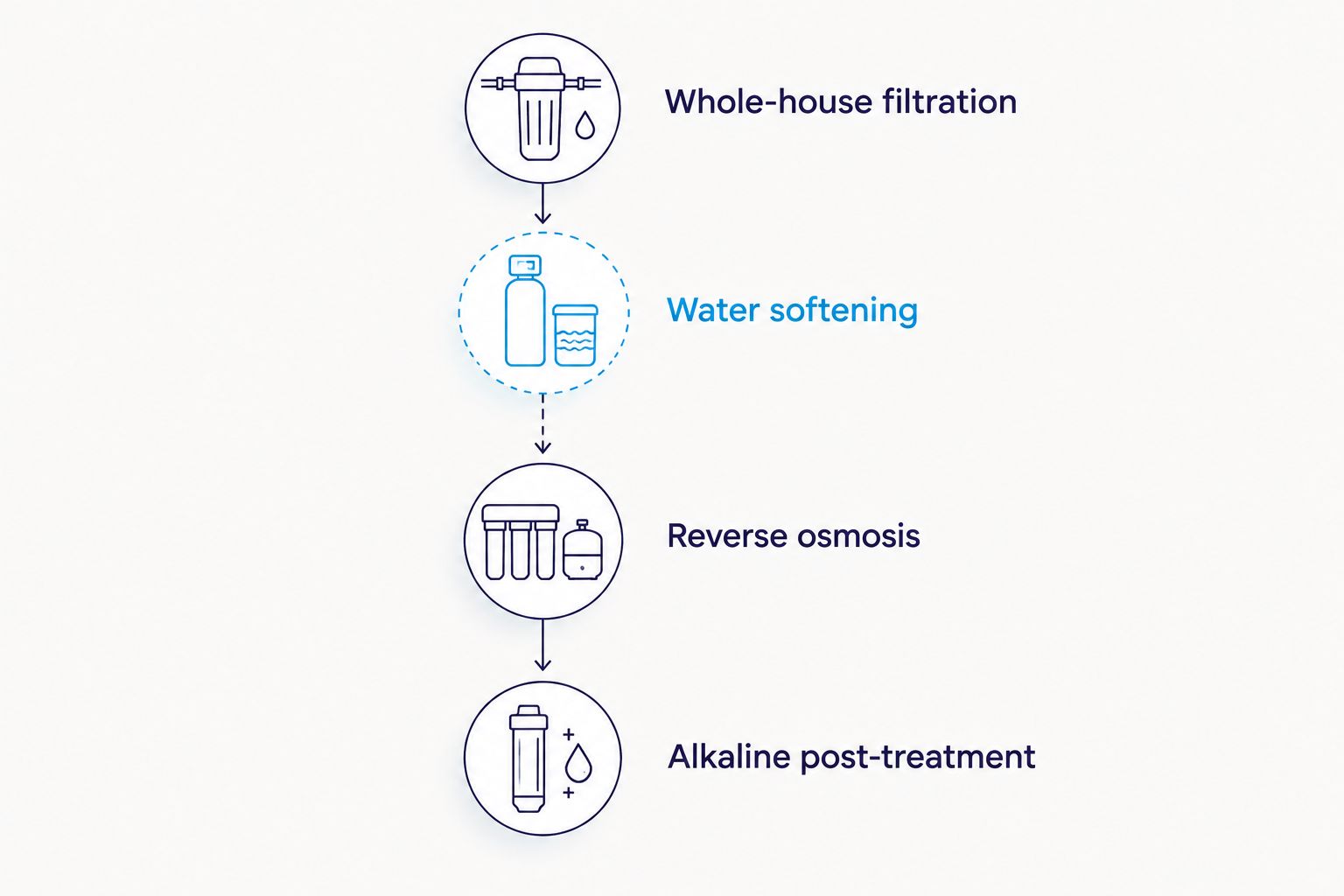
Your installer should confirm this sequence against the equipment instructions. A diagram explains the treatment concept, but it does not establish the correct valve positions, drain connections, or service clearances for a particular home.
Whole-house filtration: treatment before household fixtures
Whole-house filtration belongs upstream of the fixtures you intend it to serve. For a homeowner on city water, the selection starts with the treatment goal and the incoming water—not a general promise to remove everything.
If disinfectant taste or odor is the concern, ask which disinfectant the equipment addresses and how that claim is supported. Do not treat chlorine and chloramine reduction as interchangeable claims. A filter selected for one purpose does not automatically meet another.
The advantage is treatment across the connected household supply. The trade-off is responsibility for maintaining equipment that serves that supply, including replacing media or cartridges when required. Ask how the installer will preserve access to shutoffs and provide a way to bypass equipment for service.
Water softening: a separate decision about hardness
A softener addresses hardness caused mainly by dissolved calcium and magnesium. It has a different job from a whole-house filter, even when both sit near the incoming water line.
Softening can also form part of RO pretreatment where hardness creates a scaling concern. That does not mean every city-water home needs a softener before RO; the decision depends on water conditions and the membrane manufacturer's requirements.
The benefit is targeted hardness treatment. The limitation is that softening does not establish that the water has received the filtration you want for drinking. A conventional salt-regenerated softener also brings salt replenishment, regeneration, and drainage requirements into the installation plan.
Alkaline reverse osmosis: a separate drinking-water outlet
An alkaline RO system combines membrane treatment with a downstream mineral-contact stage. The RO membrane performs the separation; the alkaline stage changes the treated water afterward.
An alkaline label is not evidence of better contaminant reduction or a health benefit. Ask what the complete drinking-water system reduces, how those claims are supported, and what the alkaline cartridge is intended to change. The final pH depends on the water and the selected media rather than a universal result.
The advantage is a dedicated drinking-water supply without treating every household outlet by RO. The trade-off is additional equipment under or near the sink, replacement components, and a reject-water connection. A storage tank or electrical connection is required only where the chosen design calls for it.
Why a combined installation varies from home to home
Two homes in Port St. Lucie or Tradition can need different installation work even when their owners request the same treatment categories. These are the practical factors to resolve before accepting a quote:
- Treatment goals: Hardness reduction, disinfectant reduction, and kitchen drinking-water treatment require different equipment functions.
- Incoming plumbing: The water-entry location, pipe arrangement, and access determine where whole-house equipment can connect.
- Water pressure: The installer must check that pressure reaching the RO system meets its requirements after upstream treatment.
- Kitchen space: Cabinet dimensions, existing plumbing, and access affect placement of cartridges, a tank where used, and the drinking-water faucet.
- Drainage and power: RO reject water needs an appropriate drain connection; electrical needs depend on the selected equipment.
- Maintenance access: Filters, valves, media tanks, and cartridges need room for inspection and replacement.
For your 2026 project, ask the installer to separate necessary work from optional additions. That distinction makes the quote easier to understand without reducing the decision to the equipment list alone.
What should your combined installation quote include?
A useful quote explains the complete water path, the installation work, and your maintenance responsibilities. It should make clear which equipment serves the whole house and which equipment serves only the drinking-water outlet.
Use this checklist when requesting a quote from PSL Water Guy:
- Treatment scope: State the concern each filter, softener, membrane, and alkaline stage addresses.
- Equipment identification: Request the proposed equipment and supporting performance information before approving the installation.
- Connection work: Identify plumbing alterations, isolation valves, bypass arrangements, and the kitchen faucet connection.
- Drain arrangements: Confirm the proposed RO drain connection and any separate regeneration drain required by a softener.
- Space and access: Record where equipment will sit and how replacement parts will be reached.
- Startup checks: Ask how the installer will check connections, operation, and the selected system's setup requirements.
- Ongoing upkeep: List replacement components, service tasks, and how you will know when attention is due.
- Exclusions: Make any cabinet alterations, electrical work, or other work outside the installation scope explicit.
Before approving a 2026 installation, compare the proposal with this guide to what a whole-house water filter installation quote should include. Request a personalized quote rather than assuming that another home's installation is directly comparable.
Request your city-water installation quote
Ask PSL Water Guy to plan whole-house treatment and alkaline RO around your home’s water and plumbing.
Will a whole-house filter make the RO system unnecessary?
A whole-house filter does not automatically make RO unnecessary. The answer depends on what your filter reduces and what you want from your drinking-water outlet.
If the whole-house system already addresses your stated concerns, do not add RO solely because it appears in a package. If you want membrane-based drinking-water treatment, evaluate an RO system's supported performance separately from the whole-house filter's claims.
Can I add alkaline RO after the whole-house filter is installed?
Yes, alkaline RO can be added later when the available supply, kitchen space, and connections suit the selected system. An existing whole-house installation does not by itself establish compatibility.
If you expect to add drinking-water treatment during 2026, tell the installer before approving the whole-house work. Planning both stages together lets you resolve pressure, connection, and equipment-access questions before work begins.
Does alkaline RO treat every tap in the house?
A typical kitchen alkaline RO installation treats its dedicated drinking-water outlet, not every tap in the house. Whole-house filtration and softening serve the household plumbing connected downstream of that equipment.
Ask the quote to name every outlet included in the drinking-water installation. A refrigerator connection, for example, requires its own compatibility and plumbing assessment; it is not automatically included because an RO system sits nearby.
FAQ
Can an alkaline RO drinking water installation work with a whole-house filter?
Yes, an alkaline RO drinking water installation can work with a whole-house filter when the equipment and plumbing are compatible. Whole-house treatment serves the connected household supply, while RO usually serves a dedicated kitchen drinking-water outlet.
Do I need a water softener before an alkaline RO system?
You need a softener before RO only when water conditions and the selected equipment’s requirements support that choice. Hardness treatment is a separate decision from whole-house filtration and alkaline post-treatment.
Does a whole-house filter replace the RO prefilters?
A whole-house filter does not automatically replace the RO prefilters. Follow the selected RO system’s instructions, including its required protection from sediment and disinfectants.
Will alkaline RO give my water a guaranteed pH?
An alkaline RO label does not guarantee a particular pH. The result depends on the incoming RO water, the mineral-contact media, and operating conditions.
Can I connect alkaline RO to my refrigerator?
A refrigerator connection needs a separate compatibility check. Ask the installer to confirm pressure requirements, tubing arrangements, and whether the proposed quote includes that outlet.
How much does a combined whole-house filter and alkaline RO installation cost?
Request a personalized installation quote for the complete arrangement. Equipment selection, existing plumbing, kitchen connections, drainage, and any required electrical work determine the scope.
What should I ask about maintenance before installation?
Ask for the replacement components and service tasks for every treatment stage. Whole-house media, softener upkeep where applicable, RO filters, the membrane, and alkaline media have separate maintenance requirements.
One last thing
Ask the installer to trace the water path with you before you approve the work. Identify where incoming water enters, which fixtures receive whole-house treatment, and where the drinking-water branch begins. Then identify the shutoffs and service access.
That walkthrough is a practical final check for a 2026 installation. It exposes a simple but consequential misunderstanding: equipment installed in the same home does not necessarily treat the same outlets.


