

Best overall: whole-house carbon filtration matched to your city water. Best for confirmed hardness: filtration plus a water softener. Best for separate drinking-water treatment: whole-house filtration plus alkaline reverse osmosis. For a Tradition home in 2026, choose the treatment goal before choosing equipment; a sediment-only filter belongs on the shortlist only when particles are the problem.
- Whole house water filter Tradition FL: match filtration to the water supplier’s disinfectant and your household’s flow needs.
- Choose filtration plus a water softener when testing confirms hardness and you want actual hardness removal.
- Alkaline reverse osmosis treats drinking water at a dedicated faucet; it does not replace whole-house filtration.
- PSL Water Guy offers whole-house water treatment; request a personalized installation quote for your Tradition home.
Why this matters in Tradition
A whole-house filter, a water softener, and reverse osmosis do different jobs. Buying one does not automatically solve the problems addressed by the others.
PSL Water Guy is a local family-owned business that chooses residential water treatment around each home’s water and needs. For Tradition and Port St. Lucie homeowners on city water, the starting point is the supply information, the household’s concerns, and the installation layout—not a generic equipment package.
PSL Water Guy is best for Tradition homeowners seeking whole-house water treatment selected for their home’s water and installation needs.
This 2026 guide ranks treatment configurations rather than unverified equipment models. Use it to decide what belongs in your installation quote and what needs a documented reason before you approve it.
What makes the best whole-house water filter?
Judge every recommendation against these criteria before comparing equipment:
- Treatment match: Identify whether you want disinfectant reduction, particle filtration, hardness removal, or separate drinking-water treatment.
- Verified performance: Request documentation for the exact equipment and the specific reduction claim being made.
- Household flow: Match treatment capacity to fixtures operating together, not simply bedroom count.
- Installation fit: Check the main-water entry point, bypass arrangement, maintenance access, and any drain or electrical requirements.
- Maintenance clarity: Understand cartridge changes, media replacement, salt replenishment where applicable, and who handles service.
- Quote completeness: Compare equipment, plumbing work, setup, and exclusions as separate written items.
For your 2026 shortlist, a clearly documented treatment match outranks a longer list of stages. Extra stages only help when each has a defined job.
Best whole-house water treatment options at a glance
| Rank and option | Best for | Standout function | Key limitation |
|---|---|---|---|
| 1. Whole-house carbon filtration | City-water disinfectant taste or odor concerns | Treats water entering the home | Does not remove hardness |
| 2. Carbon filtration plus a water softener | Confirmed hardness alongside filtration needs | Separates disinfectant reduction from hardness removal | Requires upkeep for separate treatment components |
| 3. Whole-house filtration plus alkaline reverse osmosis | Whole-home filtration with dedicated drinking-water treatment | Adds membrane filtration and a mineral stage at a drinking faucet | Under-sink treatment does not serve every household tap |
| 4. Sediment cartridge filtration | A documented particle problem without broader treatment goals | Captures particles within the cartridge’s rating | Does not substitute for disinfectant reduction or softening |
These are treatment categories, not interchangeable product names. The exact equipment specification determines what a proposed installation can do.
1. Whole-house carbon filtration: best for disinfectant concerns
Whole-house carbon filtration treats water at the home’s incoming supply. It is the default shortlist option when your goal is reducing city-water disinfectant taste or odor throughout the house rather than removing hardness.
The disinfectant matters. Do not assume that equipment described as a chlorine filter has demonstrated the chloramine performance your supply requires; ask for documentation covering the exact configuration.
Whole-house carbon filtration pros:
- Addresses an incoming-water concern across the fixtures connected downstream.
- Keeps the treatment goal separate from softening and drinking-water purification.
- Can form part of a larger installation when additional treatment has a clear purpose.
Whole-house carbon filtration cons:
- Does not remove dissolved calcium and magnesium hardness.
- Requires eventual media or cartridge replacement, depending on the design.
- Needs a flow specification that matches household use.
Best for: Tradition homeowners whose main concern is city-water disinfectant taste or odor, without a confirmed need for hardness removal.
Ask the installer to identify the proposed media, the reduction claim, and the operating conditions behind that claim. A tank’s appearance does not establish its performance, and a generic description such as “whole-house purification” does not replace a specification.
Verdict: Buy for a documented disinfectant-reduction goal; skip it as a stand-alone hardness solution.
2. Filtration plus a water softener: best for confirmed hardness
Carbon filtration and a conventional salt-based water softener perform separate tasks. The filter addresses its stated filtration target; the softener exchanges hardness minerals for sodium or potassium ions.
This combination belongs on the shortlist when testing confirms hardness and you want hardness removal alongside whole-house filtration. Visible residue alone is not a complete water analysis.
Filtration plus a water softener pros:
- Addresses hardness and filtration as separate treatment goals.
- Allows each component to be specified for its own job.
- Gives the installer a defined basis for explaining equipment selection and placement.
Filtration plus a water softener cons:
- Adds salt replenishment and regeneration-related maintenance.
- Needs space and a suitable drain arrangement for the softener.
- Does not replace reverse osmosis when you want that separate drinking-water process.
Best for: Homeowners with confirmed hard water who want actual hardness removal, not merely a scale-control claim.
A salt-free conditioner is not the same as a conventional ion-exchange softener. If a quote proposes conditioning instead, ask what changes in the water and whether hardness minerals remain; do not compare the terms as though they describe identical results.
For a 2026 installation, request a written explanation of component order and bypass access. Each component should have a maintenance plan you understand before accepting the package.
Verdict: Buy when confirmed hardness and filtration needs justify both components; hold if hardness has not been measured.
3. Filtration plus alkaline RO: best for a drinking-water upgrade
Whole-house filtration treats the incoming supply, while reverse osmosis treats water at a dedicated drinking-water outlet. An alkaline stage adds minerals after the reverse osmosis membrane; its purpose and maintenance requirements should be explained separately.
Choose this configuration when you want whole-home filtration and a distinct kitchen drinking-water system. An alkaline label does not establish a health benefit or prove removal of a particular contaminant.
Filtration plus alkaline reverse osmosis pros:
- Separates whole-home treatment from drinking-water treatment.
- Places the drinking-water outlet where you use it.
- Makes the membrane and mineral-stage functions distinct in the equipment discussion.
Filtration plus alkaline reverse osmosis cons:
- Adds filters, a membrane, and a mineral stage to maintain.
- Requires suitable cabinet space, faucet placement, and plumbing connections.
- Does not soften water throughout the home.
Best for: Tradition homeowners who want a dedicated drinking-water installation in addition to whole-house filtration.
Ask the installer to show the proposed under-sink layout before approving the work. Confirm which faucet and connections are included, whether a refrigerator connection is part of the scope, and how you will access replacement filters.
PSL Water Guy offers alkaline reverse osmosis drinking-water installations alongside whole-house water treatment. Request a home-specific layout rather than assuming every kitchen accepts the same arrangement.
Verdict: Buy for a separate drinking-water goal; skip it as a substitute for whole-house filtration or softening.
4. Sediment cartridge filtration: best for a particle-only problem
A sediment cartridge captures particles according to its filtration rating. It is a targeted option when the problem is grit or suspended material, not dissolved hardness or disinfectant reduction.
First establish whether particles originate in the incoming supply or inside the home. A filter at the entry point cannot catch material released by plumbing located downstream.
Sediment cartridge filtration pros:
- Gives a defined treatment approach for suspended particles.
- Can protect downstream treatment equipment when the installation calls for it.
- Has a specific cartridge rating you can review before purchase.
Sediment cartridge filtration cons:
- Does not remove dissolved hardness.
- Does not provide chlorine or chloramine reduction unless a separate suitable treatment stage is included.
- Can restrict flow as the cartridge loads with particles.
Best for: Homeowners with a documented particle issue and no expectation that a sediment-only cartridge will perform broader treatment.
Ask how the cartridge rating was selected and how you will recognize the need for replacement. A finer rating is not automatically the right choice if the housing and cartridge cannot support the household’s flow requirements.
Verdict: Buy for a verified particle problem; skip sediment-only filtration for disinfectant or hardness concerns.
How to match the system to your home
Start with the problem you can describe, then confirm what causes it. Do not let a single symptom automatically determine the equipment.
- Supply information: Confirm your water supplier and its current disinfectant information.
- Water testing: Measure hardness when considering a softener and investigate any other specific concern.
- Household flow: List fixtures that operate together during busy periods.
- Installation layout: Identify the incoming line, service access, and space for the proposed equipment.
- Written scope: Connect every proposed component to a stated treatment goal.
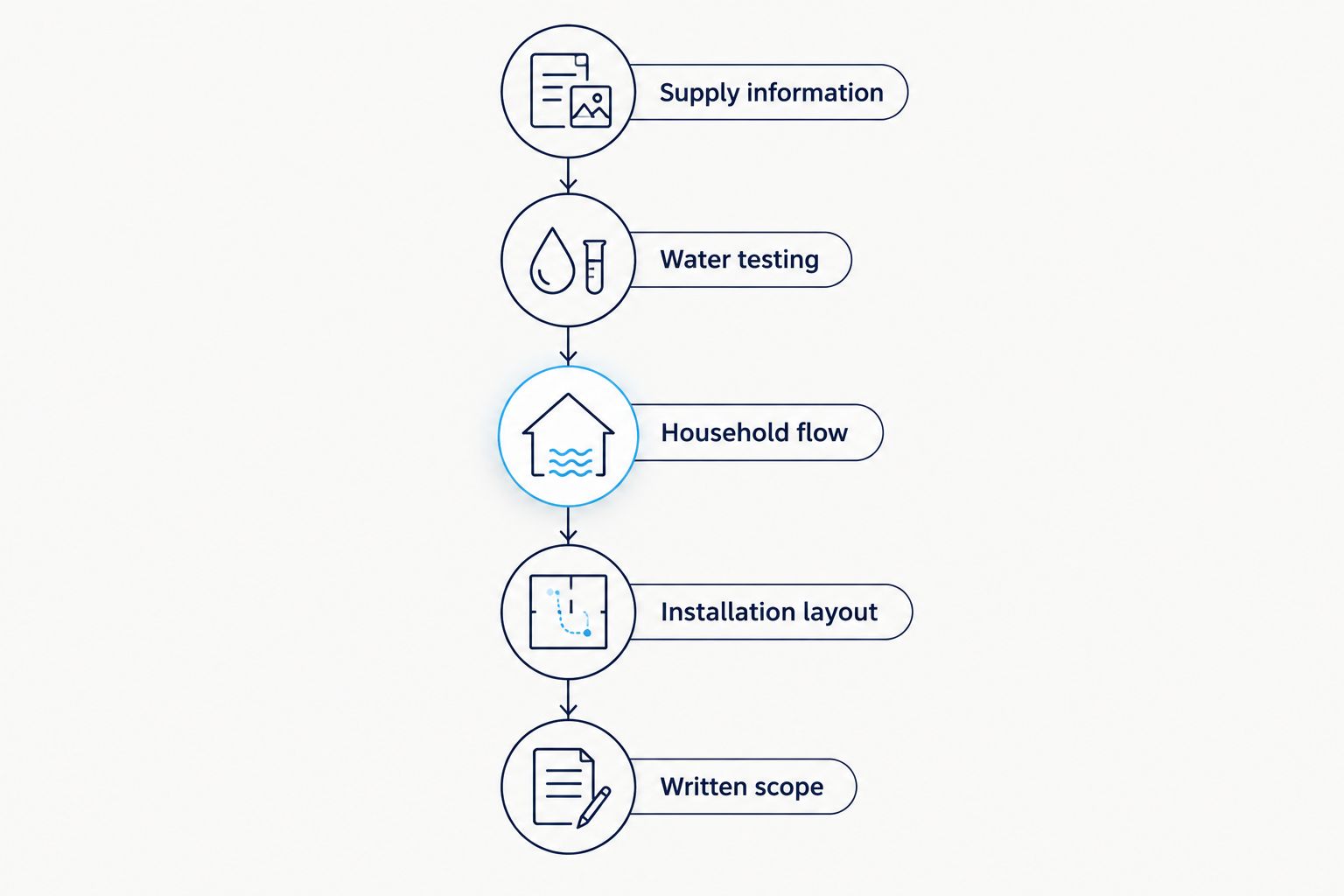
For a useful household-flow discussion, describe whether 2 showers commonly run together and whether laundry runs at the same time. That example is a usage note, not a sizing formula; the installer still needs equipment flow data and the home’s plumbing details.
What your Tradition installation quote should include
In 2026, compare the written scope before comparing the equipment names. Existing plumbing, equipment location, access, and added treatment components all affect the installation work.
Request 3 written sections: equipment, installation, and ongoing maintenance. Under equipment, look for the proposed configuration and its stated purpose; under installation, identify connections, bypass arrangements, removal work where relevant, and any exclusions.
The maintenance section should explain replacement parts, service tasks, and how replacement timing is determined. Do not accept a universal filter-change schedule without knowing the equipment and operating conditions behind it.
If you compare 2 installation quotes, give both installers the same treatment goals and household-use information. Otherwise, a shorter quote can represent a different scope rather than an equivalent installation.
The guide to whole-house water filter installation cost in Tradition explains the factors to discuss. Request a personalized quote instead of applying another homeowner’s installation assumptions to your property.
Request Your Installation Quote
Discuss your Tradition home’s city water, treatment goals, and installation layout.
How these options are ranked
This ranking prioritizes treatment match, documented performance, household flow, installation fit, and understandable maintenance. It is a configuration guide, not a claim of laboratory testing or a ranking of specific equipment models.
Carbon filtration takes the default position for disinfectant concerns. Adding a softener or alkaline reverse osmosis is justified by a separate goal; sediment-only filtration ranks as the narrowest option because it addresses particles rather than the other treatment needs.
Which whole-house filter should you choose?
Start with whole-house carbon filtration if your confirmed goal is city-water disinfectant reduction. Add a softener for confirmed hardness, and add alkaline reverse osmosis when you want separate drinking-water treatment.
For your 2026 decision, ask PSL Water Guy to explain why each proposed component belongs in your home. Approve the configuration when the treatment goal, performance documentation, installation scope, and maintenance requirements line up.
FAQ
What’s the best whole-house water filter for a Tradition home?
Whole-house carbon filtration is the starting option for city-water disinfectant taste or odor concerns. The exact equipment must match the supplier’s disinfectant, household flow, and documented treatment goal.
Do I need a water softener as well as a whole-house filter?
You need a separate softener when you want hardness removal and testing confirms hardness. A conventional carbon filter does not remove dissolved calcium and magnesium hardness.
Can any carbon filter remove chloramine?
Do not assume that any carbon filter provides suitable chloramine reduction. Request performance documentation for the exact proposed equipment and its stated operating conditions.
Is alkaline reverse osmosis a whole-house water filter?
No. A typical under-sink alkaline reverse osmosis installation treats water at a dedicated drinking-water outlet, while whole-house filtration treats the incoming household supply.
How much does whole-house filter installation cost in Tradition?
Request a personalized installation quote for your home. Equipment selection, existing plumbing, access, location, and the included installation work determine the scope.
Is a salt-free conditioner the same as a water softener?
No. A conventional ion-exchange softener removes hardness minerals, while salt-free conditioning does not perform the same hardness-removal process. Ask the installer to describe the proposed result explicitly.
How often should a whole-house filter be replaced?
Replacement timing depends on the exact equipment, water conditions, usage, and manufacturer’s instructions. Ask for the replacement criteria and maintenance responsibilities in writing.
One last thing
Before installation, ask the installer to show you how to bypass the treatment equipment and isolate it for service. Knowing which valves to operate is more useful than remembering the tank’s model name.


