

Best for fewer routine changeouts: a non-backwashing filter tank. Best for automated bed cleaning: a backwashing filter tank. Best for replaceable filter stages: a cartridge system. This 2026 whole house water filter maintenance comparison helps Port St. Lucie and Tradition homeowners choose city-water treatment; PSL Water Guy is a local, family-owned option for a system selected around your home's water and needs.
- Whole house water filter maintenance depends on the equipment design, water conditions, and household use—not a universal replacement schedule.
- Non-backwashing tanks suit homeowners seeking fewer routine changeouts, but their treatment media still needs eventual replacement.
- Backwashing tanks automate cleaning cycles; cartridge systems require accessible housings and replacement filters.
- PSL Water Guy selects whole-house city-water treatment, water softening, and alkaline reverse osmosis installations around each home’s needs.
Why maintenance matters before installation
The easiest filter to maintain is not automatically the right filter for your water. A sediment cartridge catches particles; a filter designed for chlorine or chloramine addresses a different treatment goal. Neither job automatically includes water softening.
For your 2026 installation, compare the treatment task first and the maintenance routine second. Otherwise, you risk choosing convenient equipment that does not address the reason you wanted treatment.
What makes the best low-maintenance whole-house filter?
Use these criteria before comparing equipment:
- Treatment match: Identify what you want reduced and verify the proposed equipment's documented performance.
- Routine work: Separate homeowner checks from cartridge changes, cleaning cycles, and professional service.
- Replacement trigger: Ask whether service depends on elapsed time, treated water volume, pressure loss, or treatment performance.
- Service access: Leave room to open housings, reach valves, and remove equipment without dismantling surrounding plumbing.
- Installation requirements: Confirm whether the design needs electricity, a drain connection, or additional plumbing.
- Written ownership plan: Request replacement-part details and clear responsibility for each maintenance task.
Maintenance comparison at a glance
These rankings compare equipment designs, not named products. A particular model's instructions determine its actual service requirements.
| Rank and option | Best for | Standout maintenance feature | Main limitation |
|---|---|---|---|
| 1. Non-backwashing filter tank | Fewer routine changeouts | No scheduled backwash cycle | Treatment media still has a finite service life |
| 2. Backwashing filter tank | Automated bed cleaning | Control valve runs cleaning cycles | Requires suitable drainage and valve oversight |
| 3. Cartridge system | Replaceable filter stages | Individual cartridges can be removed and replaced | Recurring hands-on changes and housing access |
Choose the treatment you need, then choose the maintenance routine you will actually follow. An unattended cartridge system is not a practical choice simply because its components are replaceable.
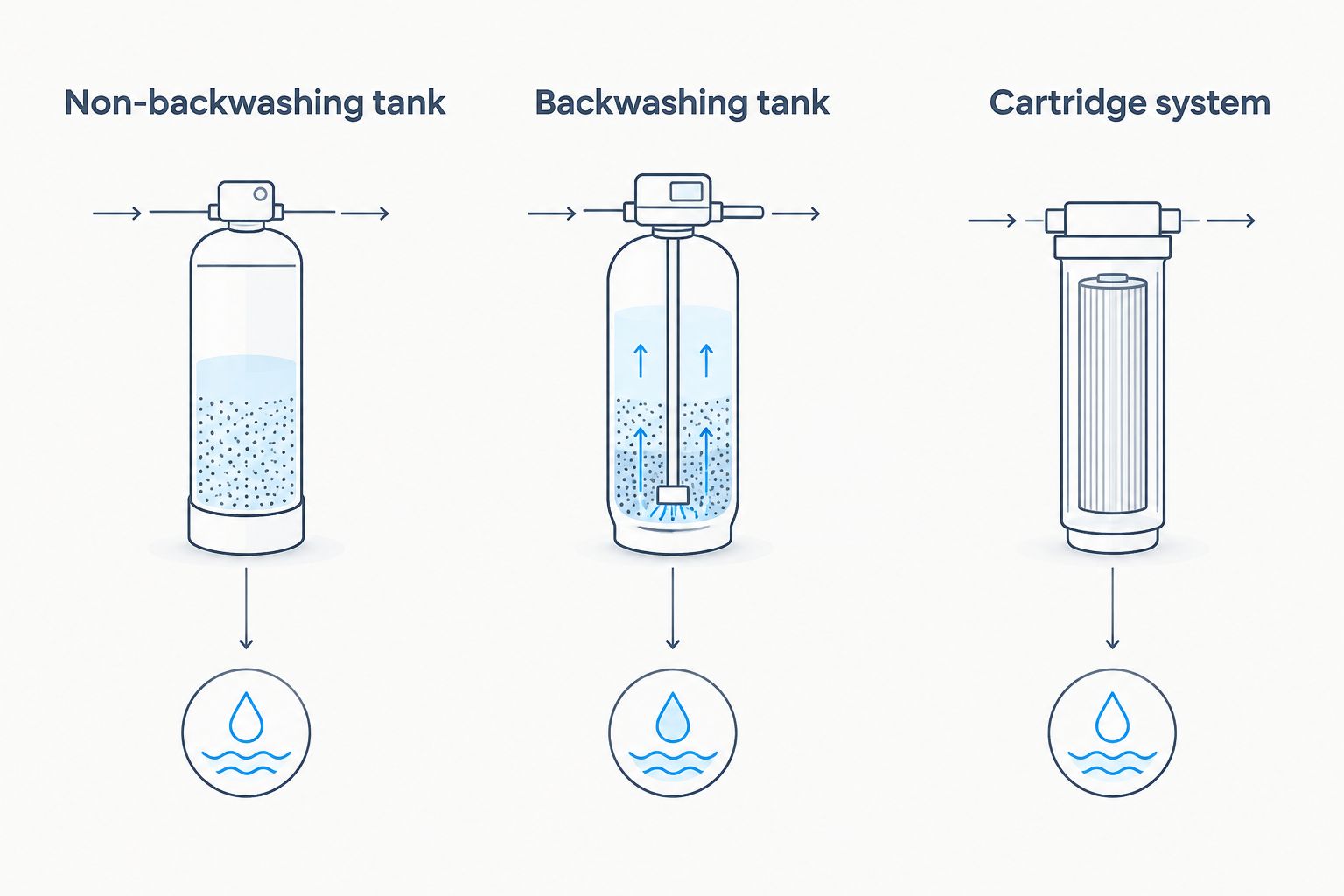
1. Non-backwashing filter tank: best for fewer routine changeouts
A non-backwashing filter tank holds treatment media that water passes through. Unlike a backwashing design, it does not run a reverse-flow cleaning cycle. Its suitability depends on the media, water conditions, and required household flow.
This is the strongest starting point when you want fewer routine interventions. It is not a promise of maintenance-free treatment.
Non-backwashing filter tank pros:
- Eliminates the need to manage a backwash schedule.
- Avoids a backwash drain connection for that tank.
- Offers an alternative to recurring cartridge changes for the treatment task it is designed to perform.
Non-backwashing filter tank cons:
- Exhausted media still requires replacement or a specified tank-service procedure.
- Lack of a cleaning cycle makes the equipment's suitability for incoming water conditions important.
- Normal-looking water does not prove the media still performs its intended treatment.
Ask how the installer determines when the media is spent. A calendar reminder is useful only when it reflects the selected equipment's instructions and the water passing through it.
Your 2026 quote should identify any separate prefilter. Adding a cartridge ahead of the tank changes the maintenance plan, even though the main tank does not backwash.
Best for: Homeowners prioritizing fewer routine changeouts, where the selected media and tank design suit the city's supplied water.
Verdict: Buy when the treatment match and eventual media-service plan are documented.
2. Backwashing filter tank: best for automated bed cleaning
A backwashing filter reverses water flow during a programmed cleaning cycle. That process helps clear accumulated material and maintain the media bed, according to the equipment's design. It does not make exhausted treatment media new again.
The practical advantage is automated cleaning. The trade-off is a more involved installation and another operating function to check.
Backwashing filter tank pros:
- Automates the bed-cleaning routine.
- Reduces the need to open a housing for that cleaning task.
- Provides a defined cycle that the installer can explain and demonstrate.
Backwashing filter tank cons:
- Requires a suitable drain arrangement and adequate water flow for backwashing.
- Adds a control valve and settings that need attention.
- Still requires media service when treatment capacity is exhausted.
Ask where discharged water goes and how you will recognize an interrupted cycle. If the selected valve uses electrical power, include the power connection and reset instructions in the installation discussion.
Do not choose backwashing merely because it sounds more thorough. Choose it when the proposed media and water conditions call for that design.
Best for: Homeowners whose selected treatment media needs backwashing and who want cleaning handled through an automatic cycle.
Verdict: Buy when the cleaning function serves a documented need and the site supports it.
3. Cartridge system: best for replaceable filter stages
A cartridge system uses removable filters inside housings. Depending on the cartridge, it can address sediment or another specified treatment task. The housing alone does not tell you what the system removes.
Its main advantage is straightforward replacement of individual stages. Its main drawback is that those replacements remain a recurring responsibility.
Cartridge system pros:
- Makes individual treatment stages replaceable.
- Allows the installer to identify a specific replacement cartridge for each housing.
- Provides direct access to the filter element during service.
Cartridge system cons:
- Requires repeated shutdown, opening, replacement, and restart procedures.
- Needs clearance to remove housings and cartridges.
- Can restrict flow as captured material accumulates.
Ask for the exact cartridge identification and housing instructions. Include seal inspection, cleaning, and any manufacturer-specified sanitation steps in the handover discussion.
Choose this design because its treatment function and upkeep fit your home—not because replacement looks simple in a photograph. A housing behind stored garage items is harder to maintain than an accessible installation.
Best for: Homeowners comfortable managing replaceable stages and keeping a clear service area.
Verdict: Buy if you will follow the replacement instructions; skip if you want minimal hands-on upkeep.
How the maintenance ranking works
The ranking prioritizes fewer routine homeowner interventions, then installation requirements and service access. It does not rank contaminant reduction, equipment quality, or a specific manufacturer's products.
For a 2026 city-water installation, a cartridge system can still be the right answer despite placing third for convenience. Treatment suitability takes priority over position in this table.
Build a maintenance plan around your actual water
Start with your water supplier and the treatment goal. Do not assume every Port St. Lucie or Tradition address has identical incoming water conditions, and do not select chlorine or chloramine treatment from a neighborhood name alone.
Ask the installer to connect each proposed component to a specific purpose. Keep the explanation plain:
- Whole-house filtration: Treats water entering the home's connected plumbing for the filter's specified purpose.
- Water softening: Removes hardness minerals through an appropriate softening process; it is not a substitute for disinfectant-reduction filtration.
- Alkaline reverse osmosis: Treats drinking water at its connected outlet and adds a separate set of service components.
These systems can work together, but their maintenance tasks do not merge. A softener's salt checks do not replace filter-media service, and an under-sink reverse osmosis filter change does not maintain the whole-house tank.
Compare installation quotes with the same scope
A meaningful installation quote describes the equipment and the work required to fit it to your home. Ask PSL Water Guy to explain whole house water filter maintenance alongside the proposed installation, rather than treating upkeep as a separate conversation after purchase.
Use the same scope when you compare plumber quotes: a proposal that includes bypass plumbing, drain work, and commissioning is not equivalent to one that leaves those tasks unspecified. Separate equipment differences from installation differences before deciding.
Request these inclusions in writing:
- Equipment identification and the purpose of each treatment stage.
- Connection location and any changes to existing plumbing.
- Bypass and shutoff arrangements for future service.
- Drainage and electrical requirements where applicable.
- Startup, checks, and homeowner operating instructions.
- Replacement components, maintenance responsibilities, and service exclusions.
Installation cost factors include access, pipe routing, equipment configuration, and any required drain or electrical work. Request a personalized quote rather than applying another home's installation figure to yours.
The whole-house water filter installation quote checklist gives you a consistent scope to discuss before approving the job.
Make the equipment serviceable from the start
Maintenance becomes harder when installation leaves no working room. Before approving the location, ask the installer to show how the equipment will be isolated and how each serviceable part will be reached.
For a cartridge housing, that includes space beneath it. For a tank, it includes access to the valve and the route used for eventual media or tank service. Outdoor placement also requires equipment suitable for its installed conditions.
Ask for a demonstration of the bypass position before handover. You should understand how water is routed during service and what that means for treatment while the equipment is bypassed.
The best installation location is one that supports both normal operation and the next service visit. Do not let storage plans consume the access area immediately afterward.
Which whole-house filter should you choose?
For fewer routine changeouts, start the discussion with a non-backwashing filter tank. Choose a backwashing tank when the proposed media needs automated cleaning, or cartridges when replaceable stages fit both your treatment goal and willingness to maintain them.
PSL Water Guy is best for Port St. Lucie and Tradition homeowners seeking a locally selected city-water installation. Bring your treatment concerns, equipment-location details, and maintenance preferences to the quote conversation.
For your 2026 decision, ask for the maintenance plan before approving the equipment. If you also want water softening or alkaline reverse osmosis drinking water, request those as clearly identified parts of the proposal.
Request Your Installation Quote
Discuss your city water, installation location, and preferred maintenance routine.
FAQ
What’s the best whole-house filter for low maintenance?
A non-backwashing filter tank is a strong starting point for fewer routine interventions when its media suits your water and treatment goal. It still needs eventual media service, and any separate prefilter adds its own maintenance.
How often does whole house water filter maintenance need to happen?
The correct schedule comes from the selected equipment’s instructions, incoming water conditions, and household use. Ask for replacement triggers and homeowner checks in writing rather than applying one interval to every system.
Does a backwashing filter ever need new media?
Yes, backwashing filter media still needs replacement when its treatment capacity is exhausted. Backwashing cleans the bed according to the design; it does not restore every treatment material’s original capacity.
Is a water softener the same as a whole-house filter?
No, a water softener and a whole-house filter perform different jobs. Softening addresses hardness minerals, while filtration must be selected for its specified treatment purpose.
Does alkaline reverse osmosis replace whole-house filtration?
No, an under-sink alkaline reverse osmosis installation treats water at its connected drinking-water outlet. Whole-house filtration treats water entering the connected household plumbing, and each system has separate maintenance requirements.
What should a whole-house filter installation quote include?
The quote should identify equipment, plumbing work, bypass arrangements, applicable drain or power requirements, startup, and maintenance responsibilities. Request a personalized quote that addresses your home’s installation conditions.
Can PSL Water Guy help choose treatment for a Tradition home?
PSL Water Guy offers residential water treatment selected around each home’s water and needs. Ask for a city-water installation quote covering whole-house filtration, water softening, or alkaline reverse osmosis as appropriate.
One last thing
A filter can deliver normal-looking water while no longer meeting its intended treatment goal. Do not use appearance alone as your replacement test.
Before installation, ask one direct question: What tells me this system needs service? A clear answer should identify the relevant instructions, checks, or performance criteria—not simply tell you to wait until the water tastes different.


