

Best overall for chloramine-treated city water: a properly sized catalytic-carbon system. Best for chlorine-treated water: activated carbon. Best for hardness plus disinfectant reduction: a matched filter-and-softener combination. For a whole house water filter South Florida homeowners can compare by purpose, start with your water supplier and installation needs; PSL Water Guy is a local family-owned business that chooses treatment for each home's water and needs.
- For a whole house water filter South Florida shortlist, match carbon filtration to your supplier’s disinfectant first.
- Choose a filter-and-softener combination when you need disinfectant reduction and actual hardness removal.
- PSL Water Guy fits homeowners seeking a locally selected city-water treatment installation in Port St. Lucie or Tradition.
- Add alkaline reverse osmosis for a separate drinking-water goal, not as a substitute for whole-house treatment.
Why this matters
A whole-house filter, a water softener, and an under-sink drinking-water system do different jobs. Buying one because its description mentions cleaner water does not establish that it addresses your concern.
For your 2026 installation, separate taste and odor, hardness, and drinking-water preferences before comparing equipment. You can then request a quote for the treatment you need rather than a package whose individual parts have no clear purpose.
PSL Water Guy is best for Port St. Lucie and Tradition homeowners seeking a locally selected whole-house city-water treatment installation. The useful starting point is your address, water supply, household demand, and installation location—not a tank size chosen from a generic ranking.
What makes the best whole-house city-water filter?
Use these criteria before choosing a system type:
- Disinfectant match: Confirm whether your supplier uses chlorine or chloramine. Carbon selection and sizing must address the disinfectant actually entering your home.
- Documented reduction: Ask for evidence supporting the exact equipment's claimed reduction, including operating conditions and rated flow. A media description alone does not verify an assembled system.
- Household flow: Compare treatment performance at simultaneous household demand, not just the largest flow figure on a brochure.
- Hardness treatment: Specify a softener when actual hardness removal is the goal. Carbon filtration does not replace softening.
- Installation fit: Check the main-line location, equipment clearance, bypass access, and any drain or power requirements.
- Service requirements: Establish what gets replaced or replenished, how service timing is determined, and who handles it.
Start by understanding whether chlorine and chloramine require different filter choices. Do not assume every South Florida address receives the same disinfectant or needs the same equipment.
Best whole-house filter options at a glance
These are treatment configurations, not rankings of unverified manufacturers. The order starts with disinfectant-specific filtration, then adds equipment for separate household needs.
| Treatment configuration | Best for | Standout function | Key limitation |
|---|---|---|---|
| Catalytic-carbon whole-house filtration | Confirmed chloramine treatment | Carbon selected specifically for the disinfectant | Performance still depends on system design and flow |
| Activated-carbon whole-house filtration | Confirmed chlorine treatment | Whole-house chlorine taste and odor reduction | Does not remove hardness |
| Matched filter-and-softener combination | Disinfectant concerns plus hardness | Separate filtration and hardness-removal stages | More equipment and maintenance responsibilities |
| Whole-house filtration with alkaline reverse osmosis | Whole-house treatment plus a dedicated drinking-water outlet | Separate treatment at the main line and drinking faucet | Under-sink RO does not treat every household tap |
1. Catalytic carbon: best for confirmed chloramine treatment
Catalytic carbon is a filter-media option used for chloramine reduction. A whole-house system places that treatment on the incoming household water line, subject to the installation's plumbing layout.
Choose this configuration when your supplier confirms chloramine and your objective includes reducing it throughout the treated household supply. For a 2026 quote, require the installer to connect the equipment recommendation to documented treatment performance at your expected flow.
Catalytic-carbon filtration pros:
- Addresses a confirmed chloramine-treatment goal.
- Treats the household supply rather than a single drinking faucet.
- Can form the filtration stage of a larger treatment arrangement.
Catalytic-carbon filtration cons:
- Does not soften hard water.
- A catalytic-carbon label does not establish the complete system's reduction performance or service life.
Best for: City-water households with confirmed chloramine treatment that want whole-house disinfectant reduction.
Ask which document supports the reduction claim and whether that evidence applies to the quoted equipment. Also ask what signals the need for media replacement; do not accept a replacement interval detached from water use and operating conditions.
Verdict: Buy a catalytic-carbon system when chloramine is confirmed and the quoted system's performance matches your household demand.
2. Activated carbon: best for confirmed chlorine treatment
Activated carbon is used to reduce chlorine and associated taste and odor. For city water treated with chlorine, it provides a direct filtration option without adding a softener unless hardness creates a separate need.
The distinction is purpose. You are selecting carbon filtration for the disinfectant concern, not asking it to remove every dissolved substance or correct hardness.
Activated-carbon filtration pros:
- Addresses chlorine taste and odor concerns.
- Provides treatment across the connected household supply.
- Keeps the initial equipment scope focused when softening is unnecessary.
Activated-carbon filtration cons:
- Does not remove hardness minerals.
- A chlorine-reduction claim does not establish chloramine-reduction performance.
Best for: Homeowners whose supplier confirms chlorine and whose main concern is chlorine taste or odor across the home.
Before accepting this option, identify what the installer means by carbon filtration. Ask for the media type, treatment capacity, service-flow rating, and replacement procedure in the written proposal.
Verdict: Buy activated-carbon filtration for confirmed chlorine treatment; skip a chlorine-only specification when chloramine reduction is your goal.
3. Filter and softener: best for disinfectant concerns plus hardness
A filter-and-softener combination assigns different jobs to different equipment. The filtration stage addresses its specified disinfectant or other reduction claims; a salt-based ion-exchange softener removes hardness minerals.
This combination belongs on your shortlist when you have both a filtration objective and a demonstrated hardness concern. Do not add a softener solely because you dislike chlorine taste, or assume that a device described as a conditioner removes hardness.
Filter-and-softener combination pros:
- Separates disinfectant reduction from hardness removal.
- Allows each treatment stage to be selected for its own job.
- Addresses two distinct household concerns in one installation plan.
Filter-and-softener combination cons:
- Requires space and access for multiple treatment components.
- Adds softener salt, regeneration, and maintenance considerations to filter servicing.
Best for: Homeowners who need both disinfectant reduction and actual hardness removal.
For your 2026 comparison, request the hardness measurement used for sizing and an explanation of how household demand affects the selection. Ask where regeneration water goes and how the installed arrangement can be bypassed for service.
Verdict: Buy the combination when both needs are established; skip the extra equipment when only filtration is required.
4. Filtration with alkaline RO: best for separate drinking-water needs
Whole-house filtration with an alkaline reverse osmosis drinking-water installation addresses two locations. The main-line equipment treats the connected household supply; the under-sink RO system treats water delivered through its designated outlet.
An alkaline stage typically adds minerals after reverse osmosis. That is a drinking-water preference, not evidence of a health benefit and not a replacement for choosing the correct whole-house filter.
Filtration with alkaline RO pros:
- Separates whole-house treatment from drinking-water treatment.
- Provides a dedicated drinking-water outlet.
- Lets you specify an alkaline stage without applying it to every household tap.
Filtration with alkaline RO cons:
- Adds under-sink equipment and a separate filter-service schedule.
- Requires planning for cabinet space, faucet placement, and a drain connection.
Best for: Homeowners who want whole-house city-water treatment and a separate alkaline RO drinking-water installation.
Ask what the alkaline stage adds, how it is maintained, and which outlets the installation will serve. A refrigerator connection is a separate plumbing detail to include explicitly, not an assumed feature.
Verdict: Buy this arrangement for two defined treatment goals; skip the RO addition if your only concern is whole-house disinfectant reduction.
How the options are ranked
The ranking follows treatment fit: disinfectant first, hardness second, and a separate drinking-water goal third. Installation access and ongoing maintenance then determine whether a configuration suits your home.
This is not a manufacturer performance ranking. For a 2026 purchase, compare the exact equipment's supporting documentation and written installation scope before selecting a proposal.
Plan the installation before choosing equipment
A suitable filter still needs a workable installation location. In Port St. Lucie and Tradition, start with the home's actual plumbing arrangement rather than assuming an existing loop or outdoor space is suitable.
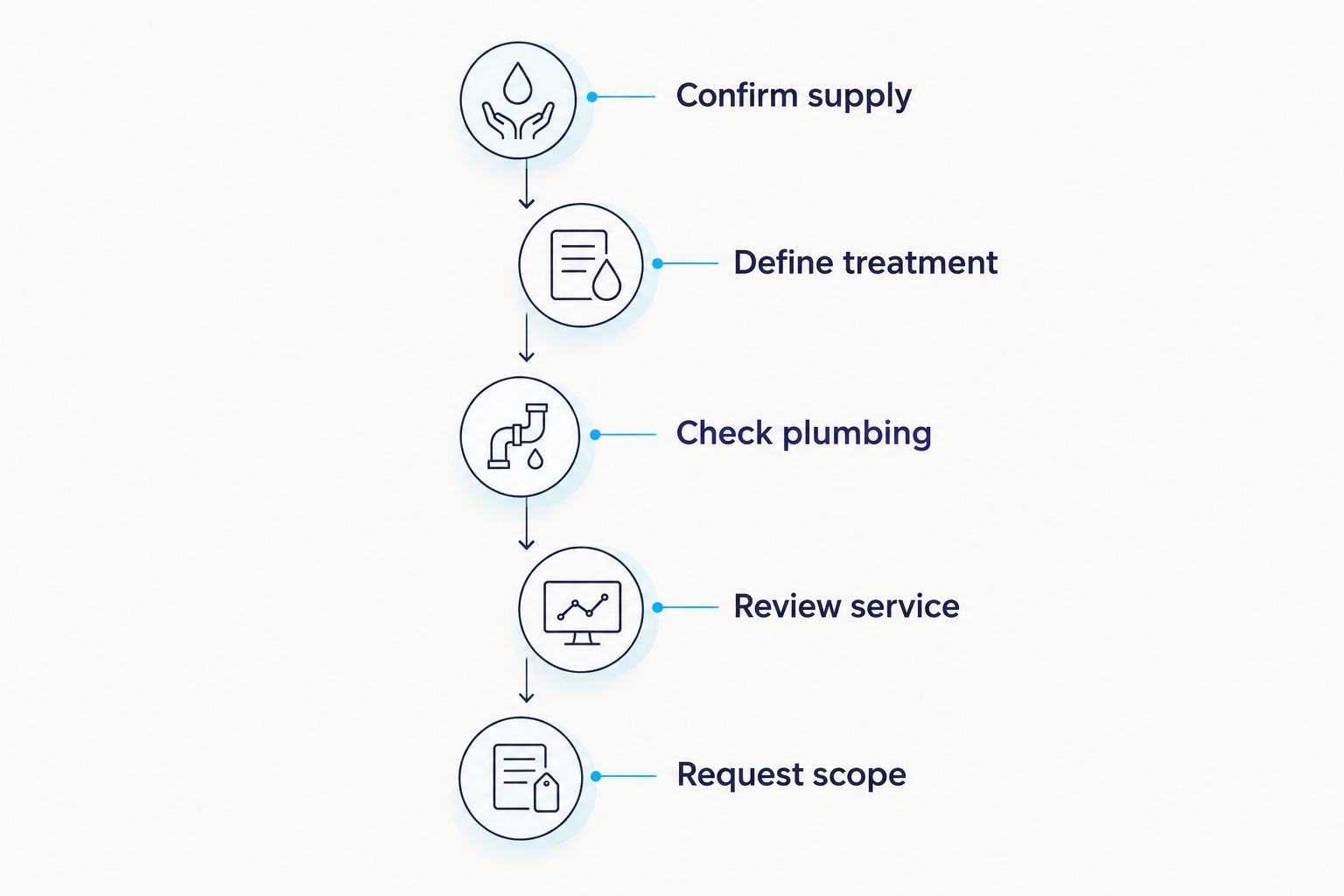
Use this sequence when requesting a personalized quote:
- Confirm supply: Identify your water supplier and current disinfectant information.
- Define treatment: Separate disinfectant reduction, hardness removal, and drinking-water preferences.
- Check plumbing: Locate the incoming line, existing treatment, and accessible connection points.
- Review service: Establish clearance, bypass access, and equipment-specific drain or power needs.
- Request scope: Obtain an itemized installation proposal and maintenance explanation.
For a useful installation discussion, send 3 photos: the main-line area, the proposed equipment location, and any existing treatment equipment. Explain your busiest water-use period; if 2 showers run while the washing machine fills, describe that overlap rather than reporting bathroom count alone.
Ask the installer to show which branches will receive treatment. Outdoor taps, irrigation, and indoor fixtures should not be left to assumption when the connection layout determines coverage.
What changes the installation quote?
Equipment is only part of the installed scope. Pipe access, connection work, placement, and the number of treatment stages all affect what the job includes.
Ask for these items in writing:
- Equipment identification: The exact filter, media, softener, and drinking-water components being proposed.
- Performance basis: The treatment goal, relevant water information, and household flow assumptions.
- Connection work: Pipe changes, fittings, bypass valves, and isolation arrangements.
- Placement work: Mounting or support requirements and access for future service.
- Utility connections: Any necessary drain and power provisions for the selected equipment.
- Existing equipment: Disconnection, removal, disposal, or reuse, where applicable.
- Completion work: Startup, flushing, operating instructions, and any specified checks.
- Ongoing care: Filter replacement, media servicing, softener salt, and RO maintenance responsibilities.
Request a personalized 2026 installation quote instead of comparing tank descriptions alone. Two proposals are not equivalent when one includes plumbing changes and removal work while the other leaves those tasks unspecified.
PSL Water Guy selects systems for each home's water and needs. Bring the installation details and treatment priorities to that discussion so the quote addresses your house rather than a generic package.
Request your installation quote
Discuss city-water filtration, softening, and alkaline RO for your Port St. Lucie or Tradition home.
Which whole-house filter should you choose?
Choose the disinfectant-matched whole-house filter as your starting point. Select catalytic carbon for a documented chloramine goal or activated carbon for a documented chlorine goal, with evidence supporting the exact system's performance.
Add a softener only when hardness removal is part of the job. Add alkaline RO only when you want separate drinking-water treatment. For your 2026 installation, every component should have a stated purpose and a defined maintenance requirement.
FAQ
What’s the best whole-house filter for South Florida city water?
The best fit is a system matched to your supplier’s disinfectant and your household flow. Compare catalytic-carbon equipment for confirmed chloramine treatment and activated-carbon equipment for confirmed chlorine treatment, then assess hardness separately.
Do Port St. Lucie and Tradition homes all need the same filter?
No. Your supplier information, treatment goals, household demand, and plumbing layout determine the appropriate configuration. Confirm those details for your address before choosing equipment.
Can a whole-house carbon filter soften my water?
No. Carbon filtration does not remove hardness minerals. If actual hardness removal is required, specify a properly selected softener as a separate treatment stage.
Is a water softener enough to remove chloramine?
A conventional ion-exchange softener is not a substitute for chloramine filtration. Ask for a separate, documented chloramine-reduction stage when that is your treatment goal.
Can alkaline reverse osmosis work with a whole-house filter?
Yes. Whole-house filtration treats the connected household supply, while an under-sink alkaline RO installation serves its designated drinking-water outlet. Each system needs its own installation and maintenance plan.
How much does whole-house filter installation cost?
Request a personalized installation quote for your home’s equipment and plumbing requirements. Ask whether the proposal includes connection work, bypass valves, existing-equipment removal, startup, and operating instructions.
What should I prepare before asking PSL Water Guy for a quote?
Prepare your address, water supplier information, treatment concerns, and photos of the proposed installation area. Describe simultaneous water use and identify any existing filter, softener, or drinking-water equipment.
One last thing
Ask the installer to show you how to bypass the equipment before the job is finished. Bypass access belongs in the installation plan, not behind equipment you cannot reach when service is needed.
Also keep the exact equipment identification with your installation paperwork. Future filter and media decisions should follow the installed system—not a remembered tank color or a general product description.


