

Best overall: whole-house carbon filtration matched to your city water. Best for confirmed hardness: filtration plus a water softener. Best for drinking-water treatment too: whole-house filtration plus alkaline reverse osmosis. For new homeowners in Port St. Lucie and Tradition, PSL Water Guy offers residential water treatment selected for each home's water and needs.
- For a whole house water filter, new homeowners in Port St Lucie should prioritize treatment matched to their city water.
- Whole-house carbon filtration is the default shortlist choice; confirm the disinfectant and household flow before selecting equipment.
- Add a water softener for confirmed hardness, not as a substitute for chlorine or chloramine filtration.
- PSL Water Guy offers whole-house water treatment and alkaline reverse osmosis; request a personalized installation quote.
Why this matters before you install
A whole-house filter, a water softener, and an under-sink reverse osmosis system do different jobs. Buying one does not automatically give you the benefits of the others.
For your 2026 installation, start with the water supplier serving your exact address, the issue you want treated, and the plumbing available at the house. A Port St. Lucie or Tradition address alone does not establish which equipment fits.
Choose treatment by the problem it addresses, not by the number of tanks or filter stages. New construction also needs this check: new pipes do not change the characteristics of the incoming city water.
What makes the best whole-house water filter?
Use these criteria before comparing equipment:
- Disinfectant match: Confirm whether the supplied water uses chlorine or chloramine, then check the filter's documented reduction claim.
- Household flow: Match treatment performance to simultaneous water use, not just bedroom count.
- Hardness treatment: Separate hardness removal from filtration. Carbon filtration is not water softening.
- Installation fit: Check the main connection, bypass access, service clearance, and any required drain or electrical connection.
- Maintenance access: Understand cartridge changes, media replacement, salt refills, and service requirements before choosing.
- Written scope: Require the quote to identify the equipment, treatment purpose, installation work, and exclusions.
The 2026 shortlist at a glance
These are treatment configurations, not named product packages. Each serves a different household need, and the final equipment selection depends on the home's water and installation conditions.
| Rank and option | Best for | Standout function | Key limitation |
|---|---|---|---|
| 1. Whole-house carbon filtration | City-water taste and odor concerns | Treats incoming water for the specified disinfectant | Does not soften hard water |
| 2. Filtration plus softener | Confirmed hardness plus filtration needs | Separates disinfectant treatment from hardness removal | Adds salt handling and regeneration requirements |
| 3. Sediment prefilter plus carbon | Confirmed particles alongside disinfectant concerns | Adds particle capture before carbon treatment | Adds cartridge maintenance and potential pressure loss |
| 4. Whole-house filtration plus alkaline RO | Homeowners also wanting dedicated drinking-water treatment | Separates whole-home treatment from kitchen treatment | Requires additional under-sink equipment and maintenance |
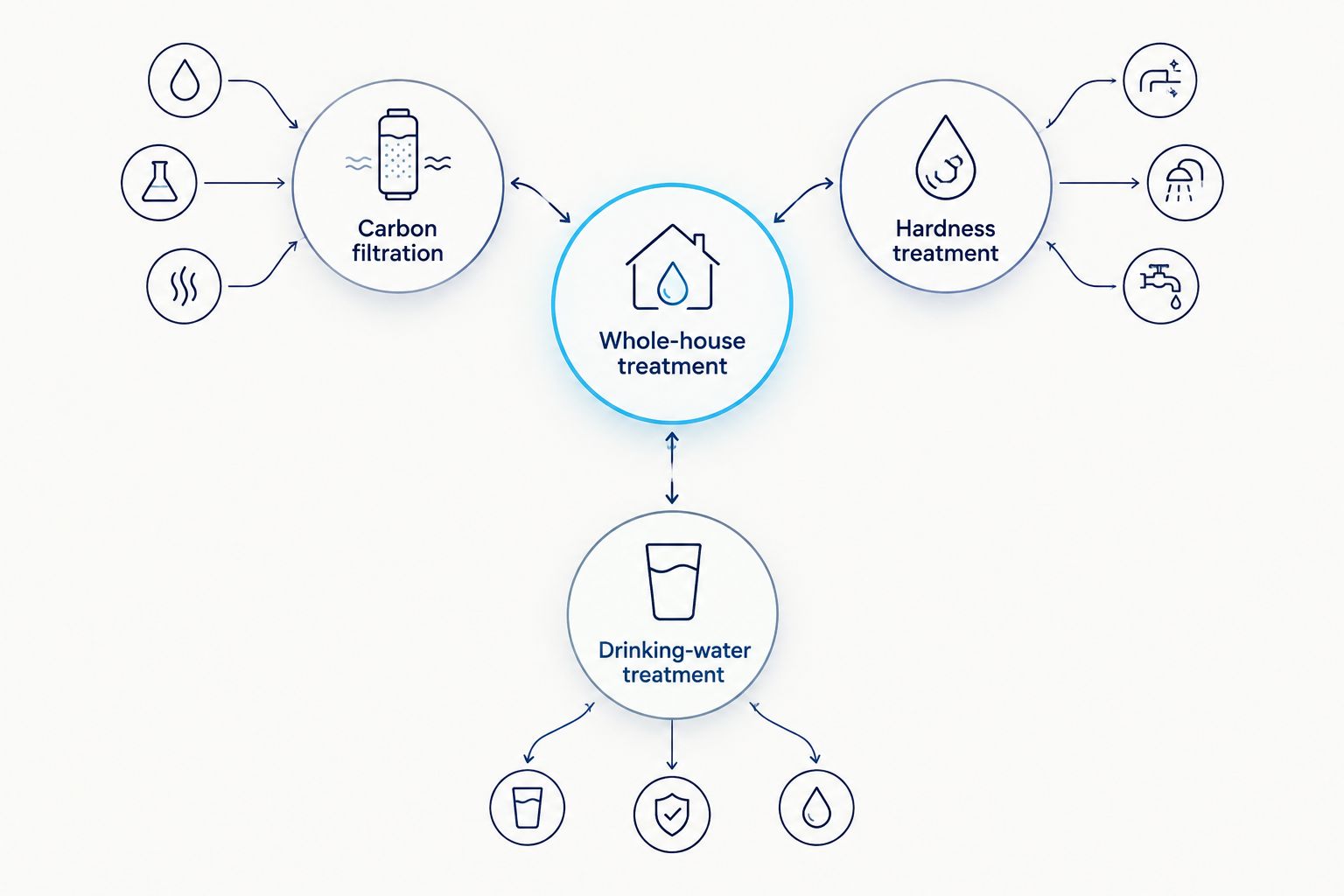
The practical distinction is where each system works. Whole-house treatment serves the connected household plumbing; an under-sink drinking-water system serves its dedicated outlet and any specifically connected fixtures.
1. Whole-house carbon filtration: best for taste and odor concerns
Whole-house carbon filtration treats water as it enters the connected household plumbing. Select media and equipment with documented performance for the disinfectant you want reduced; a general carbon description is not enough to establish chloramine performance.
This is the default starting point when your priority is city-water taste or odor rather than hardness removal. It is not a claim that every home needs the same filter.
Whole-house carbon filtration pros:
- Treats water beyond a single kitchen outlet.
- Addresses the specified disinfectant when correctly selected and operated.
- Leaves hardness treatment as a separate, deliberate decision.
Whole-house carbon filtration cons:
- Does not remove hardness minerals through ion exchange.
- Requires media or cartridge replacement according to the equipment's service requirements.
- Performance depends on flow and the particular treatment claim.
Best for: Homeowners whose main concern is disinfectant-related taste or odor throughout the home.
Before approving a 2026 installation, ask for the exact model, media type, and performance documentation. Verdict: Buy when the documented treatment matches your supplied water and household flow.
2. Filtration plus softener: best for confirmed hardness
A filtration-and-softener combination assigns different jobs to separate treatment components. The filter addresses its specified targets; a salt-based ion-exchange softener removes hardness minerals responsible for scale.
Consider this configuration when hardness is established and you also want whole-house filtration. Do not add a softener merely because a quote calls the package complete.
Filtration plus softener pros:
- Addresses hardness and filtration needs separately.
- Provides softened water to the plumbing included in the installation.
- Makes the purpose of each treatment component clear.
Filtration plus softener cons:
- Requires salt replenishment for salt-based softening.
- Adds regeneration, drainage, and maintenance considerations.
- Needs space and access for the combined equipment.
Best for: Homeowners with confirmed hard water who also want disinfectant-focused filtration.
Ask which fixtures receive softened water and which remain untreated. A salt-free conditioner is not interchangeable with an ion-exchange softener: ask what it does, rather than accepting the word conditioner as proof of hardness removal. Verdict: Buy for confirmed hardness; hold if hardness has not been checked.
3. Sediment prefilter plus carbon: best for confirmed particles
A sediment prefilter captures particles within its stated filtration rating before water reaches the next treatment component. Carbon then handles the separate disinfectant-reduction job for which it is selected.
This configuration belongs on your shortlist when particle capture has a clear purpose. A sediment cartridge does not replace carbon treatment for dissolved disinfectants, and visible discoloration alone does not identify the cause.
Sediment prefilter plus carbon pros:
- Adds a defined particle-filtration step.
- Separates sediment capture from disinfectant treatment.
- Lets cartridge selection follow the particle problem being addressed.
Sediment prefilter plus carbon cons:
- Adds cartridge replacement work.
- Can restrict flow as the cartridge loads with material.
- Does not soften water or identify the source of discoloration.
Best for: Homes with an established particle issue alongside a separate filtration need.
Ask why the prefilter is included and how you will know it needs service. Adding another housing without a defined purpose adds equipment, not a demonstrated benefit. Verdict: Hold until the particle concern and maintenance plan are clear.
4. Filtration plus alkaline RO: best for dedicated drinking water
Whole-house filtration and under-sink reverse osmosis work at different points in the home. RO uses a membrane-based process for drinking-water treatment; an alkaline stage adds mineral media after that process, depending on the selected equipment.
This configuration suits homeowners who want whole-home treatment and a separate drinking-water installation. The alkaline stage is not a reason to claim health benefits, and it does not replace the RO membrane's treatment function.
Filtration plus alkaline RO pros:
- Separates household-water and drinking-water priorities.
- Provides a dedicated treated-water outlet at the kitchen.
- Allows the alkaline stage to be considered separately from whole-house filtration.
Filtration plus alkaline RO cons:
- Requires cabinet space and installation connections.
- Adds filters, a membrane, and an alkaline stage to the maintenance plan.
- Does not supply every household faucet unless additional connections are specifically included.
Best for: Homeowners wanting dedicated drinking-water treatment alongside whole-house filtration.
For a 2026 quote, specify whether you want only the drinking-water faucet or additional connections. Verdict: Buy when dedicated RO drinking water is part of your goal; skip the add-on if you only want whole-house filtration.
How to choose without buying unnecessary equipment
Use a short sequence before requesting the final equipment recommendation. PSL Water Guy is a local family-owned business offering whole-house water treatment, softening, and alkaline reverse osmosis installations selected for the home's water and needs.
Confirm the incoming water
Check the supplier for your address and review the latest available water-quality information. Confirm the disinfectant rather than assuming a neighboring property's setup applies to yours.
If you review a report during 2026, check the sampling period it covers. The publication date and the period represented are not necessarily the same.
Describe simultaneous use
Tell the installer how your household actually uses water. For example, 2 showers running together create a different sizing question from a home where showers run separately; this is a planning example, not an equipment specification.
Ask for treatment performance at the proposed service flow, not just the largest flow figure printed on a brochure. Also ask how the system affects pressure under normal household use.
Separate whole-home and kitchen goals
List scale, taste, odor, particles, and drinking-water preferences separately. Each concern needs its own explanation and proposed treatment.
If the kitchen plan includes 1 dedicated drinking-water faucet, identify its location before the quote is finalized. Confirm cabinet clearance, faucet installation, and any proposed refrigerator connection rather than treating them as assumed extras.
What changes the installation quote?
Installation scope matters as much as the equipment list. Compare quotes with the same treatment goals and the same plumbing work included.
Request 3 written quote sections so you can compare like with like:
- Equipment: Model identification, treatment purpose, sizing basis, and the components included.
- Installation: Main-line connection, bypass, mounting or placement, and any required drainage, electrical work, or kitchen connections.
- Maintenance: Replacement items, salt requirements where applicable, service tasks, and what the homeowner must arrange.
Existing plumbing access, equipment location, pipe routing, service clearance, and the number of treatment components all affect the work. An outdoor installation also needs an equipment-specific placement discussion; do not assume every unit belongs outside.
Use the whole-house water filter installation quote checklist to compare inclusions before accepting a proposal. Request a personalized quote, not a generic package estimate detached from your house.
Request your installation quote
Discuss your city water, plumbing layout, and whole-house or drinking-water treatment goals.
How the options rank
The ranking prioritizes a match between treatment and need: disinfectant-focused filtration first, hardness treatment when established, particle filtration when justified, and dedicated drinking-water treatment when requested. Installation fit and maintenance obligations remain part of every decision.
This is a buying framework, not a laboratory performance ranking of named models. A lower-ranked configuration becomes the right choice when its distinct use case matches your home.
Which whole-house filter should you choose?
Start with whole-house carbon filtration matched to your city water, then add only the treatment your home needs. Confirm hardness before adding a softener, and keep alkaline RO tied to your drinking-water goals.
For Port St. Lucie and Tradition homeowners planning a 2026 installation, PSL Water Guy offers a local route to a home-specific recommendation. Request a quote that explains each component, where it connects, and what maintaining it involves.
FAQ
What’s the best whole-house water filter for a new Port St. Lucie homeowner?
Whole-house carbon filtration matched to your supplied water is the default starting point for disinfectant-related taste and odor concerns. Confirm the disinfectant, household flow, and documented equipment performance before choosing a model.
Do I need a water softener as well as a whole-house filter?
You need separate hardness treatment if hardness removal is your goal. A carbon filter does not replace a water softener, so establish hardness before adding softening equipment.
Will any carbon filter remove chloramine?
No; a general carbon-filter description does not establish chloramine-reduction performance. Ask for documentation covering the exact equipment, treatment claim, and operating conditions.
Does a new home in Tradition need different water treatment?
New construction does not by itself determine the required treatment. Choose equipment using the supplied water, household needs, and plumbing layout at the specific property.
Can alkaline reverse osmosis work with a whole-house filter?
Yes; whole-house filtration and under-sink alkaline reverse osmosis perform different jobs at different locations. Confirm the drinking-water faucet, cabinet space, connections, and maintenance requirements in the installation quote.
How do I get an installation quote from PSL Water Guy?
Request a personalized quote and describe your city-water concerns, household use, and installation location. Ask the proposal to separate equipment, installation work, and maintenance responsibilities.
Does alkaline drinking water provide a proven health benefit?
Do not choose an alkaline stage on the promise of health benefits. Evaluate the drinking-water system by its documented treatment performance, maintenance requirements, and your preferences.
One last thing
A bypass deserves attention before the installation is complete. It lets water be routed around treatment equipment during service, but water flowing through that route does not receive that equipment's treatment.
Ask the installer to identify the bypass, show its normal position, and explain the service procedure. Knowing how the system operates is part of owning it—not an optional detail after the sale.


