

Best overall: a metered salt-based water softener. Best for hardness plus separate filtration needs: a whole-house filter and softener combination. Best for households needing softened water during regeneration: an alternating twin-tank softener. This 2026 guide helps Port St. Lucie and Tradition homeowners choose an installation layout, not just a tank.
- For a water softener Port St. Lucie installation, start with measured hardness and household water demand.
- Metered salt-based softeners are the default choice when hardness removal is the main goal.
- Choose whole-house filtration separately from softening; neither replaces reverse osmosis drinking-water treatment.
- Ask PSL Water Guy for a personalized city-water installation quote matched to your home.
Why this matters
A water softener removes dissolved calcium and magnesium that cause hardness. A whole-house filter addresses different treatment goals, while an under-sink reverse osmosis system treats drinking water at a dedicated outlet. Buying one does not automatically accomplish the jobs of the others.
For a home-specific water softener installation in Port St. Lucie or Tradition, request a quote from PSL Water Guy. The local family-owned business chooses treatment around each home's water and needs. Start your 2026 project with the problem you want solved, then compare equipment that addresses it.
What makes the best water softener for city water?
Use these criteria before comparing installation proposals:
- Hardness removal: Choose salt-based ion exchange when you want calcium and magnesium removed, rather than simply a scale-control approach.
- Demand-based regeneration: A metered control tracks water use and triggers regeneration according to its settings and remaining capacity.
- Peak household flow: Size for overlapping fixtures, not just the number of bedrooms or the home's floor area.
- Separate filtration needs: Identify any taste, odor, or disinfectant-reduction goal before adding a whole-house filter.
- Installation fit: Check the water entry connection, drain route, electrical requirements, bypass access, and space for service.
- Maintenance fit: Understand salt replenishment, settings, filter changes, and future service before approving the installation.
Ask for the measured hardness and proposed capacity in writing. A tank description alone does not explain whether the softener matches your home.
Best water softener layouts at a glance
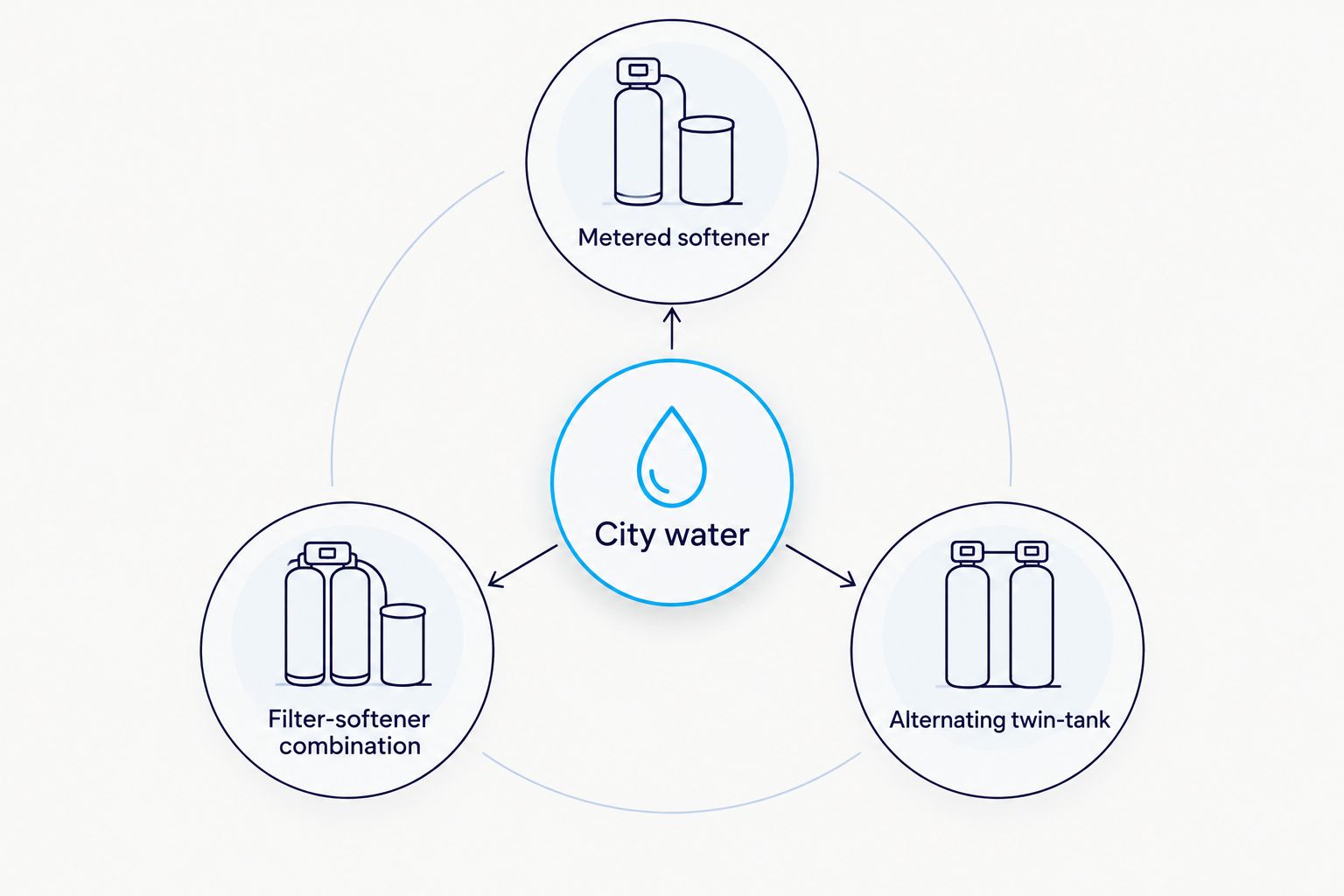
These are treatment configurations, not named product models. Each fills a different household need.
| Rank and layout | Best for | Standout feature | Key limitation |
|---|---|---|---|
| 1. Metered softener | Hardness removal | Regenerates according to measured water use and control settings | Requires salt and a suitable regeneration drain |
| 2. Filter-softener combination | Hardness plus filtration | Separates hardness removal from the selected filtration task | Adds equipment and separate maintenance requirements |
| 3. Alternating twin-tank | Softened water during regeneration | One resin tank treats water while the other regenerates or waits | More equipment than a standard single-resin-tank layout |
Do not compare these layouts by tank count alone. A filter beside a softener performs a different job from a second softener resin tank; a separate salt tank is not another treatment stage.
1. Metered softener: best for household hardness removal
A metered salt-based softener is the starting choice when your city-water concern is hardness. Water passes through resin that exchanges hardness minerals for sodium or potassium ions, depending on the regenerant used. Regeneration restores the resin's ability to soften water.
The meter tracks water use rather than relying only on a fixed calendar schedule. Correct programming still matters: the installer needs hardness, usable capacity, and an appropriate reserve setting. A metered valve cannot correct an undersized installation.
Best for: Port St. Lucie and Tradition homeowners who want actual hardness removal without adding unrelated treatment equipment.
Metered softener pros:
- Removes calcium and magnesium rather than leaving hardness minerals in the water.
- Uses measured water consumption to guide regeneration.
- Provides whole-house softening when connected to the intended household supply.
- Keeps the equipment scope focused when separate filtration is unnecessary.
Metered softener cons:
- Requires salt replenishment and a suitable discharge route for regeneration.
- Does not replace a filter selected for chlorine or chloramine reduction.
- A standard single-resin-tank system does not provide softened water through that tank while it regenerates.
Ask which fixtures the installation will serve. Outdoor taps, irrigation connections, and plumbing branches need explicit treatment decisions rather than assumptions.
Verdict: Buy a metered salt-based softener when measured hardness is the main problem and the installation site supports it.
2. Filter-softener combination: best for separate water concerns
A filter-softener combination treats hardness and a separately identified filtration need. The softener removes hardness minerals; the selected filter addresses its specified treatment task. These functions remain separate even when both units appear on one proposal.
For a 2026 city-water installation, confirm your supplier and disinfectant before choosing filtration media. Do not assume a filter described only as carbon has documented performance for every disinfectant or household flow condition.
Best for: Homeowners who need hardness removal and have a defined whole-house filtration goal, such as reducing a specified disinfectant or related taste and odor.
Filter-softener combination pros:
- Addresses two distinct treatment goals within a planned installation.
- Allows the filter selection to match the actual filtration requirement.
- Lets you review filtration and softening capacities separately.
- Keeps whole-house treatment separate from optional drinking-water equipment.
Filter-softener combination cons:
- Needs room for additional equipment and service access.
- Introduces filter maintenance beyond salt replenishment.
- Requires attention to pressure loss and the supported flow of the complete assembly.
Ask the installer to explain equipment order and each component's purpose. A combination should solve documented needs, not add a tank because a package includes one.
Verdict: Buy a filter-softener combination when both hardness removal and a separate filtration need are established. Skip the extra filter when its purpose is unclear.
3. Alternating twin-tank: best for softening during regeneration
An alternating twin-tank softener uses two resin tanks. One tank supplies softened water while the other regenerates or remains ready for service, according to the system's control design.
This layout addresses continuity, not a different kind of hardness. It deserves consideration when household schedules leave no convenient regeneration window. It is not automatically the right choice for a larger house.
Best for: Homes with water-use patterns that make softened water during regeneration a specific requirement.
Alternating twin-tank pros:
- Maintains a treatment path while a resin tank regenerates.
- Fits households with water use spread across the day and night.
- Separates the continuity decision from the hardness-removal decision.
Alternating twin-tank cons:
- Requires space for two resin tanks plus the salt-storage arrangement.
- Adds equipment that a household with a suitable regeneration window does not necessarily need.
- Still requires correct capacity, flow sizing, salt, and drainage.
Ask what happens during tank switching and regeneration in the exact model proposed. Confirm the documented service flow rather than assuming that two tanks provide twice the usable flow.
Verdict: Buy an alternating twin-tank softener when continuity justifies the layout. Skip it when a correctly sized single-resin-tank system meets your schedule.
How these layouts are ranked
The 2026 ranking starts with the simplest layout that performs the required job: metered softening for hardness. Separate filtration comes next only when you need another treatment function; alternating twin tanks address continuity during regeneration.
These are suitability rankings, not claims of hands-on product testing. Compare the control approaches in the guide to water softeners ranked by regeneration type before evaluating individual proposals.
What about salt-free conditioners and alkaline reverse osmosis?
A salt-free conditioner is not an interchangeable substitute for an ion-exchange softener. Salt-free scale-control approaches do not remove calcium and magnesium in the same way. If hardness removal is your goal, require the proposal to state whether the equipment actually softens water.
Alkaline reverse osmosis serves another purpose: drinking-water treatment at a dedicated outlet, with an added stage intended to change the treated water's mineral content or pH. It does not replace whole-house softening. Ask what the proposed alkaline stage contains and what maintenance it requires; the word alkaline does not establish a health benefit.
| Treatment | Best for | Main advantage | Main limitation |
|---|---|---|---|
| Salt-based softener | Removing hardness | Removes calcium and magnesium through ion exchange | Requires regeneration and salt |
| Salt-free conditioner | A defined scale-control goal | Does not use salt-based regeneration | Does not provide equivalent hardness removal |
| Alkaline reverse osmosis | Dedicated drinking-water treatment | Treats water at the selected drinking outlet | Does not soften the whole-house supply |
For an installation discussion with PSL Water Guy, separate whole-house city-water treatment from alkaline reverse osmosis drinking water. You can request both, but each needs its own equipment description and installation scope.
What should your installation quote include?
For your 2026 comparison, request a personalized, itemized scope rather than an unexplained package total. Installation work depends on the home's existing plumbing, access, equipment layout, and selected treatment.
Water conditions and sizing
Ask for hardness, the proposed softener capacity, and the household demand used for sizing. Have the installer explain the supported service flow and expected regeneration approach. Bedroom count alone is not a sizing explanation.
Plumbing and placement
Confirm the connection location, pipe modifications, bypass arrangement, isolation valves, and drain routing. Ask which fixtures remain untreated. If outdoor placement is proposed, request an explanation of how the installation will meet equipment requirements and applicable local rules.
Equipment and startup
Require the proposed equipment identification and treatment purpose. The quote should say whether delivery, connection, programming, startup checks, and homeowner instructions are included. Do not assume those tasks are covered by an equipment-only description.
Maintenance responsibilities
Ask who replenishes salt, which consumables require replacement, and what service tasks the homeowner should expect. For combined installations, separate the softener's maintenance from the filter's maintenance. For alkaline reverse osmosis, request a separate drinking-water maintenance outline.
Before requesting a quote, complete this short preparation list:
- Write down 2 treatment goals: Separate the main concern from an optional improvement, such as hardness removal versus drinking-water treatment.
- Photograph 1 proposed installation area: Include the surrounding plumbing and access space, not just an empty wall.
- Compare 3 scope categories: Equipment, installation work, and ongoing maintenance should each be clear.
PSL Water Guy can be your starting point for a home-specific softener installation discussion. Describe your city-water supply, your location in Port St. Lucie or Tradition, and the result you want before asking for a personalized quote.
Request your installation quote
Discuss your city-water needs, equipment layout, and installation scope for your home.
Which water softener should you choose?
Choose a metered salt-based softener by default when measured hardness is the issue. Add whole-house filtration only for a defined filtration goal. Choose alternating twin tanks when softened water during regeneration matters to your household.
For a 2026 installation in Tradition or elsewhere in Port St. Lucie, choose by water conditions, peak demand, and installation fit. A larger tank or longer feature list does not replace a clear sizing explanation.
FAQ
What’s the best water softener for Port St. Lucie city water?
A correctly sized metered salt-based softener is the default choice when hardness removal is your main goal. Add filtration only for a separately identified treatment need.
Do I need a water softener if my home uses city water?
City-water service alone does not establish whether you need a softener. Base the decision on measured hardness and the household problems you want to address.
Is a salt-free conditioner better than a salt-based softener?
A salt-free conditioner is not better for removing hardness because it does not remove calcium and magnesium like an ion-exchange softener. Compare the equipment against your actual goal rather than treating the terms as equivalent.
Will a water softener remove chloramine?
A standard water softener is not a substitute for filtration selected for chloramine reduction. Confirm the supplier’s disinfectant and the proposed filter’s documented performance.
How much does water softener installation cost in Port St. Lucie?
Request a personalized installation quote for your home. Equipment selection, plumbing changes, placement, drainage, and the included startup work determine the scope.
Can I install alkaline reverse osmosis with a whole-house softener?
Yes, whole-house softening and alkaline reverse osmosis can serve different treatment points in the same home. Ask the installer to assess compatibility, drinking-water connections, drainage, and maintenance separately.
Does a bigger home need an alternating twin-tank softener?
Home size alone does not establish a need for alternating twin tanks. Choose that layout when softened water during regeneration is a specific household requirement, then size it for hardness and demand.
One last thing
A softener with a resin tank and a separate salt tank is not necessarily an alternating twin-tank system. Ask the installer to identify every tank and explain what happens during regeneration. That simple question distinguishes equipment count from treatment capability before you approve the job.


