

Best overall: a separate whole-house filter and salt-based softener. Best for drinking water: that combination plus alkaline reverse osmosis. Best for limited space: an integrated filter-softener. For a water softener filter combo new construction project in Port St. Lucie or Tradition, choose the layout around your city-water supply, household demand, and installation access—not the package name.
- For a water softener filter combo new construction project, choose filtration and softening for separate jobs.
- PSL Water Guy is best for homeowners seeking locally selected city-water treatment and a personalized installation quote.
- Add alkaline reverse osmosis when you also want a separate drinking-water installation.
- Confirm the water supplier, treatment claims, plumbing layout, and maintenance requirements before choosing equipment.
Why this matters
New construction gives you a chance to plan equipment placement before cabinets, landscaping, and finished surfaces restrict access. It does not tell you which treatment your water needs. A new house still requires a supply-specific equipment choice.
PSL Water Guy is a local family-owned business that selects residential water treatment for each home's water and needs. For Port St. Lucie and Tradition homeowners on city water, the practical starting point is whole-house filtration, actual hardness, and whether you want a separate drinking-water faucet.
For a 2026 installation, separate those decisions before comparing packages. A softener, whole-house filter, and reverse osmosis system do different work; buying them together does not make their functions interchangeable.
What makes the best water softener filter combo?
Use these criteria to judge the configuration before choosing equipment:
- Supply match: Identify your water supplier and its disinfectant before selecting filter media.
- Hardness removal: Choose a salt-based softener when the job is removing dissolved calcium and magnesium.
- Household flow: Size equipment around simultaneous water use, not bedroom count alone.
- Installation fit: Confirm the main line, bypass access, regeneration drain route, and service space.
- Maintenance clarity: Get separate instructions for salt replenishment, filter service, and drinking-water cartridges.
- Written scope: Require the quote to identify equipment, plumbing work, startup, and exclusions.
A salt-free conditioner is not interchangeable with a salt-based softener. If you want hardness minerals removed, the quote must specify equipment that performs that job rather than relying on a general scale-control claim.
Best combinations at a glance
These 2026 rankings compare installation configurations, not named equipment models. Each option has a different best-use case.
| Rank and configuration | Best for | Standout feature | Key limitation |
|---|---|---|---|
| 1. Separate whole-house filter and salt-based softener | General city-water treatment | Independently selected filtration and softening | Requires space and separate service planning |
| 2. Filter, softener, and alkaline reverse osmosis | Whole-house treatment plus drinking water | Adds a dedicated kitchen treatment point | Adds under-sink equipment and maintenance |
| 3. Integrated filter-softener | Restricted equipment space | Combines treatment in a shared equipment layout | Service requirements depend on the internal design |
| 4. Chloramine-rated filter and salt-based softener | A confirmed chloramine supply | Matches filtration to the disinfectant | Requires documented performance at the intended flow |
There is no automatic budget winner. Installation conditions and the written scope determine whether one configuration is the better fit for your home.
1. Separate filter and softener: best for general city-water treatment
A separate whole-house filter and salt-based softener divide the work between dedicated equipment. The filter addresses its stated treatment targets; the softener removes hardness minerals through ion exchange.
This is the default configuration to evaluate when you want both filtration and genuine softening. Choose the filter media after confirming the supply, rather than assuming every carbon filter treats every disinfectant equally.
Separate filter and softener pros:
- Filtration and softening can be sized independently.
- Separate equipment allows different service schedules.
- The quote can explain each treatment stage clearly.
Separate filter and softener cons:
- Separate tanks and a brine tank need installation space.
- Softener regeneration needs an appropriate drain connection.
- You must track both filter maintenance and softener care.
Best for: Homeowners seeking whole-house city-water treatment without adding kitchen drinking-water equipment immediately.
Ask the installer to show the proposed equipment order and bypass arrangement. Do not assume a builder's water-treatment loop includes the drain, electrical supply, or access the selected equipment requires.
Verdict: Buy this configuration when filtration and hardness removal are both justified.
2. Filter, softener, and alkaline RO: best for drinking-water treatment
This configuration combines whole-house filtration and softening with alkaline reverse osmosis at a dedicated drinking-water point. The kitchen system treats water for that outlet; it does not replace treatment serving the rest of the house.
An alkaline stage adds minerals after reverse osmosis, depending on its media and design. Choose it for the drinking-water characteristics you want, not an unsupported health promise.
Filter, softener, and alkaline RO pros:
- Separates whole-house needs from drinking-water preferences.
- Adds a dedicated treated-water faucet.
- Lets you plan kitchen equipment before cabinetry limits access.
Filter, softener, and alkaline RO cons:
- Requires room for the selected under-sink components.
- Adds cartridges and a membrane to the maintenance plan.
- A refrigerator connection adds routing decisions to the installation.
Best for: Homeowners who want whole-house treatment and an alkaline reverse osmosis drinking-water installation from the outset.
For your 2026 build, identify the faucet location before approving countertop work. Ask whether the selected system uses a storage tank and how its components will remain accessible after you fill the cabinet.
Verdict: Buy this configuration when dedicated drinking-water treatment is part of your move-in plan.
3. Integrated filter-softener: best for restricted equipment space
An integrated filter-softener combines filtration and softening within a shared equipment arrangement. Designs differ, so the label alone does not explain the media, treatment capacity, or replacement process.
Choose this layout only after comparing its actual dimensions and service clearances with a separate-equipment proposal. A smaller footprint is useful only if routine maintenance remains practical.
Integrated filter-softener pros:
- Can reduce the space devoted to separate treatment vessels.
- Consolidates equipment in one installation area.
- Offers a combined layout for homes with constrained utility space.
Integrated filter-softener cons:
- Internal media can have different maintenance requirements.
- Servicing one function can affect access to the other.
- A shared housing does not prove adequate filtration or softening capacity.
Best for: Homeowners whose equipment location cannot comfortably accommodate separate treatment vessels.
Ask how the filtration media is serviced and whether that work affects the softening section. Also confirm that the proposal includes any required brine tank; the phrase integrated system does not mean every component fits inside one enclosure.
Verdict: Hold until the installer documents dimensions, treatment performance, and service access.
4. Chloramine-rated filter and softener: best for confirmed chloramine
A chloramine-rated whole-house filter paired with a salt-based softener addresses two distinct jobs: disinfectant reduction and hardness removal. This configuration belongs on your shortlist when the supplier confirms chloramine use.
Do not treat a chlorine-reduction statement as proof of chloramine performance. Ask for documentation covering the proposed filter, its rated flow, and its replacement conditions.
Chloramine-rated filter and softener pros:
- Matches the filtration decision to a confirmed supply characteristic.
- Keeps hardness removal separate from disinfectant reduction.
- Makes filter performance documentation part of the buying decision.
Chloramine-rated filter and softener cons:
- Requires more verification than a general carbon-filter description.
- Filter performance depends on operating conditions and service life.
- The softener does not substitute for the chloramine-treatment stage.
Best for: City-water homeowners whose supplier uses chloramine and who also need hardness removal.
The distinction matters when comparing proposals: chlorine and chloramine require different filter choices. Have the installer identify which claim applies to your selected equipment rather than accepting an unspecified carbon-filter description.
Verdict: Buy this configuration when chloramine is confirmed and the proposed filter's performance is documented.
Plan the plumbing before approving the equipment
For a 2026 new-construction installation, mark the incoming water line, equipment area, kitchen treatment point, and service routes on the same plan. Those locations determine what plumbing work belongs in the quote.
Keep these functions separate when reviewing the layout:
- Whole-house filtration: Treats water passing through the selected main-line filter.
- Water softening: Removes hardness minerals from water routed through the softener.
- Drinking water: Uses a separate reverse osmosis installation at the intended outlet.
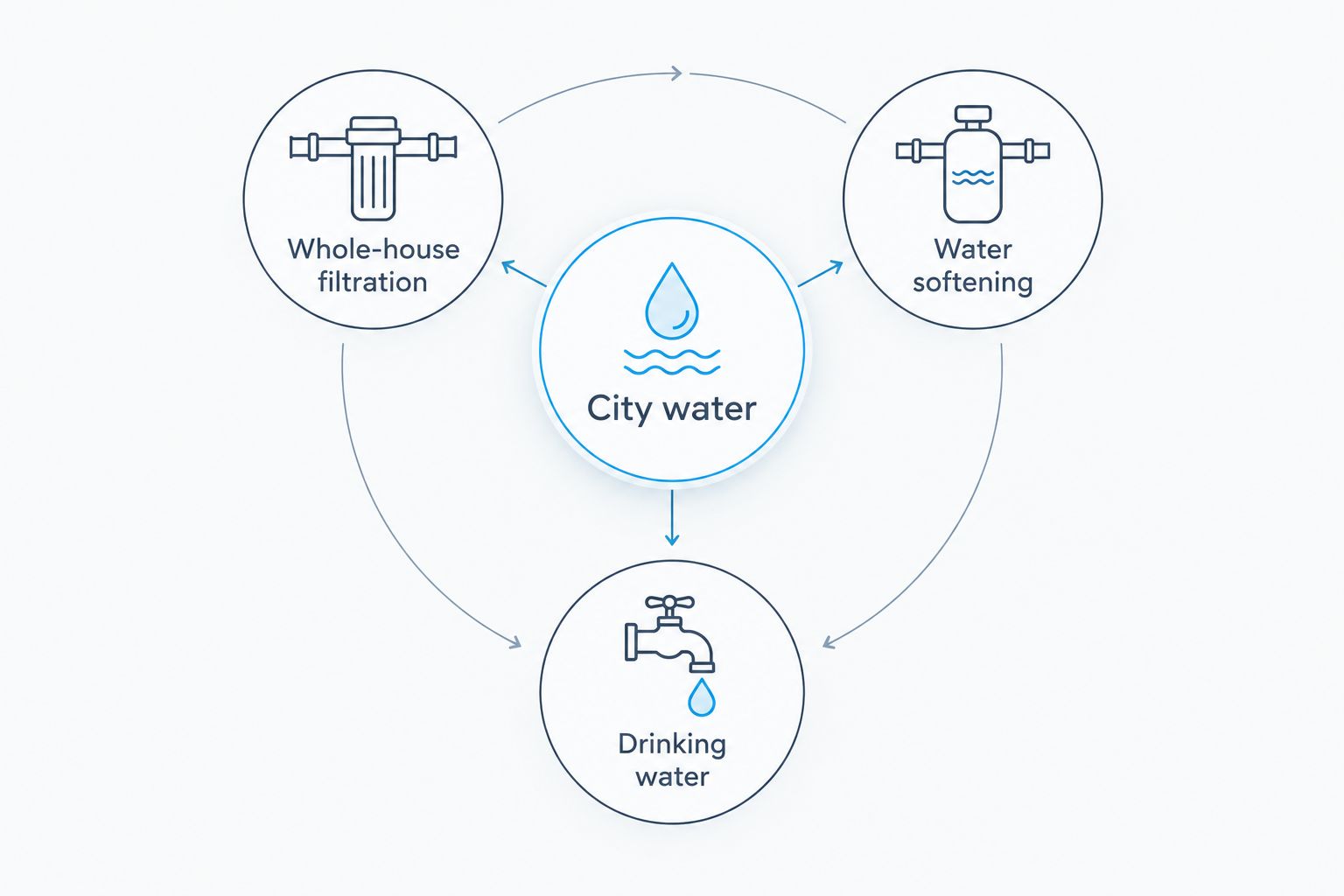
Have the installer identify which outlets the proposed main-line connection serves. Discuss outdoor taps explicitly rather than assuming they will receive the same treatment as indoor fixtures.
Also separate a plumbing problem from a treatment choice. If pressure is already poor, diagnosing low water pressure helps distinguish a supply or plumbing restriction from a treatment-equipment issue; adding another filter is not a diagnosis.
Ask what operating pressure and flow the selected equipment requires. Then confirm how the planned installation will meet those requirements when fixtures run together.
What should the installation quote include?
A useful quote explains the installed result, not just the equipment names. Compare at least 2 written quotes against the same scope so you can distinguish a layout difference from an omitted task.
For your 2026 project, request these inclusions or explicit exclusions:
- Equipment identification: Filter media, softener type, and any alkaline reverse osmosis components.
- Sizing basis: Water hardness, household demand, and the filter's intended treatment targets.
- Plumbing connections: Main-line tie-in, bypass valves, isolation points, and any outdoor-tap separation.
- Site preparation: Mounting, equipment support, weather exposure, and access requirements.
- Drain and power: Required connections and who supplies them.
- Kitchen work: Faucet opening, drain connection, cabinet routing, and any refrigerator line.
- Startup: Programming, flushing, operational checks, and homeowner instructions.
- Responsibilities: Who handles permits or inspections where required, and what work is excluded.
These details affect installation cost because they change labor, materials, and coordination. Request a personalized quote rather than comparing equipment-only descriptions with complete installation proposals.
PSL Water Guy selects water softener and filter combinations around each home's water and needs. For an installation quote, provide your city-water supplier, construction stage, equipment-area photos or plans, and intended drinking-water outlet locations.
Request your installation quote
Discuss city-water treatment, equipment placement, and alkaline reverse osmosis for your new home.
How the combinations rank
The ranking prioritizes supply match, hardness removal, household flow, installation fit, maintenance clarity, and written scope. Separate equipment is the default because it makes the filtration and softening decisions independently reviewable.
The other configurations solve specific needs: a dedicated drinking-water installation, restricted space, or confirmed chloramine treatment. None wins simply by having more stages or a larger equipment package.
Which combination should you choose?
Start with a separate whole-house filter and salt-based softener if your water assessment supports both functions. Add alkaline reverse osmosis when you also want a dedicated drinking-water installation.
Choose an integrated configuration for a verified space constraint, not just a shorter equipment list. If your supplier uses chloramine, make documented chloramine reduction a filter-selection requirement.
Before signing, list 3 treatment goals: what you want filtered, whether you need hardness removed, and what you want at the drinking-water faucet. Each proposed component should have a clear job against that list.
FAQ
What’s the best water softener filter combo for new construction?
A separate whole-house filter and salt-based softener is the default configuration to evaluate when you need both filtration and hardness removal. Match the filter to your city-water supply and size both components for household demand.
Should I install water treatment before moving into a new home?
Plan water treatment before moving in so equipment placement and plumbing requirements are settled early. Coordinate installation timing with the builder and installer rather than assuming the equipment can be connected at any construction stage.
Does a whole-house filter replace a water softener?
A whole-house filter does not replace a softener unless it specifically performs hardness removal. Filtration and ion-exchange softening address different treatment goals.
Is an integrated filter-softener better than separate tanks?
An integrated filter-softener is better suited to some restricted spaces, but separate equipment makes independent sizing and servicing easier to evaluate. Compare actual dimensions, performance documentation, and maintenance procedures before deciding.
Do I need alkaline reverse osmosis with a whole-house system?
You need a separate drinking-water installation only if it serves your drinking-water goals. Whole-house filtration and softening do not perform the same job as reverse osmosis, and an alkaline stage should not be sold as an unsupported health benefit.
How much does a new-construction softener and filter installation cost?
Request a personalized installation quote based on your equipment and plumbing layout. Main-line access, drain routing, electrical requirements, kitchen connections, and site preparation determine the scope.
Who should I contact about city-water treatment in Tradition?
PSL Water Guy serves homeowners considering city-water treatment in Tradition and Port St. Lucie. Request a system selection and installation quote based on your home’s water, household needs, and construction layout.
One last thing
A builder-provided treatment loop is a connection opportunity, not a complete installation plan. Before closing walls or approving landscaping, ask the installer to confirm the drain route and show how every serviceable component will remain accessible.
That check prevents you from choosing equipment around an unfinished assumption. Finalize the layout before finalizing the package.


