

Best overall for reverse osmosis Port St. Lucie FL: an under-sink RO system matched to your kitchen and drinking-water needs. Best for mineral-adjusted taste: alkaline RO. Best for avoiding a separate storage tank: tankless RO. This 2026 guide compares installation configurations, not unverified product models.
- For reverse osmosis Port St. Lucie FL, choose under-sink RO after checking plumbing, cabinet space, and drinking-water demand.
- PSL Water Guy offers reverse osmosis drinking-water installations for homeowners seeking a system selected for their home.
- Alkaline RO adds a mineral-adjustment stage; it does not establish a health benefit.
- Whole-house filtration, water softening, and drinking-water RO address different treatment goals.
Why this matters
A drinking-water system belongs in a kitchen plan, not just a product comparison. Cabinet access, the faucet location, and any refrigerator connection affect what an installer needs to supply and connect.
For Port St. Lucie and Tradition homeowners on city water, the first decision is scope: drinking water at one location or treatment across the home. PSL Water Guy is a local, family-owned business offering reverse osmosis drinking-water installations selected for each home's water and needs. Start with the installation requirements, then choose equipment; this guide to reverse osmosis installation cost in Port St. Lucie explains the quote factors.
What makes the best RO drinking-water system?
Use these criteria to compare your 2026 installation options before choosing a configuration:
- Water match: Identify the treatment goal and check the proposed system's documented reduction claims. Do not assume every RO system addresses every substance.
- Kitchen fit: Check equipment dimensions, tubing routes, faucet placement, and access for filter changes.
- Drinking-water demand: Describe how you fill glasses, cooking pots, and reusable bottles. Include any refrigerator connection you want quoted.
- Taste preference: Decide whether you want standard RO water or an alkaline stage that adjusts mineral content after the membrane.
- Maintenance access: Ask how filters, the membrane, and any mineral cartridge are replaced and how service timing is determined.
- Installation scope: Compare the same connections, fittings, startup work, and handover instructions across quotes.
The best choice satisfies your actual use without adding equipment for an unrelated problem. A high stage count alone does not tell you which substances a system reduces, how it fits, or what maintenance it needs.
Best RO configurations at a glance
These options describe different installation priorities. Alkaline treatment and whole-house equipment can accompany other configurations, so the rows are decision paths rather than mutually exclusive technologies.
| Rank and configuration | Best for | Standout feature | Key limitation |
|---|---|---|---|
| 1. Standard under-sink RO with storage tank | A dedicated kitchen drinking-water supply | Stores treated water for dispensing at a separate faucet | Tank and filters require cabinet space |
| 2. Alkaline under-sink RO | Homeowners who prefer mineral-adjusted drinking water | Adds a mineral-adjustment stage after RO treatment | Adds another cartridge to maintain |
| 3. Tankless under-sink RO | Avoiding a separate storage tank | Produces treated water without a separate storage tank | Requires checking power, dimensions, and dispensing performance |
| 4. RO coordinated with whole-house treatment | Drinking-water and household treatment goals together | Assigns different treatment jobs to different equipment | Requires a broader installation and maintenance plan |
1. Standard under-sink RO: best for a dedicated kitchen supply
A standard under-sink reverse osmosis system treats water near the kitchen sink and stores it in a tank for dispensing. It is the default configuration to discuss when you want drinking and cooking water at 1 dedicated faucet rather than treatment at every tap.
The installation needs more than an empty corner under the sink. The installer must account for the feed-water connection, drain connection, faucet, tank, filter assembly, and future service access.
Standard under-sink RO pros:
- Keeps the treatment scope focused on drinking and cooking water.
- Stores treated water for use at the dedicated faucet.
- Separates drinking-water treatment from whole-house equipment decisions.
Standard under-sink RO cons:
- The storage tank takes up usable cabinet space.
- Stored water is finite; the system needs time to replenish it.
- Filters and membrane components require ongoing maintenance.
Best for: A homeowner who wants a straightforward kitchen drinking-water installation and has room for the complete assembly.
For your 2026 quote, ask the installer to show where each component will sit. Check that the tank does not block the shutoff valve or make routine plumbing access difficult. Describe repeated bottle filling and cooking use before the system is selected, rather than discovering a mismatch after installation.
Verdict: Buy this configuration when a dedicated kitchen supply is the goal and the cabinet layout supports it.
2. Alkaline under-sink RO: best for mineral-adjusted taste
Alkaline reverse osmosis adds a mineral-adjustment stage after RO treatment. That stage changes the finished water's mineral content and can change its taste; the result depends on the cartridge and operating conditions.
PSL Water Guy offers alkaline reverse osmosis drinking-water installations. Ask for the proposed equipment and cartridge details rather than choosing from the word “alkaline” alone.
Alkaline under-sink RO pros:
- Adds a defined post-treatment step for homeowners who prefer mineral-adjusted water.
- Keeps drinking-water treatment at the kitchen rather than across every household outlet.
- Makes taste preference part of equipment selection.
Alkaline under-sink RO cons:
- Adds a cartridge that needs replacement.
- The alkaline label does not establish contaminant-reduction performance.
- Mineral adjustment does not establish a health benefit.
Best for: A homeowner who specifically wants mineral-adjusted RO drinking water and accepts the additional maintenance task.
In a 2026 proposal, ask what the alkaline cartridge contains, what it is intended to change, and how replacement is determined. Do not accept a promised finished-water pH without documentation and relevant operating conditions. Taste preference and verified treatment performance are separate decisions.
Verdict: Buy alkaline RO for a stated mineral or taste preference; skip it if the only reason is an unsupported health claim.
3. Tankless under-sink RO: best for avoiding a storage tank
Tankless RO produces treated water without a separate storage tank. It is an option to evaluate when a tank conflicts with the cabinet layout, but removing the tank does not remove the need for equipment space.
Check the complete unit's dimensions, service clearances, and installation requirements. Electrically powered models also need an appropriate power connection; a tankless label alone does not tell you whether your kitchen is ready.
Tankless under-sink RO pros:
- Eliminates the separate storage tank from the layout.
- Provides an alternative when tank placement is the main obstacle.
- Lets you assess dispensing performance against your actual filling habits.
Tankless under-sink RO cons:
- The treatment assembly still occupies cabinet space.
- Power requirements depend on the model.
- Dispensing performance needs checking against the manufacturer's specifications and your incoming conditions.
Best for: A homeowner whose installation constraint is the separate tank, not simply a desire for newer-looking equipment.
Ask whether a proposed tankless system supports the refrigerator connection you want. Do not assume compatibility, pressure, or flow from the configuration name. This comparison does not establish that every configuration is offered by the same installer; request confirmation of the actual equipment being quoted.
Verdict: Hold until dimensions, power, dispensing performance, and connection requirements are confirmed.
4. RO with whole-house treatment: best for separate household goals
A coordinated installation uses drinking-water RO alongside equipment selected for whole-house needs. Whole-house filtration, water softening, and RO perform different jobs; one does not automatically replace the others.
A softener addresses hardness minerals. A whole-house filter targets substances covered by its media and documented performance, while kitchen RO treats the water routed through its own assembly.
Coordinated treatment pros:
- Separates kitchen drinking-water goals from whole-house concerns.
- Allows each treatment stage to be selected for a defined purpose.
- Gives the installer a reason to plan equipment placement and maintenance together.
Coordinated treatment cons:
- Adds equipment and separate maintenance responsibilities.
- Requires more installation planning than a kitchen-only project.
- Creates unnecessary scope when the homeowner only needs drinking-water treatment.
Best for: A city-water homeowner with both a kitchen drinking-water goal and a separate, identified whole-house treatment need.
PSL Water Guy offers whole house water treatment, water softening, and reverse osmosis drinking water. Request separate explanations for each proposed component. With 2 treatment locations—the main water entry and the kitchen—you need a clear reason for equipment at each location, not a bundle justified only by its size.
Verdict: Buy the combined approach only when each treatment stage has a defined job.
Match the treatment to the job
Use three plain labels when discussing your home: Whole-house filtration, Water softening, and Drinking-water RO. Whole-house filtration treats water passing through the main installed filter, water softening addresses hardness, and drinking-water RO serves its connected drinking-water outlet.
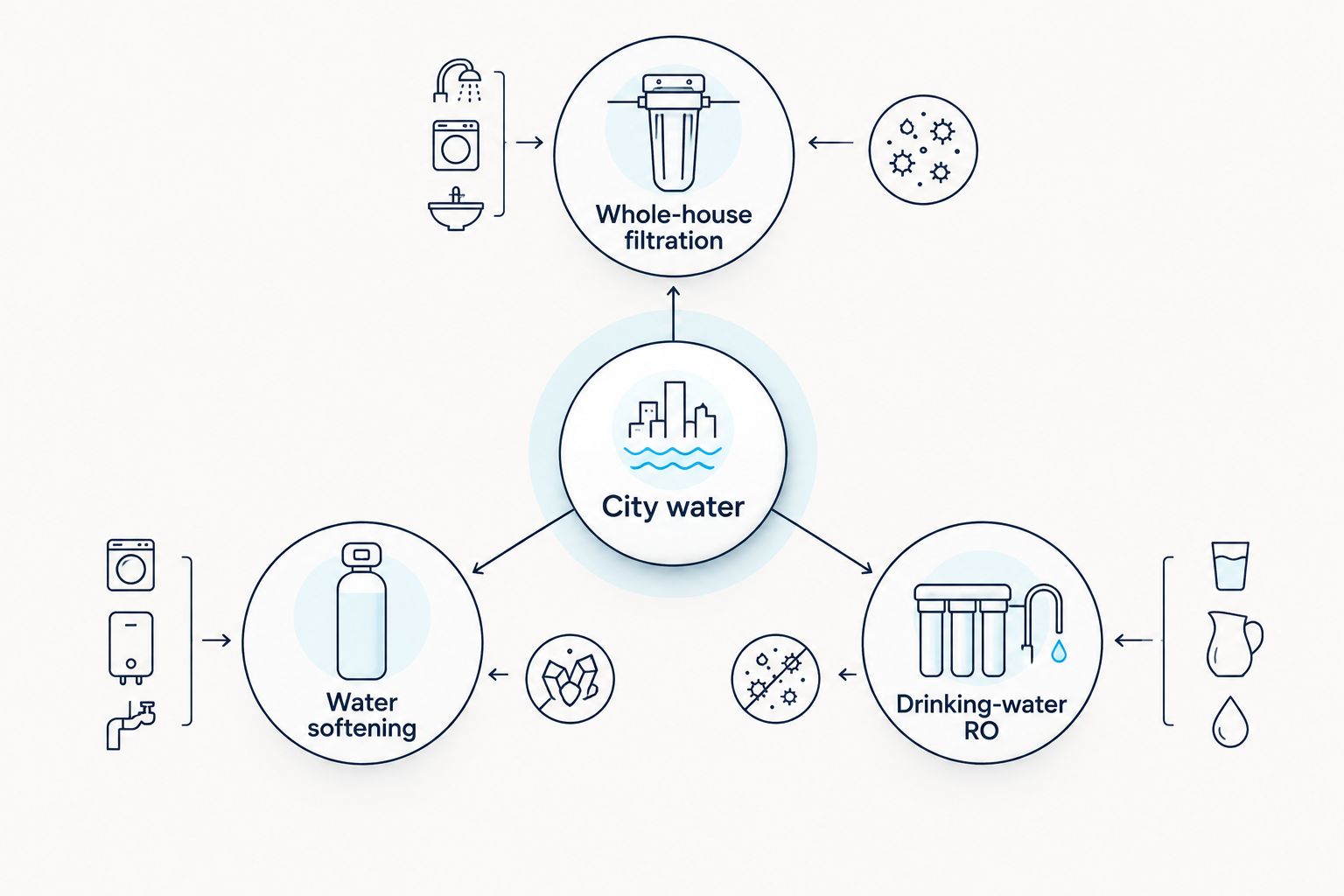
For a Tradition home, start by stating what you want changed at the kitchen faucet and what, if anything, concerns you elsewhere. Do not infer the home's hardness, disinfectant, or contaminant levels from the neighborhood name. Use the relevant supplier information and any appropriate water assessment to support equipment selection.
What your 2026 installation quote should include
Ask for a written scope that identifies the proposed equipment and the work included. A personalized quote is useful only when you can tell what will be installed, where it will go, and what remains outside the agreement.
Check these items before approving the installation:
- Equipment: The RO assembly, membrane, filters, storage tank where applicable, and alkaline cartridge if selected.
- Faucet work: The faucet supplied, mounting location, and whether a new opening is required.
- Connections: Feed-water connection, drain connection, tubing route, and any requested refrigerator line.
- Site work: Cabinet access, existing plumbing changes, and electrical requirements where applicable.
- Startup: The manufacturer's preparation, flushing, operating checks, and homeowner instructions included in the work.
- Maintenance: Replacement components, access requirements, service responsibilities, and the basis for replacement timing.
Installation cost depends on the equipment and the work your home requires. A kitchen with an existing suitable faucet opening presents a different scope from one needing a new opening and a refrigerator connection. Request a personalized quote rather than applying another homeowner's total to your project.
For a useful first conversation, prepare 3 photos: the open sink cabinet, the sink deck, and the intended refrigerator connection area if that connection is requested. Photos support planning; they do not replace confirmation of measurements and plumbing conditions.
Request your installation quote
Discuss your city-water treatment goals, kitchen layout, and preferred drinking-water setup.
How these configurations are ranked
This 2026 ranking prioritizes treatment fit, kitchen fit, maintenance access, and a clear installation scope. Standard under-sink RO is the default because it directly addresses a dedicated drinking-water goal; the other configurations answer more specific preferences or constraints.
These are configuration recommendations, not laboratory-tested product rankings. No model-level removal claim follows from a category name. For any proposed system, request documentation for the exact model and the substances you want addressed.
Which RO configuration should you choose?
Choose standard under-sink RO unless a specific preference or installation constraint points elsewhere. Choose alkaline RO for mineral-adjusted taste, evaluate tankless RO when the separate tank is the obstacle, and add whole-house equipment only for a separate treatment goal.
For Port St. Lucie and Tradition city-water homeowners, PSL Water Guy is a local option for an RO installation quote matched to the home's water and needs. Bring your kitchen layout and intended uses to that conversation. The next decision is the written equipment and installation scope—not the longest list of filter stages.
FAQ
What’s the best reverse osmosis system for a Port St. Lucie home?
An under-sink RO system matched to your water, kitchen layout, and drinking-water demand is the default choice. Compare the exact equipment, documented treatment claims, and installation scope before approving a quote.
Is alkaline RO better than standard reverse osmosis?
Alkaline RO is the better fit when you specifically prefer mineral-adjusted drinking water. Its additional stage does not establish better contaminant reduction or a health benefit.
Do I need whole-house filtration with a drinking-water RO system?
You need whole-house filtration only when you have a separate household treatment goal that the proposed filter addresses. Kitchen RO and whole-house filtration serve different treatment locations.
Can reverse osmosis replace my water softener?
Kitchen reverse osmosis does not replace whole-house water softening. A softener addresses hardness in the water routed through it, while kitchen RO treats its connected drinking-water supply.
How much does RO installation cost in Port St. Lucie in 2026?
Request a personalized installation quote based on the equipment and work your home needs. Faucet work, plumbing access, cabinet layout, and refrigerator connections affect the scope.
Can an RO system supply my refrigerator?
A refrigerator connection requires checking the proposed system and the refrigerator’s connection requirements. Ask the installer to confirm suitability and include the tubing route and connection work in the quote.
Is a tankless RO system always better for a small cabinet?
No. A tankless system removes the separate storage tank, but the treatment assembly still needs space and service access. Check actual dimensions and any power requirements.
How often should I replace alkaline RO filters?
Follow the exact system manufacturer’s instructions and the service plan established for your installation. Different components have different replacement requirements, so ask for a component-by-component schedule.
One last thing
Ask the installer to show how each filter will be removed before approving its location. A system can fit inside a cabinet yet leave too little access for routine maintenance. Confirm service access while the layout is still a choice.


