

Best overall: conventional under-sink reverse osmosis. Best for adjustable drinking-water taste: alkaline reverse osmosis. Best for avoiding a storage tank: tankless reverse osmosis. For Port St. Lucie and Tradition families planning a 2026 installation, the right choice depends on water use, cabinet space, and plumbing—not the longest feature list.
- For reverse osmosis systems for families Port St Lucie homeowners should compare layout, usable output, maintenance, and installation scope.
- Conventional under-sink reverse osmosis is the default choice when a storage tank fits and meets household demand.
- Alkaline reverse osmosis adds a mineral stage; choose it for drinking-water preference, not promised health benefits.
- PSL Water Guy provides local, home-specific water treatment; request a personalized installation quote.
Why this matters
Reverse osmosis treats drinking water at a selected outlet; a kitchen installation does not treat every shower, bathroom faucet, or laundry connection. Choose the treatment location before choosing the equipment. That distinction prevents you from buying kitchen equipment to solve a whole-house problem.
PSL Water Guy is a local family-owned business offering residential water treatment selected for each home's water and needs. For a city-water home in Port St. Lucie or Tradition, separate drinking-water preferences from any need for whole-house filtration or water softening.
This 2026 guide ranks installation configurations rather than named models. You can use it to choose the right layout, then compare the specific equipment and installation details in your personalized quote.
What makes the best family reverse osmosis system?
- Usable output: Match drinking, cooking, and connected-appliance demand to the proposed equipment's documented performance.
- Cabinet fit: Leave room for filters, tubing, a tank when required, and future service access.
- Water compatibility: Check the proposed system's incoming-water requirements against your home's water conditions.
- Installation scope: Identify the drinking-water faucet, drain connection, supply connection, and any electrical work before approval.
- Maintenance access: Confirm which replacement parts the system needs and how you reach them.
- Documented claims: Ask for evidence supporting any specific reduction claim for the exact model being quoted.
Before requesting a quote, keep a 24-hour usage diary covering drinking water, cooking water, and refrigerator use. This is a planning exercise, not a sizing formula: it helps you describe what your household actually expects from the installation.
Family reverse osmosis options at a glance
| Rank and configuration | Best for | Standout feature | Key limitation |
|---|---|---|---|
| 1. Conventional under-sink RO | Everyday kitchen drinking and cooking | Stores treated water for dispensing | Tank occupies cabinet space and needs time to refill |
| 2. Alkaline under-sink RO | Families choosing a mineral-adjusted taste | Adds a mineral stage after RO treatment | Adds another component to maintain |
| 3. Tankless under-sink RO | Kitchens where tank placement is the main obstacle | Produces treated water without a storage tank | Requires model-specific checks for power and delivery rate |
| 4. RO with a refrigerator connection | Families wanting treated water at the kitchen faucet and refrigerator | Extends a compatible system to another outlet | Adds routing, compatibility, and demand considerations |
These options are not mutually exclusive. An alkaline system can use a tank or a tankless layout, and a refrigerator connection is an installation extension rather than a separate treatment method.
1. Conventional under-sink RO: best for everyday family use
A conventional under-sink reverse osmosis system filters incoming water through a membrane and stores treated water in a tank. A separate drinking-water faucet dispenses that stored supply. For families who mainly want drinking and cooking water at the kitchen sink, this is the clearest starting point.
Conventional under-sink RO pros:
- Stored water supports dispensing without waiting for the membrane to produce every glass as it is poured.
- The treatment equipment sits near the kitchen water supply and drain.
- A dedicated faucet keeps treated drinking water separate from the main sink supply.
Conventional under-sink RO cons:
- The storage tank takes up cabinet space alongside the filters.
- Repeated large draws deplete stored water, after which the system needs recovery time.
- A crowded cabinet makes filter changes and leak checks harder.
Best for: Families using one kitchen drinking-water outlet for routine drinking and meal preparation.
For a 2026 installation, ask the installer to explain usable storage and recovery under the proposed operating conditions. A tank's stated size alone does not tell you how much water you will dispense before performance changes.
Verdict: Buy this configuration as the default when cabinet fit and documented output match your household.
2. Alkaline under-sink RO: best for mineral-adjusted taste
Alkaline reverse osmosis adds a mineral stage to the drinking-water treatment path. The purpose is to adjust the treated water's mineral characteristics and taste; it does not turn the system into whole-house treatment.
Alkaline under-sink RO pros:
- Provides an option for households that prefer water after a mineral stage.
- Combines RO treatment and mineral adjustment in one drinking-water installation.
- Keeps the treatment decision focused on the water you drink and cook with.
Alkaline under-sink RO cons:
- The added cartridge creates another replacement task.
- Final water characteristics depend on the equipment and operating conditions, not just the word alkaline.
- An alkaline label does not establish a health benefit or verify contaminant-reduction performance.
Best for: Families who specifically want a mineral-adjusted drinking-water taste rather than a basic RO configuration.
PSL Water Guy offers alkaline reverse osmosis drinking-water installations. Ask your quote to identify the proposed mineral stage, its replacement requirements, and whether the layout includes a storage tank.
Verdict: Buy alkaline RO for a defined taste preference; skip it if your only reason is an unsupported health promise.
3. Tankless under-sink RO: best when tank placement is the obstacle
A tankless reverse osmosis system produces treated water without a separate storage tank. That removes one bulky component, but the treatment unit still needs a suitable installation space and access for maintenance.
Tankless under-sink RO pros:
- Eliminates the need to position a separate storage tank.
- Makes tank-free cabinet planning possible where a tank blocks access or storage.
- Lets you evaluate delivery performance directly against the household's expected use.
Tankless under-sink RO cons:
- Electrically powered models need a suitable power connection.
- Dispensing performance depends on the model and incoming-water conditions.
- A compact enclosure does not guarantee easy cartridge access in your cabinet.
Best for: Families whose main installation constraint is finding room for a storage tank.
Do not rank a tankless system above a conventional system solely because it looks smaller. In a 2026 quote, confirm the equipment dimensions, service clearance, power requirements, and expected delivery performance before choosing this layout.
Verdict: Hold until the installer confirms fit, power, and output; choose tankless only when those checks support it.
4. RO with a refrigerator connection: best for shared kitchen outlets
A refrigerator connection routes treated water from a compatible RO installation to the refrigerator's water or ice supply. It is an extension of the kitchen system, not a different kind of membrane treatment.
Refrigerator-connected RO pros:
- Supplies treated water to a compatible refrigerator as well as the drinking-water faucet.
- Gives families a way to include refrigerator water and ice in the installation plan.
- Lets the installer assess both outlets together instead of treating the refrigerator as an afterthought.
Refrigerator-connected RO cons:
- Tubing routes through cabinets or other spaces add installation work.
- Refrigerator inlet requirements must match the proposed supply.
- Shared demand must be included when choosing the RO equipment.
Best for: Families who regularly use refrigerator water or ice and want that outlet included in the project.
Give the installer the refrigerator model and describe its location relative to the sink. Ask who is responsible for checking compatibility and whether any existing refrigerator filter arrangement needs attention under the appliance manufacturer's instructions.
Verdict: Buy the connection only after the quote confirms compatibility, routing, and shared demand.
Plan the installation before comparing equipment
Use these steps to make each quote describe the same job. PSL Water Guy reverse osmosis installations should be discussed around your home's water, kitchen layout, and family use—not a generic equipment package.
- Record water use. Include drinking, cooking, and any refrigerator connection.
- Check cabinet fit. Take 2 cabinet photos: one showing the entire space and one showing the plumbing connections.
- Choose outlets. Decide whether you want only a drinking-water faucet or a refrigerator connection too.
- Confirm connections. Have the installer assess the supply, drain, faucet opening, and any required power.
- Confirm service access. Check how filters will be removed without dismantling surrounding storage.
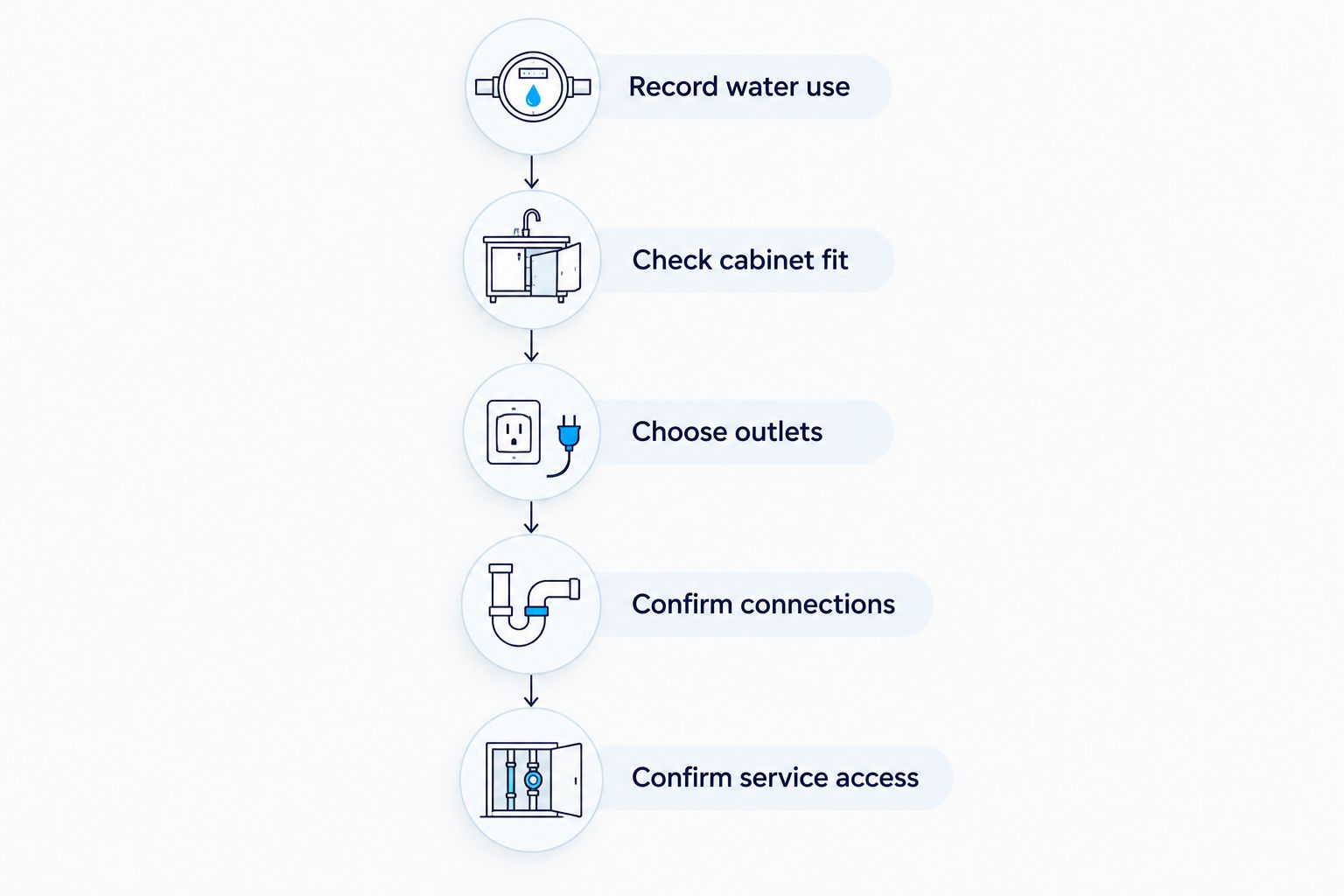
An installation that fits on paper still needs an on-site layout check. Keep the cabinet clear enough for the installer to inspect existing plumbing, identify connection points, and explain where each component will sit.
What should your personalized quote include?
For a 2026 installation, compare scope before comparing totals. The reverse osmosis installation cost factors in Port St. Lucie include more than the treatment unit itself.
Ask for a written description of:
- Equipment: Exact system identification, treatment stages, and tank arrangement.
- Faucet work: Proposed location, use of an existing opening, and any new opening required.
- Plumbing connections: Incoming supply, drain arrangement, tubing route, and isolation provisions.
- Additional outlets: Refrigerator connection work, if requested.
- Electrical scope: Any power requirement and who is responsible for providing it.
- Startup: Flushing, operational checks, leak checks, and homeowner instructions.
- Maintenance: Replacement components, service access, and model-specific care instructions.
- Exclusions: Cabinet alterations, countertop work, electrical work, or other tasks not included.
Do not assume that two quotes include the same work because both say under-sink RO. Ask each installer to address the same 3 water uses—drinking, cooking, and refrigerator use—then remove any outlet you do not need.
Request your installation quote
Discuss your city-water home, cabinet layout, and drinking-water needs in Port St. Lucie or Tradition.
How these configurations were ranked
The ranking prioritizes everyday kitchen use, cabinet fit, water compatibility, installation scope, and maintenance access. It does not claim laboratory testing, model-specific performance results, or a universal winner across all homes.
Conventional RO takes the default position because it directly addresses a single kitchen drinking-water outlet. Alkaline RO addresses taste preference, tankless RO addresses tank placement, and a refrigerator connection addresses an additional outlet. Choose by the problem you need solved.
Which reverse osmosis configuration should you choose?
For most undecided households, start your quote discussion with conventional under-sink RO. Change that starting point only for a clear reason: a mineral-adjusted taste preference, an unsuitable tank location, or a refrigerator connection that changes demand and routing.
PSL Water Guy is best suited to Port St. Lucie and Tradition homeowners seeking a home-specific reverse osmosis installation quote. Keep whole-house filtration and softening as separate decisions unless your home's water and needs justify including them in the same project.
FAQ
What’s the best reverse osmosis layout for a family in Port St. Lucie?
Conventional under-sink reverse osmosis is the starting choice when a storage tank fits and the proposed output meets household demand. Compare alkaline or tankless configurations when taste preference or cabinet layout creates a specific reason to change.
Is alkaline reverse osmosis better than regular RO?
Alkaline reverse osmosis is better suited to households that want a mineral-adjusted drinking-water taste. The added stage requires maintenance and does not establish a health benefit.
Should I choose tankless RO if my kitchen cabinet is small?
Choose tankless RO only after checking equipment dimensions, service access, delivery performance, and any power requirement. Removing the storage tank does not guarantee that the remaining equipment fits your cabinet.
Can a reverse osmosis system supply my refrigerator?
A compatible reverse osmosis installation can supply a refrigerator when routing and inlet requirements support the connection. Include refrigerator demand in the equipment assessment and connection work in the written quote.
Does kitchen reverse osmosis replace a whole-house filter or softener?
Kitchen reverse osmosis does not replace whole-house filtration or water softening. It treats water routed through the drinking-water system, while whole-house equipment addresses water supplied more broadly through the home.
How much does a family reverse osmosis installation cost?
Request a personalized installation quote based on equipment, faucet work, plumbing access, and any refrigerator connection. Ask for inclusions and exclusions so you can compare the same scope.
What maintenance does a family RO system need?
A family RO system needs the filter, membrane, sanitation, and inspection work specified for its exact model. An alkaline configuration also needs care for its mineral stage; get the instructions before approving the installation.
One last thing
Ask the installer to show you where the RO water supply shuts off and how each filter is accessed. For your 2026 installation, that practical handover matters more than adding another feature you do not need.


